Hungary set to rewrite constitution to oust Orbán-era president
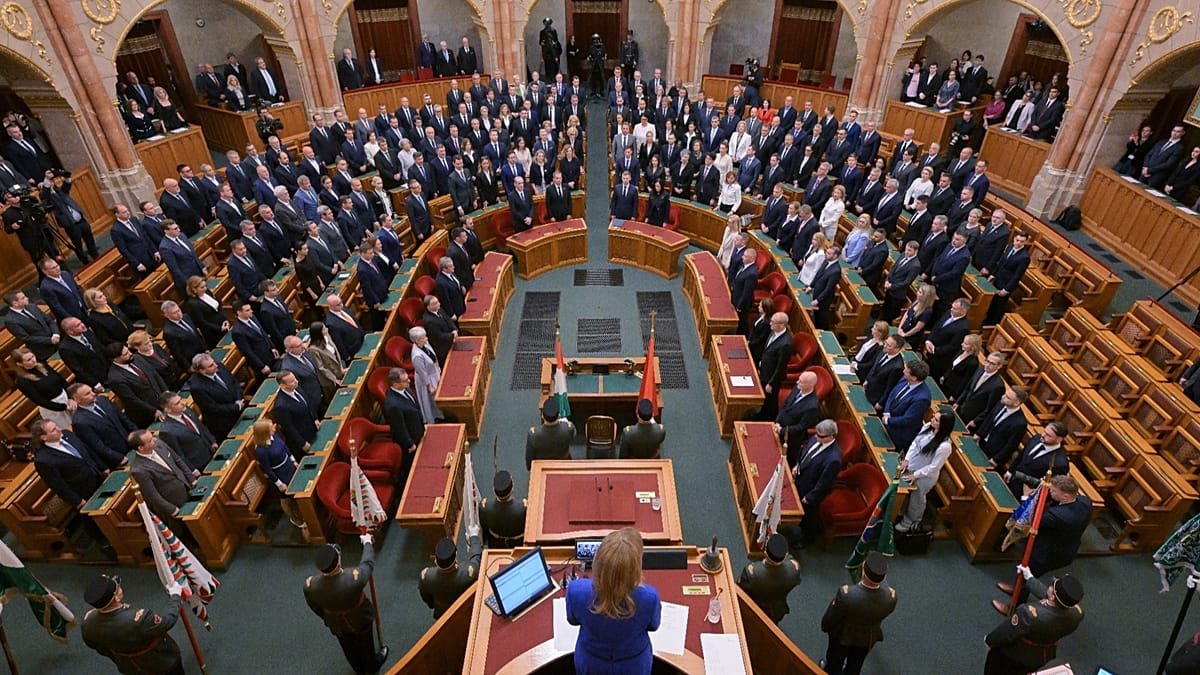
Hungary's new pro-European government is using its supermajority to rewrite the constitution and oust Viktor Orbán's allies from state institutions, a move that could restore EU confidence in Budapest's rule of law despite criticism over its methods.
Hungarian lawmakers are scheduled to vote on Monday evening to change the constitution and remove President Tamás Sulyok. Prime Minister Péter Magyar, who won a landslide election in April, has accused the 70-year-old of acting as a "puppet" for his nationalist predecessor, Viktor Orbán.
The vote represents the most aggressive step yet by Magyar's Tisza party to reverse the concentration of power that defined Orbán's 16-year premiership. Orbán's "illiberal" administration was widely viewed as corrupt, leading to severe friction with the European Union and the freezing of billions in funding. By targeting Orbán-era holdovers, Magyar is signalling a break from that system to align Hungary more closely with European norms.
The 12-point amendment goes well beyond the presidency. It would force out four constitutional court judges over the age of 70, including the court's head, Peter Polt, by reinstating a mandatory retirement age. It also restores the court's ability to review budgetary acts and establishes a National Asset Recovery and Protection Office with sweeping powers to combat corruption.
For European investors and institutions, the anti-corruption office and judicial reforms address long-standing grievances about Hungary's business climate. However, the method of achieving these reforms has sparked alarm.
Human Rights Watch warned that the constitutional tinkering is "reminiscent of (the) Fidesz era," while Amnesty International noted Sulyok is "entitled to due process." Fidesz, now in opposition, staged a protest last week denouncing the amendment as "autocratic."
Supporters argue that extraordinary measures are necessary to uproot a captured state. Andras Baka, a former head of Hungary's supreme court whose own mandate was cut short by a similar legislative act in 2011, defended the approach. "In a country governed by the rule of law such extraordinary measures cannot be used, but Hungary became a captured state under Orbán," Baka told the AFP news agency.
Sulyok has refused to resign, calling Magyar's demands "incomprehensible" and unconstitutional. While the presidency is largely ceremonial, Sulyok retains the power to veto laws or send them to the constitutional court, though he cannot block a constitutional amendment. If he refuses to sign the amendment, Magyar warned that Tisza will initiate impeachment proceedings.
The prime minister appears to have public backing, with a May poll by the 21 Research Centre showing 67% of voters want Sulyok removed. Yet, the amendment also introduces a 12-year or three-term limit on lawmakers that would prevent several prominent opposition politicians from running in 2030, a detail that may complicate Magyar's narrative of purely democratic restoration.