Argentina's Falklands chant exposes FIFA-UEFA disciplinary gap
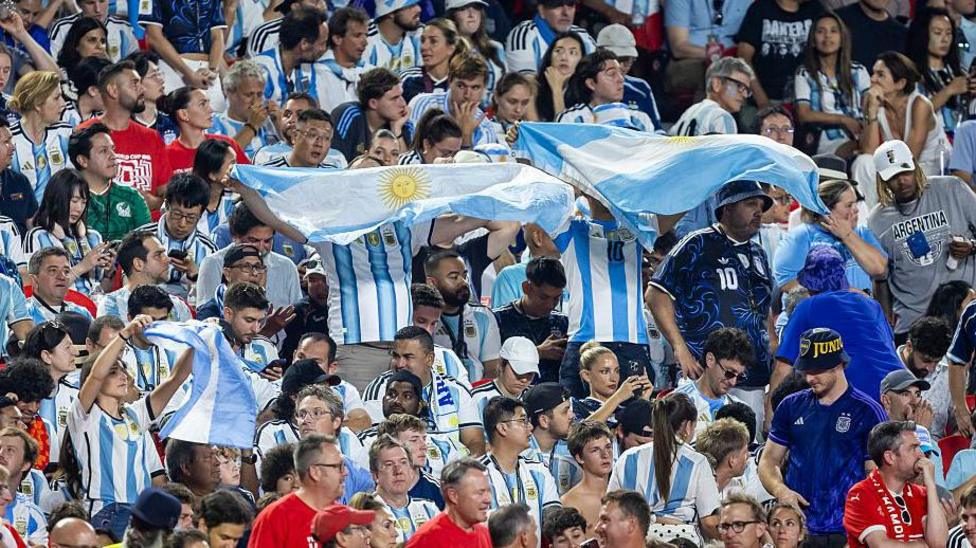
Argentina's World Cup semi-final against England has been overshadowed by territorial chants, exposing a stark contrast between how European and global football authorities police political messages.
Argentina's 3-1 quarter-final victory over Switzerland has set up a World Cup semi-final against England in Atlanta on Wednesday. The buildup has been dominated by a video of Argentine players singing "For the Malvinas, for Diego, for Leo's last one" after their win.
"Malvinas" is the Spanish name for the Falkland Islands, a British Overseas Territory since 1833 situated 300 miles off the Argentine coast. Argentina's claim to sovereignty led to a 74-day war in 1982 that killed 907 people, including 649 Argentine military personnel, 255 British forces and three Falkland Islanders.
The diplomatic row throws a spotlight on the differing disciplinary approaches of global and European football authorities. FIFA fined the Argentine FA £20,000 in 2014 after players held up a banner reading "The Malvinas are Argentine" before a friendly against Slovenia, but has shown little interest in policing the chants.
UEFA, by contrast, routinely issues charges for political symbols or chants. Following Spain's Euro 2024 victory over England, captain Álvaro Morata and teammate Rodri were both banned for one match after singing "Gibraltar is Spanish" during celebrations in Madrid. Like the Falklands, Gibraltar is a British Overseas Territory. The context of the Falklands chant would constitute a breach of UEFA regulations.
Players on both sides have attempted to separate the match from geopolitics. Argentina midfielder Rodrigo de Paul said the singing is "very much about our heroes" and that the Malvinas issue "needs to be discussed elsewhere." England goalkeeper Jordan Pickford stated it is "just a game of football" and predicted "football will do its talking."
Political institutions have been less willing to de-escalate. Argentine foreign minister Pablo Quirno said this week that the Falklands' population was "artificially implanted by the occupying power." The UK government responded by insisting the islanders are "British with a right to determine their own future."
For Argentine supporters, the chanting remains a matter of national identity rather than hatred. "It's part of the Argentine culture," journalist Nicolas Rotnitzsky said. "It's important, getting our identity around what happened with the Malvinas. It's about who we are."