Spain signs Gibraltar treaty to end Brexit, keeps sovereignty claim
Spain has signed an EU-UK treaty on Gibraltar that demolishes the territory's border fence and restores the free movement of people and goods, finally closing the last chapter of Brexit.
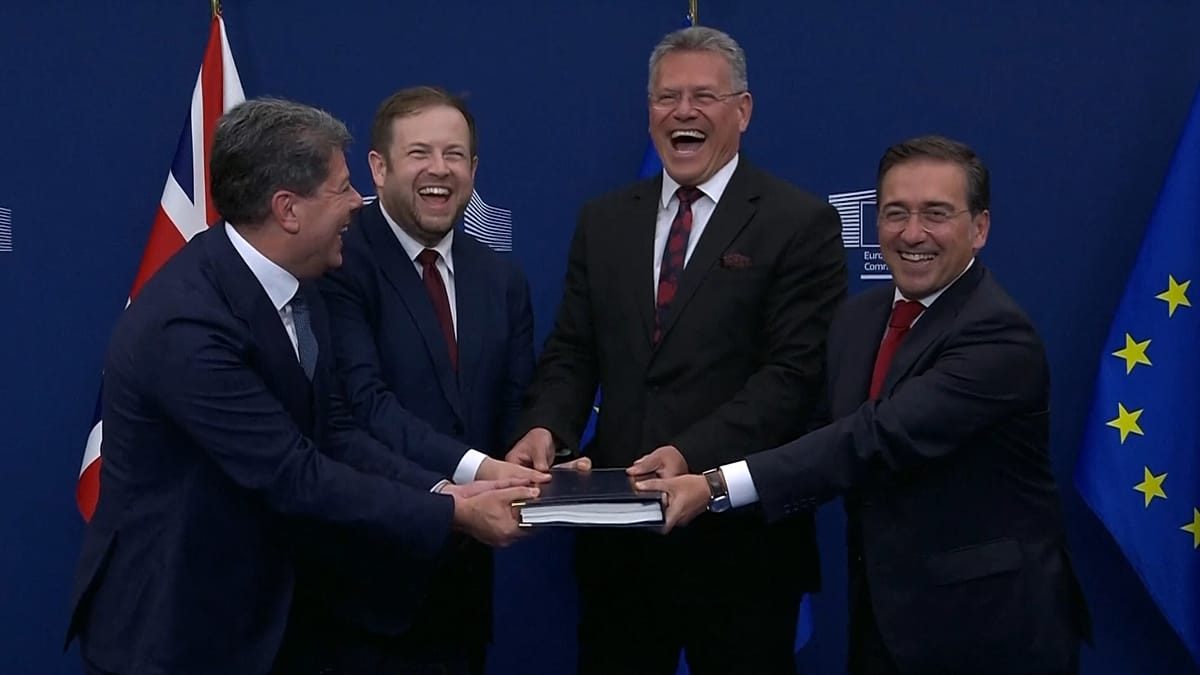
Spain ratified a landmark EU-UK treaty on Gibraltar in Brussels on Tuesday, paving the way for the immediate demolition of the territory's border fence. The agreement, signed by European Commissioner Maros Sefcovic and UK Minister Stephen Doughty, formally closes the final chapter of the United Kingdom’s exit from the bloc six years after its departure. Spanish Foreign Minister José Manuel Albares and Gibraltar’s Chief Minister, Fabian Picardo, also participated in the ceremony.
For the regional economy, the treaty promises a profound shift. The last stretch of the border fence, known locally as the Verja, will be torn down on Wednesday. Albares described the physical barrier as "the last frontier in continental Europe."
The new framework guarantees the freedom of movement for both people and goods across the border. It is designed to eliminate historical economic distortions in taxation and environmental regulation, while delivering what Albares termed "new connectivity for the Campo de Gibraltar." An estimated 300,000 Andalusians living in the surrounding region stand to benefit directly from the improved commercial and social ties.
Madrid managed to secure the economic integration of the territory while explicitly protecting its longstanding geopolitical stance. Albares stressed that Article 2 of the text ensures Spain "is not changing a single comma" in its claim to sovereignty over the Rock.
"We protect that claim and, above all, we are making a spectacular leap into the future in terms of cooperation and coexistence," Albares told reporters. He argued that the deal allows Spain to achieve all its initial negotiating objectives without trading away its historic position.
The agreement marks a turning point for a territory defined by centuries of disputes. "We are leaving behind three centuries marked by mistrust and confrontation," Albares said, adding that the two sides are moving "towards a future full of opportunities."
The diplomatic breakthrough has drawn domestic political fire. Opposition parties, including the Popular Party and Vox, have criticised the treaty. Albares pushed back, framing the deal as an unconditional win for Spanish regional interests. "Even if they do not realise it, they too have won," he said.