VW deploys sheep at Polish solar farm in agrivoltaics trial
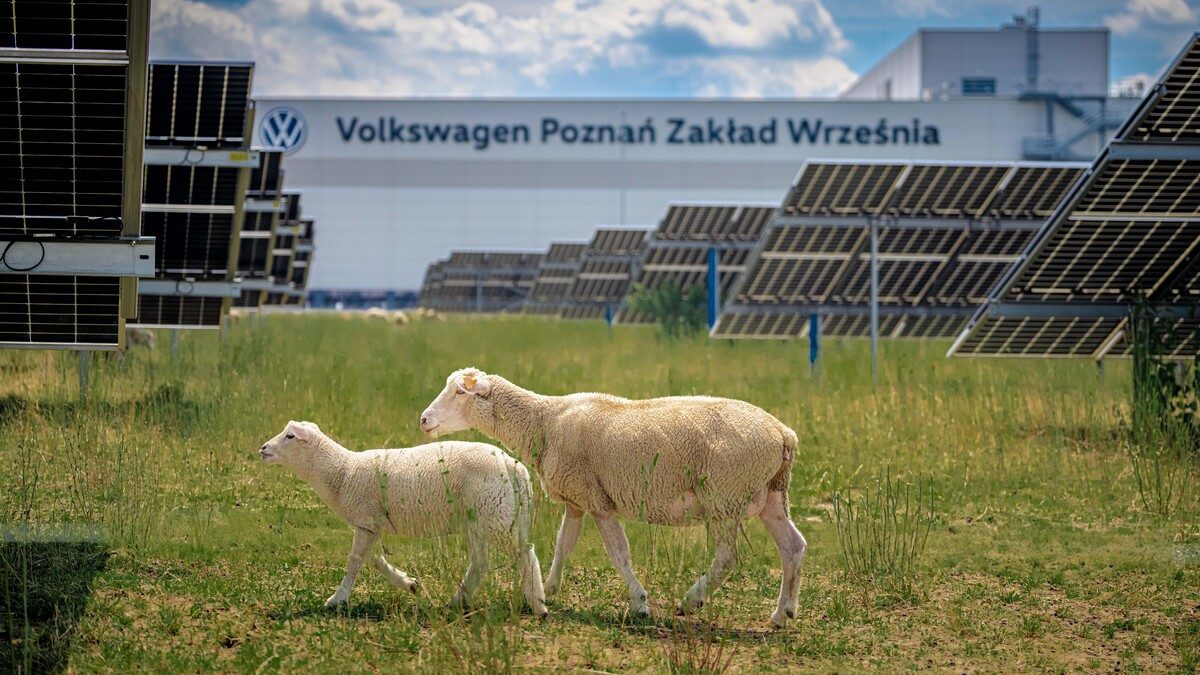
Volkswagen has deployed 100 sheep to manage vegetation at its Polish solar farm, an agrivoltaics experiment that underscores how industrial manufacturers are maximizing land use to meet renewable energy demands.
Volkswagen has deployed a flock of 100 sheep to maintain the grounds of a solar farm powering its van factory near Poznań, Poland. The animals are grazing across 27 hectares around 31,000 photovoltaic panels, replacing mechanical mowing. The initiative is a practical test of agrivoltaics, the simultaneous use of land for solar energy generation and agriculture.
The Poznań facility employs around 3,000 people producing the VW Crafter van. The adjacent solar farm, opened in 2023, can fully power the factory on sunny days and supplies roughly 25% of its annual electricity needs. By introducing livestock, Volkswagen aims to reduce maintenance costs while supporting local biodiversity.
Scientists from the Poznań University of Life Sciences are monitoring the project to measure its broader ecological impact. “We are checking, among other things, whether shade created by the panels reduces heat stress in animals, improving their comfort and living conditions,” says Joanna Składanowska-Baryza from the university’s Faculty of Veterinary Medicine and Animal Sciences. The flock’s owner, Justyna Nowak-Gajek, noted the animals adapted well, splitting into smaller groups to graze peacefully.
Industrial energy pressures
The experiment reflects the growing pressure on European industrial sites to generate and manage their own renewable energy. Volkswagen is currently building a separate €1.7 billion plant in Poland to produce materials for electric vehicle batteries, a project supported by €350 million in government grants. Efficient land use will be critical as manufacturers scale up power-hungry EV supply chains.
Poland’s broader energy transition remains a focal point for investors. Renewables grew from 9.4% of the country's electricity a decade ago to 29.4% last year, led by onshore wind at 14.2% and solar at 12.1%. However, recent figures indicate a period of stagnation in new capacity.
Major corporations operating in Poland have warned that this slowdown threatens future investment. In 2023, a coalition including Google, Amazon, Mercedes and Ikea urged the government to accelerate green energy development to attract continued foreign capital. Quanta Energy, the firm that built Volkswagen's solar farm, noted that agrivoltaics aims to create installations that “coexist with their surroundings and bring additional benefits to the environment and local communities.”
For Volkswagen, the initiative is already yielding localized benefits. “The photovoltaic farm now produces more than just green energy,” says Marzena Pillich-Grońska, director of the Poznań plant. “It has also become a place where we support biodiversity, local agriculture, and the development of scientific knowledge.”