Munich restricts water use as engineers push underground storage
A ban on filling private swimming pools in Munich highlights a deepening groundwater crisis that is forcing European cities and farmers to invest in underground water storage to protect agricultural and public water supplies.
Munich has banned residents from filling private swimming pools and watering lawns as a second extreme heatwave in weeks pushes dwindling groundwater resources to their limits. The restriction follows a dry spring where a lack of March rainfall meant that even above-average precipitation in April and May failed to replenish deep soil moisture, according to the Helmholtz Center for Environmental Research (UFZ).
Munich’s restrictions underline a broader economic vulnerability. Groundwater, which holds nearly half the world's drinking water, is currently being extracted three times faster than it was 50 years ago. Today, overexploited reserves support 40% of global agricultural production and 2 billion people, posing a severe threat to food and water security as climate change intensifies droughts.
Engineering a buffer
To address this, hydrologists are increasingly bypassing surface reservoirs in favor of storing water underground, where it does not evaporate. A team led by Thomas Baumann at the Technical University of Munich has built a "Smart Storm Water Storage" facility 60 kilometers north of the city. "Our idea was to combine flood protection with drought prevention," said Lea Augustin, a hydrogeologist on the team.
The Bavarian system, located in a hop-growing region prone to both flooding and groundwater depletion, captures heavy rainfall in a retention basin. After purification, the water is piped into infiltration wells that inject it 30 meters underground. The rising groundwater can then be pumped back up for drinking or irrigation, turning a flood risk into a drought buffer.
This approach, known as managed aquifer recharge, is gaining international traction as a climate adaptation strategy. California injected over 5 billion cubic meters of water into aquifers in 2023 alone. Windhoek, Namibia, has pumped treated wastewater underground since 2002 to avoid surface evaporation in its arid climate.
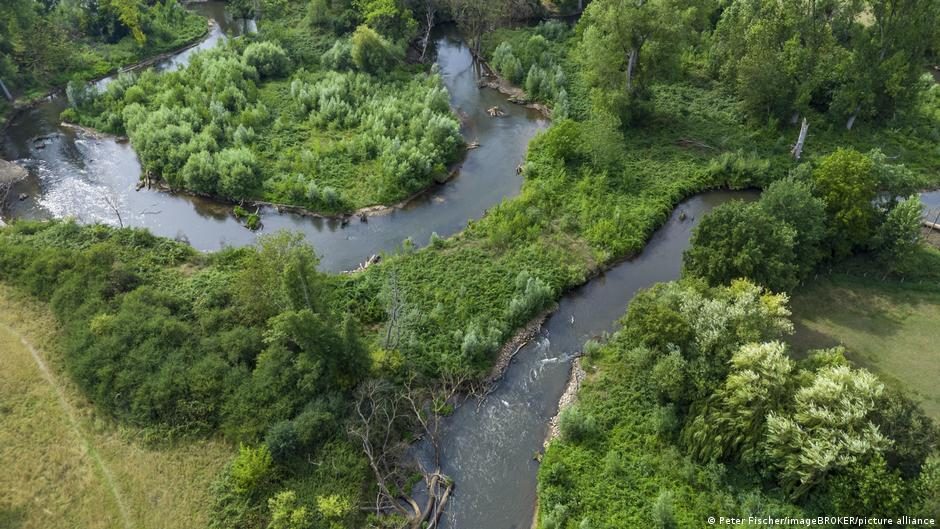
European agriculture and urban planning are also exploring lower-cost alternatives. Restoring rivers to create natural floodplains allows microorganisms to filter water as it seeps into the ground, simultaneously reducing flood damage and replenishing supplies. Germany already relies on bank filtration for more than half of Berlin's drinking water, pulling river water through the ground for natural purification.
Agricultural land, which covers 40% of the world's surface, presents another vast potential buffer if fields can be temporarily flooded during extreme rain. However, this remains difficult to implement without damaging crops or allowing pathogens to seep into the water table.