Dutch navy bets on autonomous fleets to overhaul sea defences
The Royal Netherlands Navy is testing a fully integrated network of uncrewed vessels and drones, a shift that could reshape European defence procurement and address the continent's military labour shortages.
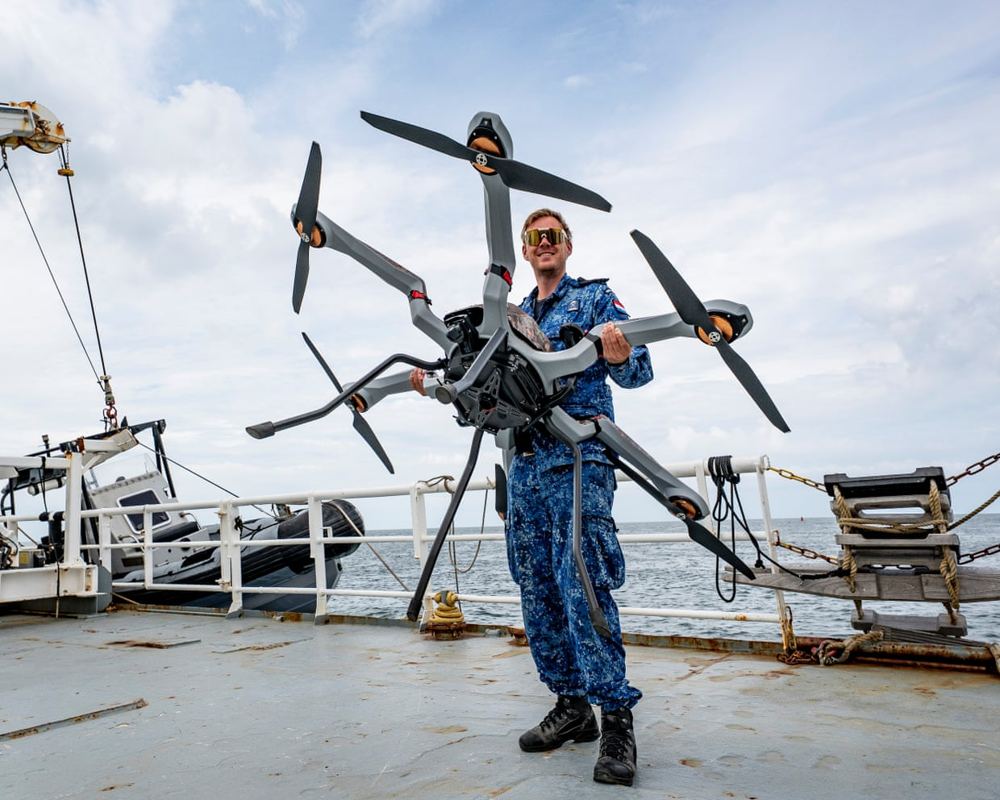
Off the coast of Den Helder, the Royal Netherlands Navy is running a five-week trial of uncrewed vessels and drones that operate autonomously around a manned warship. Vessels like Defender 1 and Defender 2, alongside airborne drones, are being controlled by a central computer system rather than human hands.
The trial marks a major shift in European naval strategy driven by both rising threats and domestic economic constraints. “In about 10 years there will be crewed platforms surrounded by a ring of uncrewed systems operating as autonomously as possible,” says Capt Sjoerd Feenstra, head of the navy’s expertise centre for unmanned systems.
To fund this transition, the latest Dutch military budget mandates that uncrewed systems perform more than half of the navy's work within five years. The UK is pursuing a similar trajectory, planning to spend more than £5bn on unmanned technology over a comparable period.
For European defence contractors, the Dutch approach offers a clear signal about future procurement. The current trials are based on the GeoSea, a vessel previously used to monitor seabeds around windfarms, demonstrating how commercial maritime technology can be adapted for military use. The navy is employing a “system of systems” architecture, allowing new drone or vessel models to be swapped in as technology advances without overhauling the entire network.
This push towards autonomy is as much about economics and demographics as it is about warfare. European militaries face severe labour shortages, and uncrewed systems offer a way to maintain capability without endless recruitment. “Uncrewed systems don’t completely remove the requirement for manpower, you tend to need more engineers, but they provide a different balance in terms of family life,” says Sidharth Kaushal, senior research fellow for sea power at the Royal United Services Institute.
The urgency of these tests is underscored by recent global conflicts. The use of military drones has grown exponentially since Russia’s invasion of Ukraine in 2022, playing critical roles in the Middle East and in US Navy operations against Iran. For northern Europe, the Dutch experiments are particularly significant. “The Dutch punch above their weight,” says naval analyst Lee Willett. “They are also advancing what they have because they recognise that they are a relatively small navy in an incredibly important part of the world.”
Willett notes that the Netherlands is becoming an inspiration for other nations collaborating on security in the North and Baltic seas. However, delegating tasks to artificial intelligence introduces new vulnerabilities. Ferdinand Peters, the software integration lead, warns that AI can hallucinate or produce false results. “You need to let the