Roblox launches text-to-game AI tool amid app store saturation
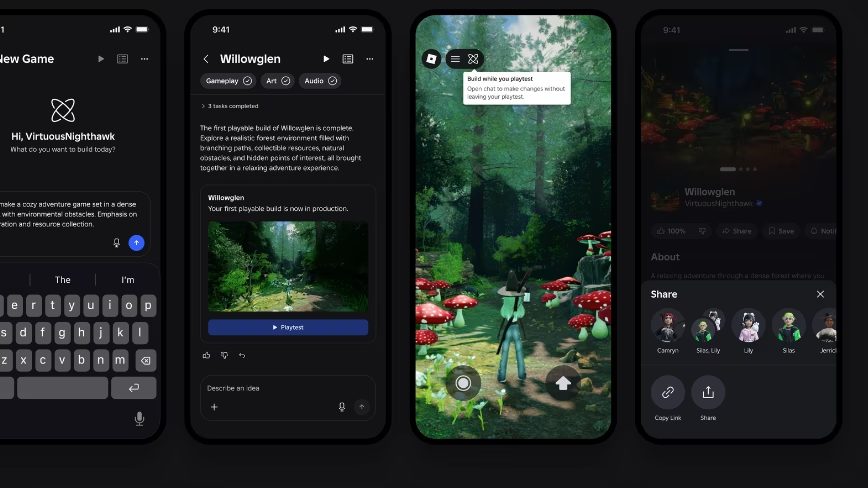
Roblox is giving its 132 million daily users the ability to generate playable games from text prompts, a move that will test whether retention-based algorithms can curb the flood of low-quality AI content hitting digital markets.
Roblox announced a feature called Build on Wednesday, a mobile creation tab that turns text descriptions into basic playable games without requiring any code or use of its desktop Roblox Studio. The tool begins public alpha testing in New Zealand on July 28 for age-verified users aged nine and older. A user can simply describe a concept, such as a forest adventure with environmental obstacles, and the system will generate a starting point complete with gameplay mechanics, environments, characters, and audio.
The system relies on a combination of open-source and proprietary Roblox AI models, including its Cube foundation model introduced earlier this year. These models are trained on a large set of 3D models and gaming-specific data to produce objects that behave correctly, such as driving or shooting, without manual scripting. Crucially for professional and aspiring developers, Build shares a back end with Roblox Studio. This allows users to prototype a concept on their phone and seamlessly transition to a desktop to refine the project with the full Studio toolset, or vice versa.
The commercial significance of this launch extends beyond a single platform. It arrives as AI-generated content overwhelms digital marketplaces, contributing to an 84 percent jump in App Store submissions and forcing Apple to actively crack down on low-quality AI-built applications. By handing game-creation capabilities directly to its 132 million daily active users, Roblox is essentially testing whether a platform can absorb a massive influx of automated content without alienating its audience or degrading the experience for independent developers who build games manually.
To manage this risk, Roblox is leaning entirely on its discovery algorithm as a quality filter. The company emphasised that its system ranks games by long-term player retention rather than volume or recency. Under this model, AI-generated games that fail to retain players will not surface on the homepage. Furthermore, all published games from Build must pass standard safety checks. Titles targeting younger audiences face an extended review process before they can be added to the Roblox Kids or Select catalogues.
Roblox is also targeting its professional creator base with a suite of agentic tools rolling out over the coming months. These include a playtesting agent to identify bugs, an analytics agent that answers performance questions in plain language, and an experiment agent designed to run tests that improve engagement and monetisation. A broader scene-generation model is also in development to create entire 3D environments from text. Build will launch with a free base version and paid options for power users, expanding to new regions after the New Zealand test.