Self-wearing clothes offer new path for assistive tech market
Researchers from Stanford and KAIST have developed self-dressing clothing using vine-like robotics, offering a softer and potentially more viable alternative to the machines currently dominating the elderly care sector.
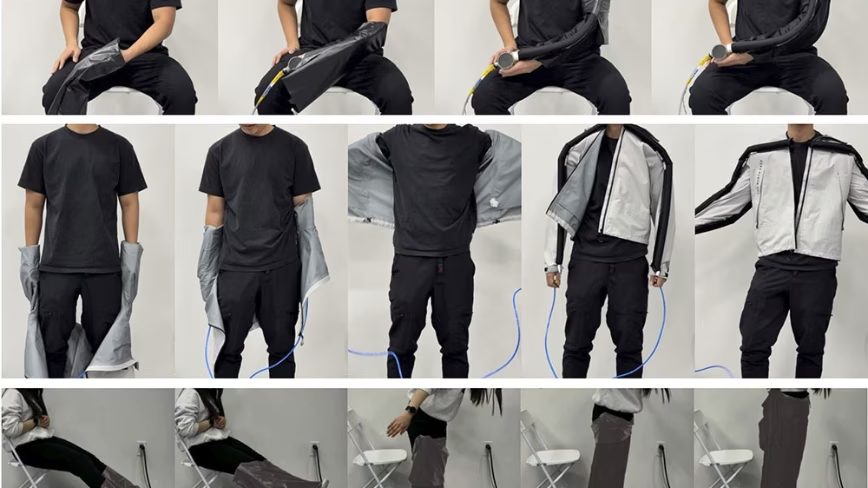
Scientists from Stanford University and South Korea's KAIST have unveiled a wearable system where clothing physically climbs onto its owner. The technology, called Self-Wearing Adaptive Garments (SWAG), uses internal air channels to unfurl fabric along a limb without the need for robotic arms or camera guidance.
For an ageing European population, the economic implications are notable. The assistive care market is currently saturated with rigid exoskeletons and expensive humanoid robots, which often struggle to safely navigate the unpredictable movements of frail bodies. SWAG bypasses the need for complex visual mapping by simply conforming to whatever posture the wearer holds.
The mechanism borrows from vine robots developed in Allison Okamura’s Stanford lab. Thin internal tubes, dubbed subvines, inflate and extend to turn the fabric inside-out. Because the material unrolls onto the skin rather than dragging across it, friction remains low. The outer layer never pressurises, keeping the garment soft enough for bruised or delicate skin.
The field has recognised the approach. Published in IEEE Robotics and Automation Letters in November 2025, the research won the journal’s Best Paper Award at the ICRA conference. Chosen from more than 1,700 papers, it marked the second consecutive year KAIST researcher Jee-Hwan Ryu’s group earned the honour.
Automating routine care is a major economic priority as labour shortages grip health systems. However, introducing heavy machinery into intimate spaces faces severe trust barriers. A jacket that quietly walks itself up an arm presents a gentler commercial proposition than a robot leaning over a bed.
Commercial deployment remains distant. Lead author Nam Gyun Kim and the team have only produced prototypes of sleeves, jackets, and trousers. They have yet to settle on a route to market, and the design still faces engineering limits. Adding more subvines to cover larger areas creates thorny tradeoffs between the flexibility and stiffness required for the fabric to function properly.