Yamaboko Festival Floats Parade Through Kyoto
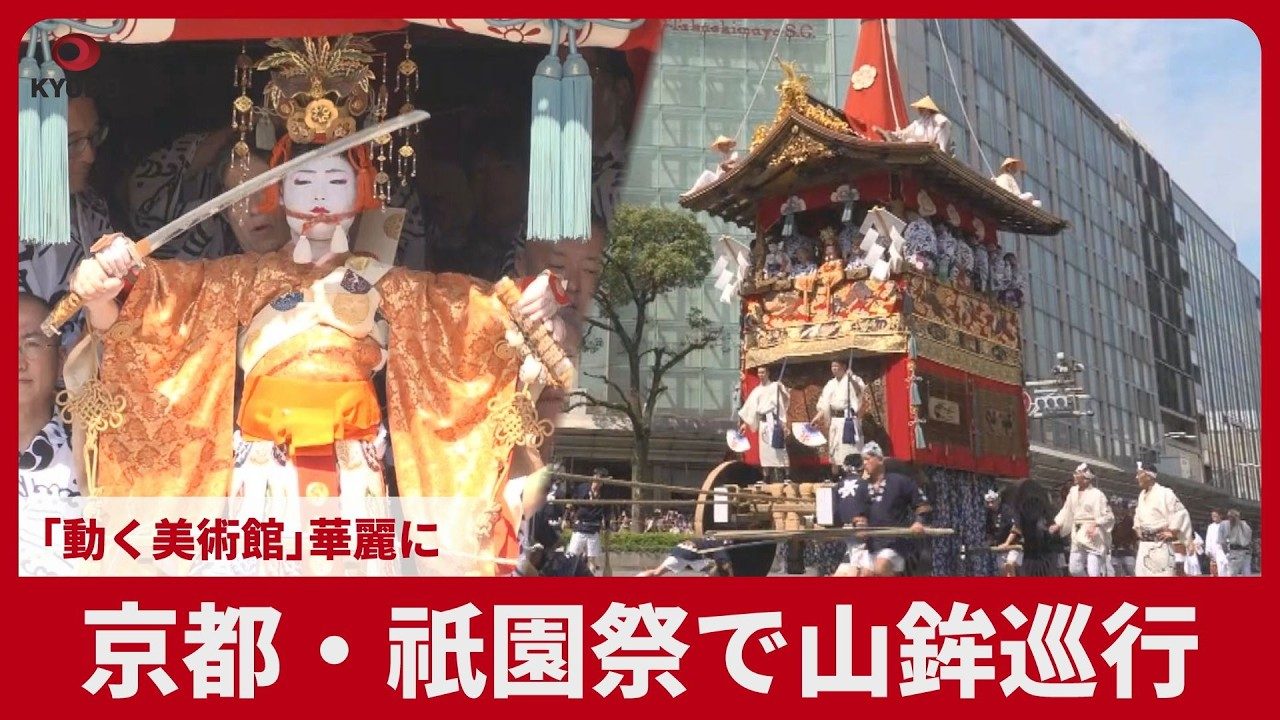
The Yamaboko float procession, a highlight of the Gion Festival’s Saki Matsuri festivities, was held in Kyoto on July 17, with 23 elaborately decorated floats known as "moving art museums" making their way through the city center. (News On Japan)
KYOTO - The Yamaboko float procession, a highlight of the Gion Festival’s Saki Matsuri festivities, was held in Kyoto on July 17, with 23 elaborately decorated floats known as "moving art museums" making their way through the city center.
The magnificent floats proceeded to the distinctive "konchikichin" sounds of traditional Gion festival music, displaying the ornate craftsmanship and splendor for which the centuries-old festival is renowned. The Gion Festival dates back to 869, when Kyoto, then the imperial capital of Heian-kyo, was suffering from an epidemic. The imperial court ordered a purification ritual known as a goryo-e at the garden of Shinsen-en, where 66 spears representing Japan's provinces were erected to appease spirits believed to be causing disease. The ceremony later became associated with Gion Shrine, now known as Yasaka Shrine, and developed into one of Japan's most important annual festivals. The name Gion originally referred to the shrine and the Buddhist guardian deity Gozu Tenno, who was worshipped there as a protector against epidemics. The surrounding district grew as pilgrims visited the shrine, with teahouses, restaurants and entertainment establishments gradually appearing along the approaches. It later became one of Kyoto's best-known traditional entertainment quarters, associated with geiko and maiko and its preserved wooden townhouses. The Yamaboko floats emerged as prominent features of the festival during the medieval period, particularly as Kyoto's merchant communities became wealthier and increasingly involved in organizing the celebrations. Each float is maintained by a neighborhood association, and the skills needed to assemble, decorate and operate them have been passed down through generations. The floats are constructed without nails, using ropes and traditional wooden joints, before being pulled through central Kyoto by teams of residents. Yama are generally smaller floats carrying figures or scenes drawn from Japanese and Chinese legends, historical episodes and Noh plays, while hoko are larger structures topped by tall poles that were traditionally believed to attract and contain harmful spirits. Many are decorated with elaborate textiles, carvings and metalwork, including valuable fabrics imported from China, Persia and Europe, earning the procession its description as a "moving art museum." The festival and its floats survived repeated wars, fires and periods of disruption. The procession was suspended during the Onin War, which devastated Kyoto from 1467 to 1477, but was revived by local residents in 1500. Several floats were later destroyed in major fires, including the Hamaguri Gate Rebellion of 1864, although preservation groups rebuilt or restored many of them over time. The Yamaboko procession was traditionally divided into an early and later festival before the two were combined in 1966. The original arrangement was restored in 2014, with the Saki Matsuri procession held on July 17 and the Ato Matsuri procession on July 24. The float ceremony was added to UNESCO's Representative List of the Intangible Cultural Heritage of Humanity in 2009 and was incorporated into the broader listing of Japan's Yama, Hoko and Yatai float festivals in 2016.
The magnificent floats proceeded to the distinctive "konchikichin" sounds of traditional Gion festival music, displaying the ornate craftsmanship and splendor for which the centuries-old festival is renowned.
The Gion Festival dates back to 869, when Kyoto, then the imperial capital of Heian-kyo, was suffering from an epidemic. The imperial court ordered a purification ritual known as a goryo-e at the garden of Shinsen-en, where 66 spears representing Japan's provinces were erected to appease spirits believed to be causing disease. The ceremony later became associated with Gion Shrine, now known as Yasaka Shrine, and developed into one of Japan's most important annual festivals.
The name Gion originally referred to the shrine and the Buddhist guardian deity Gozu Tenno, who was worshipped there as a protector against epidemics. The surrounding district grew as pilgrims visited the shrine, with teahouses, restaurants and entertainment establishments gradually appearing along the approaches. It later became one of Kyoto's best-known traditional entertainment quarters, associated with geiko and maiko and its preserved wooden townhouses.
The Yamaboko floats emerged as prominent features of the festival during the medieval period, particularly as Kyoto's merchant communities became wealthier and increasingly involved in organizing the celebrations. Each float is maintained by a neighborhood association, and the skills needed to assemble, decorate and operate them have been passed down through generations. The floats are constructed without nails, using ropes and traditional wooden joints, before being pulled through central Kyoto by teams of residents.
Yama are generally smaller floats carrying figures or scenes drawn from Japanese and Chinese legends, historical episodes and Noh plays, while hoko are larger structures topped by tall poles that were traditionally believed to attract and contain harmful spirits. Many are decorated with elaborate textiles, carvings and metalwork, including valuable fabrics imported from China, Persia and Europe, earning the procession its description as a "moving art museum."
The festival and its floats survived repeated wars, fires and periods of disruption. The procession was suspended during the Onin War, which devastated Kyoto from 1467 to 1477, but was revived by local residents in 1500. Several floats were later destroyed in major fires, including the Hamaguri Gate Rebellion of 1864, although preservation groups rebuilt or restored many of them over time.
The Yamaboko procession was traditionally divided into an early and later festival before the two were combined in 1966. The original arrangement was restored in 2014, with the Saki Matsuri procession held on July 17 and the Ato Matsuri procession on July 24. The float ceremony was added to UNESCO's Representative List of the Intangible Cultural Heritage of Humanity in 2009 and was incorporated into the broader listing of Japan's Yama, Hoko and Yatai float festivals in 2016.
Typhoon No. 24 remained nearly stationary south of Japan on September 2 but is forecast to move north toward Okinawa, bringing the risk of sudden heavy rain and stronger winds from the afternoon while waves are expected to rise steadily as the storm lingers nearby. As of 6 a.m. on September 2, the typhoon was located south of Japan and was expected to approach Okinawa while passing to the east of the main island.
Japan's Environment Ministry will conduct its first survey of animal cafes, where customers can interact with animals including exotic species, as concerns grow over infection risks, injuries and the welfare burden placed on animals.
Haneda Airport introduced two major changes on September 2, opening a new boarding facility at Terminal 1 while moving the checked-baggage deadline for all domestic flights to 30 minutes before departure.
Universal Studios Japan is considering its first expansion since opening in 2001, with plans to use about 60,000 square meters of former Nippon Steel factory land adjacent to the park and potentially increase its total area by roughly 10%.
Japan will lower the statutory speed limit on certain residential roads from 60 kilometers per hour to 30 km/h from September 1, with police in Hyogo Prefecture urging drivers to familiarize themselves with the new rules and drive more carefully in neighborhood areas.
Kashima Shrine in Kashima, Ibaraki Prefecture, held its Ofune Festival on September 2, with a spectacular fleet of more than 100 brightly decorated boats sailing along rivers and across lakes in a tradition staged once every 12 years during the Year of the Horse.
Officials in Nara are urging visitors to treat the city's famous deer with care and respect as tourist numbers rise and the autumn mating season approaches, when male deer can become particularly aggressive.
Osaka Metro began testing an artificial intelligence-powered humanoid robot at Umeda Station on August 31, using the machine to provide passengers with transfer directions and information on nearby tourist attractions as the railway operator explores ways to ease staffing shortages.
Adventure World in Shirahama, Wakayama Prefecture, has announced the final name for one of its 19 emperor penguins, completing a public naming campaign that attracted more than 30,000 submissions.
A new large ferry linking Maizuru in Kyoto Prefecture with Otaru in Hokkaido has been unveiled ahead of its first voyage on September 1, offering spacious passenger facilities and a journey time of about 21 hours.
New Chitose Airport is transforming into a destination for travelers and local visitors alike after passenger numbers reached a record 26 million in 2025, with new direct flights to North America, upgraded security facilities and a major anime-themed commercial area planned for summer 2027.