Portuguese team maps Martian clouds to cut risks for future crewed landings
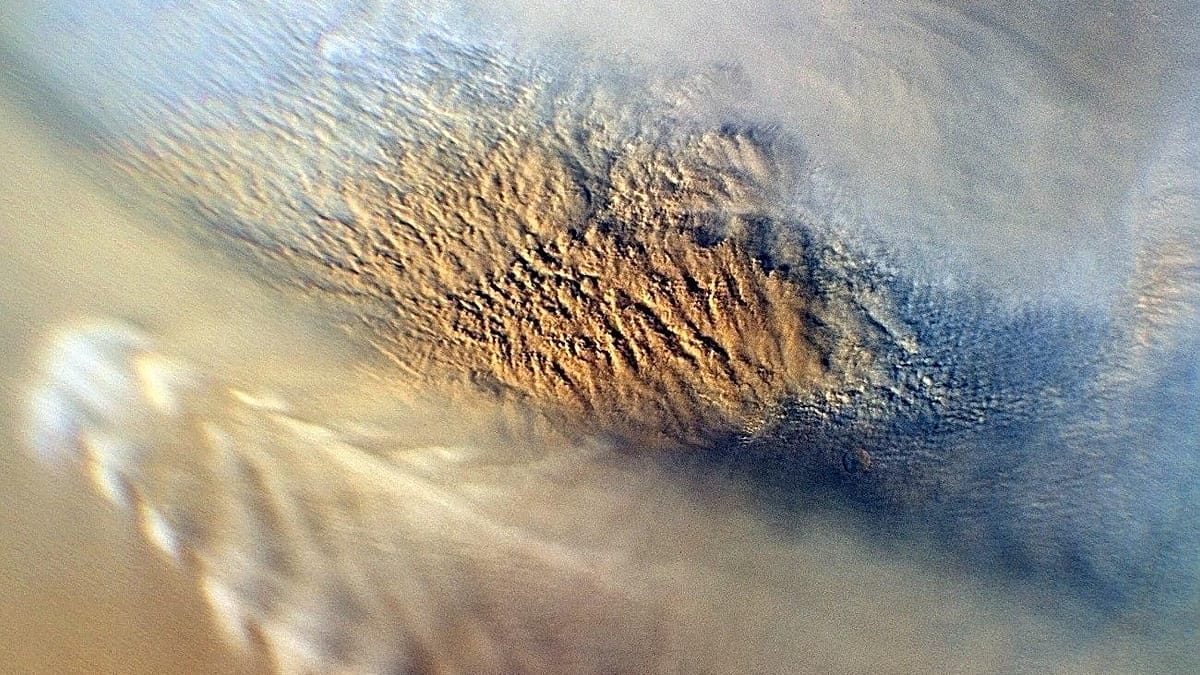
Researchers at the University of Lisbon have used European Space Agency data to map Martian atmospheric waves, providing crucial insights that will reduce hardware losses and guide the timing of future crewed missions to the Red Planet.
Francisco Brasil and Pedro Machado from the University of Lisbon have published a study in the Journal of Geophysical Research: Planets detailing the altitude and propagation speed of Martian atmospheric waves. The researchers utilized high-resolution imagery from the European Space Agency’s Mars Express spacecraft to observe cloud locations from multiple angles.
Landing on Mars remains a high-stakes challenge for the global space economy, with roughly half of all exploration missions failing since 1960. The planet’s atmosphere is exceptionally thin, generating minimal frictional force and causing descending spacecraft to behave as if they are in free fall.
"To land on a planet, just as we land on Earth, we need to know, more or less, how that atmosphere is distributed in terms of layers," Brasil explained. By characterizing these atmospheric dynamics, engineers can determine "what optimisations need to be made" to control friction and ensure "everything goes well at landing."
This atmospheric mapping directly impacts the economic efficiency of future space investments by mitigating the risk of catastrophic hardware losses. Understanding seasonal variations, such as the Aphelion Cloud Belt formed during the northern summer, allows mission planners to schedule arrivals during periods of lower atmospheric turbulence.
While recent robotic missions have achieved higher success rates using specialized parachutes and airbag-like shock absorbers, human missions demand greater precision. "Because we did not have much information about how the atmosphere was structured, they [the rovers] ended up nearly in free fall and crashed onto the surface of Mars," Brasil noted, adding that such failures are unacceptable for crewed flights.
The research leverages the Mars Express mission, which has orbited the planet for 23 years and is now extended until 2029. Beyond immediate landing logistics, Brasil described Mars as a "natural laboratory for some Earth phenomena," offering exaggerated models of atmospheric events like global dust storms that continue to puzzle the scientific community.
The Institute of Astrophysics and Space Sciences team highlighted that these global dust storms typically occur during the southern spring and summer. This happens when Mars is closest to the Sun, generating maximum atmospheric heating and immense turbulence that engineers must eventually account for in surface operations.