Gritt raises $34m as AI robots quadruple solar panel installation speed
Robotics startup Gritt has raised $34 million to deploy AI-controlled machines that quadruple solar installation speeds, offering a potential answer to the labor shortages threatening global energy infrastructure targets.
Gritt, a robotics startup founded by Carnegie Mellon-trained engineers Puneet Puri and Vishal Dugar, exited stealth on Tuesday with $34 million in total funding to automate solar farm construction. The company closed a $26 million Series A round led by Obvious Ventures, with participation from Union Square Ventures and Active Impact Investment, following an earlier seed round.
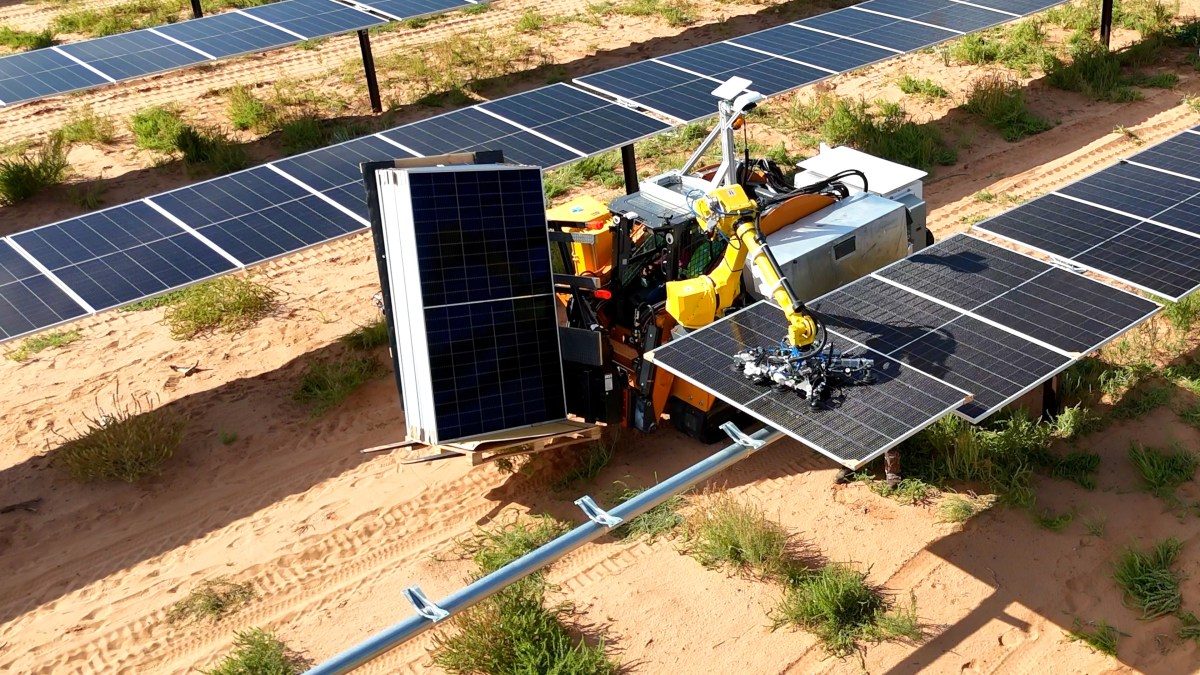
Rather than manufacturing its own machines, Gritt pairs off-the-shelf hardware—such as rented skidders and Kawasaki robotic arms—with proprietary AI models. These systems currently handle the physically demanding task of unloading large glass panels, transporting them, and positioning them on metal frames with sub-millimeter accuracy for human workers to fasten.
This addresses a critical bottleneck for the global energy transition. A severe shortage of manual labor is slowing the deployment of solar infrastructure needed to meet climate and energy independence targets. Gritt claims its technology allows an eight-person crew to install up to 4,000 panels a day, a massive increase from the typical 800 panels managed without automation.
The startup already has two systems in the field and is contracted to help install 2.8 gigawatts of solar capacity over the next 18 months. Its customer base includes three of the top 10 US power construction companies, and it plans to operate 48 systems within six months.
“If we truly want to speed up construction, you need an intelligence which can work in the outdoor, chaotic environments of these construction sites, and it has to be generalizable enough that it can work in these varied environments,” Puri said.
Gritt’s software-centric approach separates it from competitors like Luminous Robotics, Cosmic, and China’s Trinabot, which are building bespoke hardware. Relying on rented, existing machinery could allow Gritt to scale faster and maintain a leaner cost structure as demand for construction robotics surges.
The company plans to expand its AI to handle fastening panels, drilling posts, and building racks. It also aims to move beyond solar into general construction tasks like tying rebar.
“Making a system for one solution was still possible to some extent five years ago, right?” Puri said. “But AI is now making that work generalizable — the same underlying pipeline can be reused and improve across tasks.”
Eventually, the founders envision their sensor-laden systems acting as a broader site management layer. “Gritt becomes now this layer of physical AI, which is doing this dextrous, labor-intensive task, plus it can help you take decisions on the site,” Puri said, noting the technology could flag hazards like open trenches before storms or track missing inventory.