AI chip startup Etched valued at $10.3bn after $300m raise
Silicon Valley startup Etched has raised $300 million at a $10.3 billion valuation to mass-produce dedicated inference chips, intensifying the challenge to Nvidia's dominance in the AI hardware market.
Etched, a startup building computer chips dedicated exclusively to running artificial intelligence models, has raised $300 million in a Series C funding round. The investment values the San Jose-based company at $10.3 billion, doubling its $5 billion valuation from just seven months ago. Sequoia led the round, with participation from Andreessen Horowitz, Jane Street, Diffusion, and memory manufacturer SK Hynix.
The financing round represents the highest valuation ever for a Sequoia-led Series C. For European investors and businesses, this rapid revaluation signals a potential shift in the AI hardware market. If mass-produced, Etched's low-power, specialised chips could offer a cheaper alternative to Nvidia's generalist hardware, lowering the cost of deploying AI across European industries.
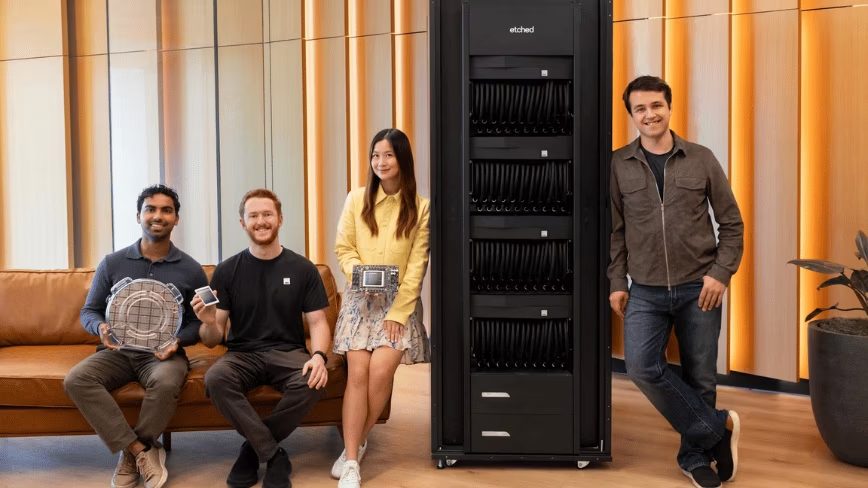
Unlike Nvidia, which produces chips designed to handle every stage of AI development, Etched focuses solely on inference—the phase where a trained model generates answers. The company sells complete rack-scale systems rather than individual chips. Its founders, chief executive Gavin Uberti, president Rob Wachen, and chief technology officer Chris Zhu, left Harvard in 2022 to pursue the idea.
Etched claims to handle this specific task far better by targeting two distinct bottlenecks. First, it uses low-voltage inference, running math blocks at under half the standard voltage. This reduces heat, allowing the chips to pack in more transistors and operate at higher speeds without throttling. Second, the company built a shared memory pool across entire clusters of chips, connected by a proprietary high-speed interconnect to handle the massive data demands of model generation.
The participation of SK Hynix, the world's leading maker of AI memory, underscores the strategic importance of this memory architecture. While initially dismissed as a niche play, Etched's approach is gaining mainstream traction. Its clusters run large mixture-of-experts models like DeepSeek and Qwen, as well as non-transformer architectures like Mamba. Google is reportedly taking a similar path by hardwiring Gemini’s architecture into its own Frozen v2 chip.
Scaling production is the startup's next major test. Etched has opened an 80,000 square-foot facility near San Jose and a factory in Taiwan. Its 400-person workforce includes engineers recruited from Nvidia, Broadcom, Google’s TPU group, and SK Hynix. With demand reportedly outstripping supply as customers move from testing to deployment, Uberti is pushing for rapid expansion. “Now is the time to be aggressive,” he said. “Our chips work, people want them, and it’s time to ship.”