UK retailers deploy Chinese autonomous robots to tackle chronic productivity gap
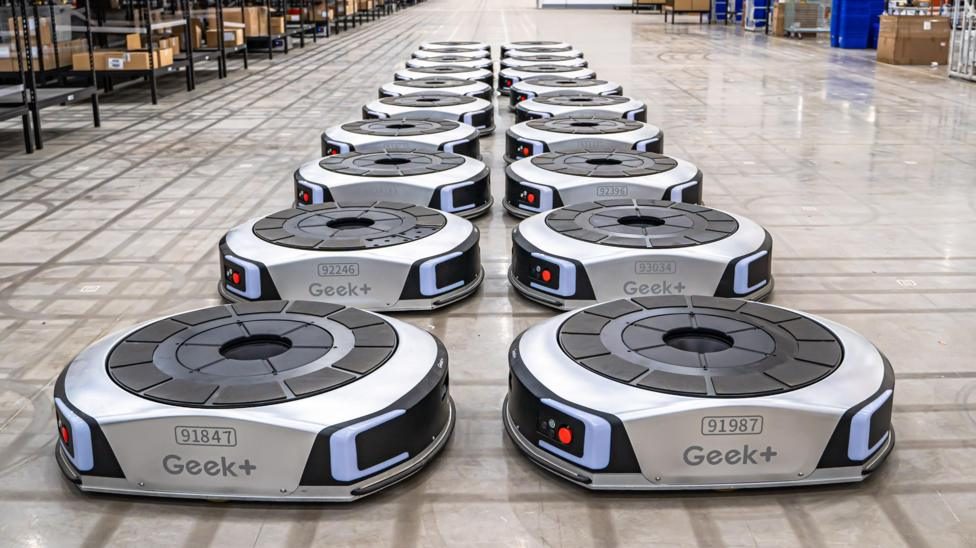
Major British supermarkets and retailers are deploying thousands of autonomous mobile robots from China's Geek+ to combat severe labour shortages and reverse a decade of stagnant productivity growth.
Major British retailers, including Tesco, Asda and Next, are deploying thousands of autonomous mobile robots manufactured by China’s Geek+ across their warehouse networks. The UK has become the Chinese technology firm's largest European market, highlighting a rapid shift in how the continent's logistics sector approaches automation.
Unlike traditional fixed conveyor systems, these squat silver robots navigate warehouses using simple QR code floor markers and safety fencing. UK partner MotionTech has already installed more than 2,000 of the machines across 10 sites to lift storage racks and carry them directly to human workers.
This rapid adoption addresses a critical vulnerability in the British economy, which has endured a prolonged period of stagnant productivity. The Organisation for Economic Co-operation and Development noted in its 2026 report that the UK’s historically low uptake of robotics is surprising given its manufacturing heritage, making automation essential for future efficiency.
Industry leaders argue the technology is vital for survival in a tight labour market. Barry Pemberton, an account director at MotionTech, noted that clients demand high-volume picking on smaller footprints with reduced headcount to keep businesses thriving amid severe UK staff shortages.
However, the Trades Union Congress warns that automation must improve jobs rather than merely slash labour costs. In its response to the government's AI strategy consultation, the union urged ministers to ensure workers are involved in deployment decisions to avoid low-productivity, job-cutting measures.
The company completed a Hong Kong listing last year during one of the most significant robotics share sales of 2025, capitalising on Beijing's strategic push to develop new quality productive forces. Researchers point out that China's robotics sector is heavily leveraging the overlapping supply chains, batteries and sensors originally developed for its dominant electric vehicle industry.
Yanyu Liu, head of communications at Geek+, stated the company is now developing end-to-end unmanned warehouse solutions to automate picking, handling and packing. Meanwhile, Chinese electric vehicle maker XPeng and US rival Tesla are investing heavily in humanoid robots, though industry experts remain sceptical about their immediate commercial viability compared to wheeled alternatives.
The global expansion of Chinese robotics faces emerging geopolitical friction, notably a recent US ban on importing foreign-made advanced robots over national security concerns. Beijing's embassy in Washington condemned the restriction, accusing American officials of politicising commerce and relying on baseless justifications.
Despite these international tensions, Britain's urgent need to modernise its logistics sector makes it a primary testing ground for China's next major technology export. For European investors and policymakers, the widespread integration of these machines signals a permanent structural shift in the continent's supply chain economics.