Bavarian municipalities operate network of chlorine-free natural pools
Bavaria's network of naturally filtered swimming pools is drawing summer visitors, highlighting a shift in European public leisure infrastructure toward bio-engineered water treatment despite climate-related operational challenges.
Across Bavaria, public leisure facilities are operating a network of "Naturbäder," swimming pools that use plant-based filtration rather than chlorine. These bio-engineered sites are currently drawing summer crowds looking for chemical-free bathing in municipal settings.
The infrastructure represents a distinct model for municipal leisure, relying on aquatic plants and microorganisms in gravel beds to purify water. This bio-engineered approach provides local governments with a sustainable alternative to the chlorinated public facilities that dominated the twentieth century.
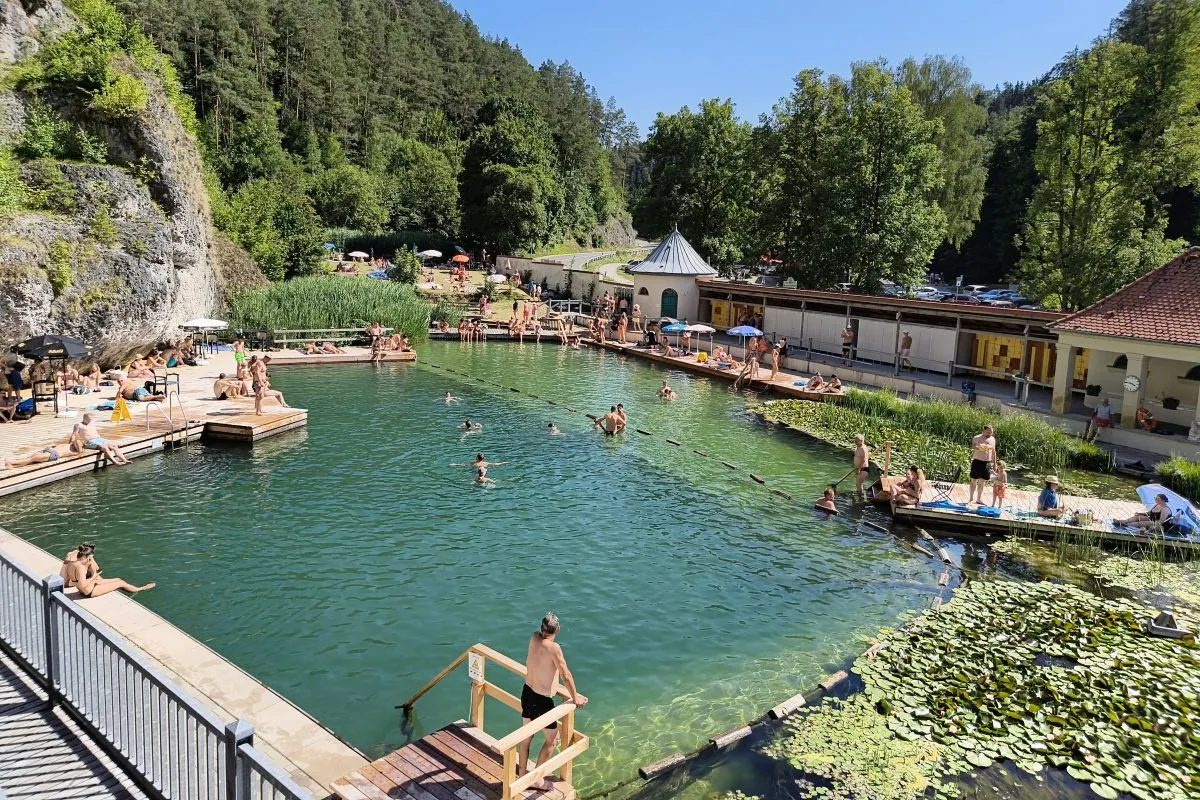
In Franconian Switzerland, Felsenbad Pottenstein operates the state's oldest outdoor pool, which opened in 1926. The facility charges €4.50 for an adult day ticket and purifies its emerald water using lily pads and reeds. It is set in a lush green ravine between the Weihersbach stream and a wall of jagged limestone cliffs, with water pumped into a densely planted corner.
Closer to Nuremberg, Naturbad Großhabersdorf offers adult tickets for €4 and a reduced €3 after-work rate. Visitors can swim until 8pm from Monday to Thursday, and children under the age of six swim for free. Meanwhile, Naturerlebnisbad Schöllkrippen near Aschaffenburg functions as a large-scale municipal leisure park featuring diving rocks, water slides, and beach volleyball courts.
The biological filtration model faces operational limits during extreme weather. In Nuremberg, the natural pool at Freibad Langsee remains closed due to water quality issues exacerbated by exceptionally hot and dry summer conditions.
Urban centers are also integrating these systems into public transit networks. Munich residents can access Naturbad Maria Einsiedel near the Isar river, while the less crowded Naturbad Vierkirchen is reachable via the S2 S-Bahn line north of Dachau.
The engineering behind these facilities originated in the 1980s when German and Austrian engineers began experimenting with natural filtration. Public bathing culture in the region initially arrived with the Roman Empire, which built early spa facilities. After a long decline during the Middle Ages due to disease concerns, the practice was revitalized in the nineteenth century at open-air river baths and lakeside beaches.
I prefer this response