Philippine refill shop undercuts sachet prices as corporate waste law stalls
A district-run zero-waste store in Malabon has diverted 145,000 plastic sachets from landfill in its first year, exposing the gap between the Philippines' packaging-recovery law and its enforcement.
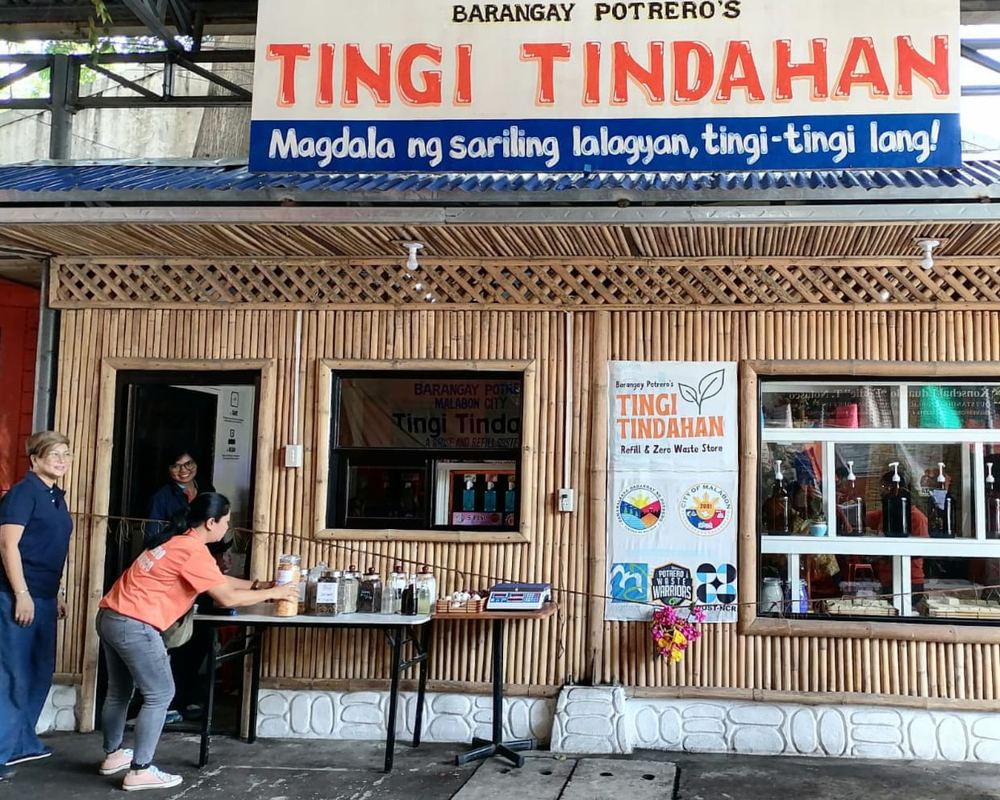
A corner shop in Potrero, a low-lying district of Malabon City north of Manila, has completed its first year of operation selling soy sauce, cooking oil, flour and cleaning products exclusively through refill and reuse. The store, Tingi Tindahan, was set up and funded by the barangay in July 2024 and has since kept an estimated 145,000 single-use sachets out of the waste stream.
The model is simple. Goods are stored in large glass jars or dispensed from spouts; customers bring their own containers, from empty water bottles to old biscuit tins, and pay by weight or volume. A 100ml refill of vinegar costs 3 Philippine pesos less than the equivalent branded sachet in a grocery shop. Because shoppers can buy in increments of just a few pesos, the store undercuts the sachet economy on price rather than asking consumers to pay a green premium.
That pricing matters in a country where an estimated 164 million sachets are used every day and annual plastic waste reaches at least 2.7 million tonnes. Regine Nayve, a campaigner with the Mother Earth Foundation, which helped stock the shop at launch, said the project was designed to challenge the assumption that refill retail serves only wealthier neighbourhoods. "We want to challenge the notion that refilling is expensive, it's not. It makes choices more accessible," she said.
A law on paper, not in practice
The shop's existence also highlights how little pressure multinational consumer-goods companies face over the packaging they flood into the Philippine market. In 2022 the country passed a law obliging large producers to recover the plastic packaging they generate, with penalties of at least 5 million Philippine pesos (roughly £60,000) for non-compliance. It was the first amendment to the Philippines' 26-year-old solid-waste framework.
Campaigners say enforcement has been weak and corporate cooperation largely absent. Deo Florence Onda, a marine scientist researching plastics and microplastics, argued that responsibility cannot rest with communities alone. "The burden of responsibility is always on communities, but a large industry is profiting from it," he said, calling for intervention across the full life cycle from raw material to disposal.
For Khate Nolasco, the 32-year-old councillor who spearheaded the shop, the consequences of inaction are visible every typhoon season. At least 20 storms hit the Philippines annually, and in flood-prone Malabon, clogged drains filled with sachets and detergent pouches can take a month to clear. A 2013 attempt at a citywide plastic-packaging ban was withdrawn after industry objections in a city that hosts several plastics manufacturers.
Replication as strategy
The store is staffed by the district's women waste monitors, who also manufacture liquid cleaning products sold on the shelves from ingredients sourced at local factories. A retrofitted vending machine, installed with Mother Earth Foundation's help, dispenses condiments and cleaning liquids after closing hours.
Nolasco said the aim is to persuade other barangays to replicate the model. "We want to send a message that even a district like us that faces this plastics problem can do something about it," she said. Whether that message carries weight beyond Malabon will depend in part on whether Manila moves to enforce the recovery obligations already on the books.