Two die in Greek firefighting crash as France declares wildfires contained
A mid-air collision over Athens killed two crew members as Greece battles a megafire, while France said its worst blaze since 1949 is now under control, underscoring the uneven toll of Europe's summer fire emergency.
Two crew members, a Greek coordinator and a Danish pilot, were killed on Sunday when their helicopters collided while fighting a wildfire in the Psatha area west of Athens. The crash came as gale-force winds drove flames toward the Greek capital and forced new evacuations, exposing the lethal conditions facing Europe's stretched fire services.
Greek Prime Minister Kyriakos Mitsotakis expressed "sorrow for the tragic accident," saying the deaths during operations at Porto Gremeno "fills us all with grief." Three other firefighters have died this week, two in Crete and one in the Peloponnese, as crews faced dozens of new blazes daily.
The Porto Gremeno fire has now scorched more than 10,000 hectares, nearly double initial estimates, according to wildfire meteorologist Theodore Giannaros of the National Observatory. He said it is "almost certain" the blaze will be classified as a megafire. Across Greece, more than 12,000 hectares of forest and farmland have been destroyed, with active fronts in Attica, Boeotia, Fokida, and the island of Cephalonia.
Civil Protection Minister Evangelos Tournas said the fire department has been "pushed to its limits," noting that winds reaching 100 kilometres per hour grounded aircraft or made water drops impossible due to extreme turbulence.
France stabilises after its worst fire in 77 years
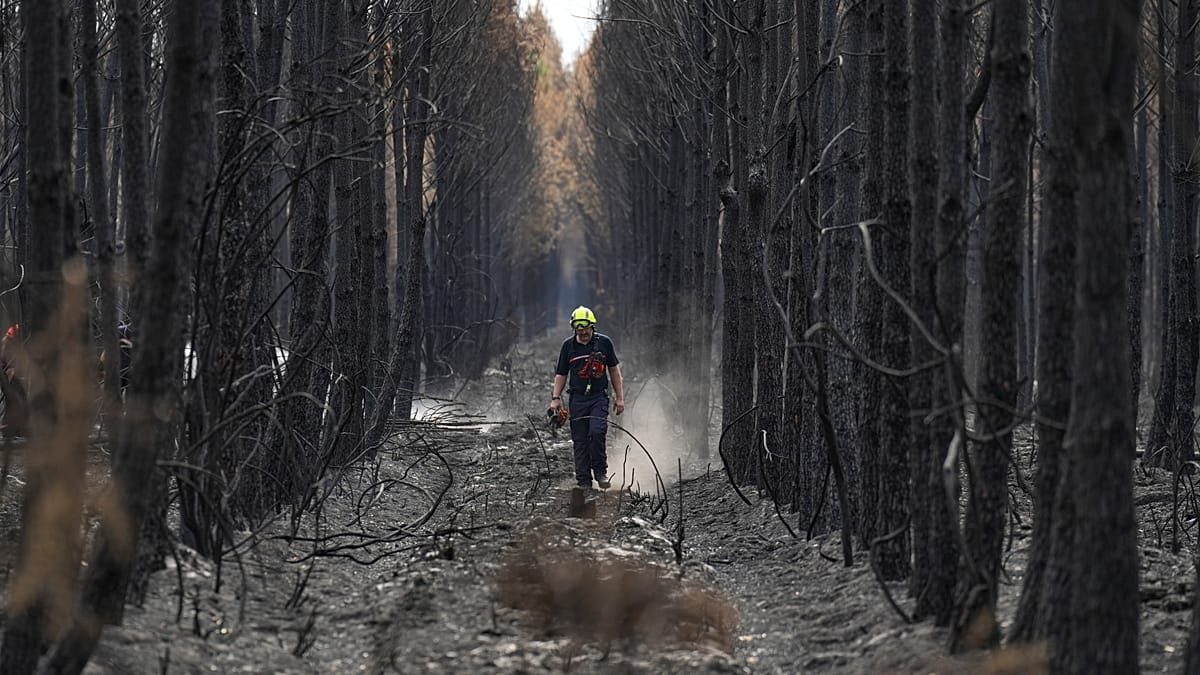
France, by contrast, announced that its major blazes are now contained. Prime Minister Sébastien Lecornu confirmed "a more stable situation" in the Gironde region near Bordeaux, where the country's largest wildfire since 1949 consumed 42,000 hectares and destroyed 240 homes. Of the 220,000 residents evacuated, 208,000 have returned.
A separate fire in the southeastern Var region remains under close watch. Regional prefect Simon Babre warned the situation is "extremely precarious," describing earlier flames as spreading "faster than a galloping horse." In total, 63,000 hectares have burned in France since early July, and police have arrested 308 people in connection with the fires.
Spain improves but new fronts emerge
Spain's major fires in the Sierra Oeste region of Madrid and Ávila, covering more than 70,000 hectares, are under control. However, fresh outbreaks flared in Zamora, León, and Cáceres over the weekend. In Castellón, a stabilised fire that burned 9,568 hectares is suspected by the Civil Guard of having been deliberately set, after investigators identified two separate ignition points.
Between 1 January and 2 August, Spain recorded 186,544 hectares burned, according to provisional figures from the Ministry for Ecological Transition.
A continental toll
The combined figures underline the scale of this summer's emergency. Across the EU, roughly 485,000 hectares have burned since the start of the year, an area equivalent to half the surface of Cyprus. Scientists link the severity of the season to heatwaves and drought driven by human-made climate change, conditions that have dried vegetation across the Mediterranean basin and turned routine summer fires into prolonged disasters.