In pictures: the best of Art Basel’s city-wide Parcours exhibition
The exhibition's curator, Stefanie Hessler, picks out some of this year's highlights
Curated for the third time by Stefanie Hessler, this year’s edition of Art Basel’s city-wide exhibition Parcours has as its theme, “conviviality”. It is a meditation on what Hessler describes as “the beauty of living together and of sharing space and time with other humans, but also the complexity and ruptures, especially in times of conflict and war”.
Spread across shop windows, churches, hotels, abandoned buildings and even Basel’s tram network, the exhibition examines how artists negotiate questions of community, ecology, labour, technology and public life. “It asks who has the ability define how we live together and how we use shared space,” Hessler says. We asked the curator to select seven works that encapsulate this year’s curatorial vision.
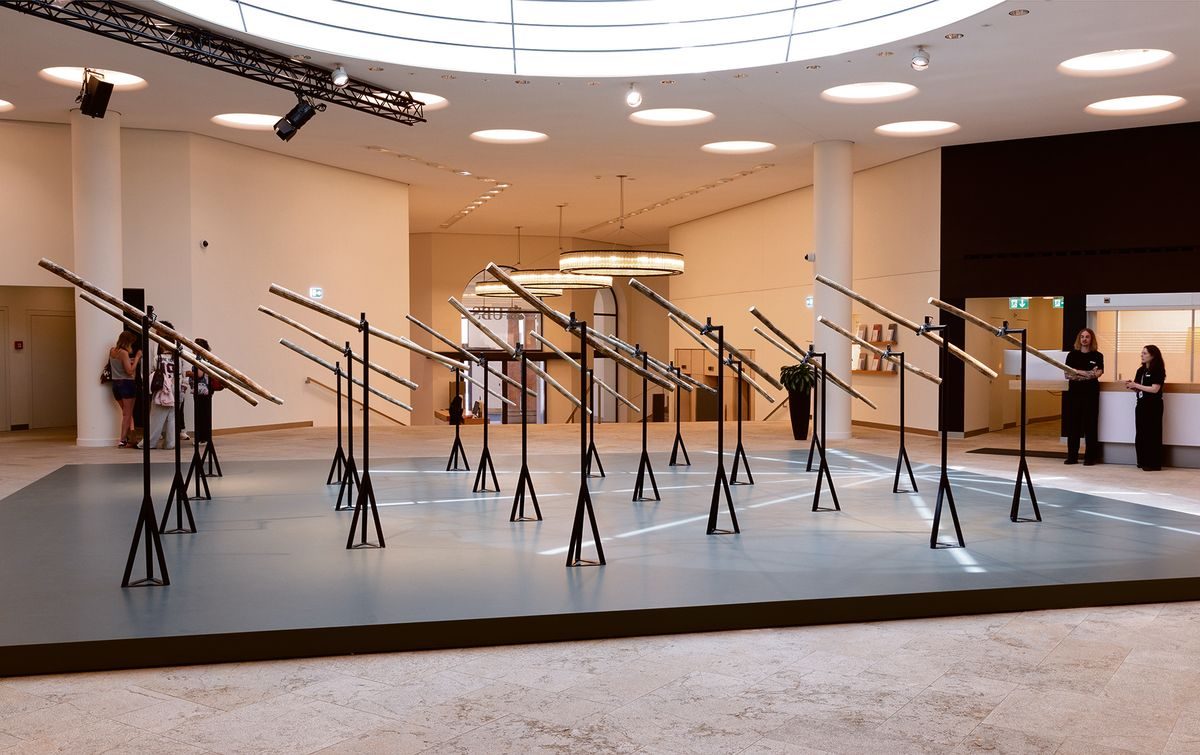
Kader Attia’s Untitled (Rainsticks) , above, consists of 21 bamboo rainsticks traditionally used by Mapuche communities in the Andes. Mounted on mechanised supports, the instruments move in a carefully orchestrated ballet, generating sounds that range from a gentle trickle to the roar of a thunderstorm. Hessler sees the installation as speaking both to “our idea of control over nature and the way that we affect nature through climate change”.
In an disused residential building, the Brazilian artist Cinthia Marcelle presents an almost imperceptible intervention: three glasses and three stacks of coins installed on three separate floors. Subtle shifts in the position of the objects create an uncanny sense of déjà vu as visitors ascend the staircase. Hessler describes it as a meditation on “the institutional and monetary conditions of the art market” and on the ways in which repetition transforms ordinary objects into something psychologically charged.
Ishi Glinsky has made a sculpture in the shape of the mask from the Friday 13th horror movie franchise. The work subverts the trope of the “cursed Indian burial ground” in popular Western culture. It will be shown in the window of the Bajour media outlet, which is open for anyone to access and to speak to the journalists. Hessler liked the idea of showing the work in a place that was open to outside influence.
The Mumbai-based artist Amol K Patil has created an immersive environment of drawing, sculpture, sound and video rooted in histories of labour activism. At the centre of the installation is a radio that emits both political speeches and real smoke, as if slowly burning itself away. Around it, moving elements create what Hessler calls a “mechanised theatre” of sound, light and motion.
Few artists embody the exhibition’s interest in movement and mythology as fully as Haegue Yang. In the window of the Manor department store, venetian blind sculptures pay homage to Minimalism and Dan Flavin while simultaneously concealing and revealing the space behind them. Elsewhere, Yang places synthetic fibre sculptures inspired by the mythical Korean water serpent Imoogi on the Mittlere Brücke and in the city’s historic distillery, linking these works to waterways that have shaped the movement of goods and people through the city.
The Belgian Beninese artist Pélagie Gbaguidi has installed two constellations of painted fragments inside St Clara Church, drawing inspiration from the Medieval Apocalypse Tapestry . Constructed from pigment-covered paper bread bags, the works weave together references to social inequality, migration, belief systems and the fractures between the global North and South. For Hessler, the church setting intensifies these themes: the installation sits within a space that continues to function as a place of worship throughout Art Basel, allowing everyday life and contemporary art to coexist.