Massachusetts museum displays last surviving statue of early American contrarian trader
The Museum of Old Newbury is exhibiting the final remaining sculpture from the estate of Timothy Dexter, an 18th-century merchant whose bizarre, highly profitable trades offer an early historical case study in supply chain arbitrage and contrarian investing.
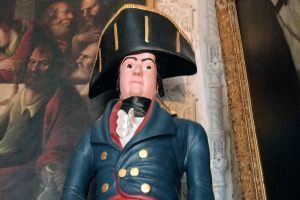
The Museum of Old Newbury in Massachusetts is exhibiting the last surviving life-size sculpture from the estate of Timothy Dexter. The painted wooden statue depicts William Pitt the Elder and is the sole remaining piece of a 40-sculpture collection once owned by the eccentric 18th-century merchant.
While remembered for his peculiarities, Dexter’s commercial record offers a striking historical case study in market inefficiencies and contrarian investing. His seemingly illogical export ventures repeatedly capitalized on unforeseen supply chain disruptions and alternative product use cases.
Unconventional arbitrage
After the American Revolution, Dexter purchased massive quantities of depreciated Continental Dollars, yielding substantial profits when the US government ultimately honored its debt. He then built two ships to export unconventional goods, including sending New England bed warmers to the tropical West Indies.
Local molasses producers repurposed the bed warmers as ladles, validating the shipment. Similarly, a cargo of wool gloves sent to the Caribbean was acquired by docked Russian merchants and successfully resold in Siberia.
Dexter’s most famous contrarian bet occurred when mocking New England elites urged him to "sell coal to Newcastle," an idiom for a futile action given the English city’s massive coal production. He executed the trade literally, only to sell the shipment at a premium because local miners were simultaneously on strike.
He also exported stray cats to the Caribbean for rodent control and hoarded whalebones that were later fashioned into corset stays. A separate shipment of trousers, hides, and whale blubber bound for the East Indies was purchased en route by Portuguese merchants traveling to China.
Eccentric wealth
Born into poverty in 1747, Dexter married a wealthy widow, Elizabeth Frothingham, in 1769, which funded his initial ventures. He used his accumulated wealth to decorate his estate with minarets, a personal mausoleum, and statues of figures like George Washington, Napoleon Bonaparte, and himself.
Dexter died in 1806, and his estate was auctioned off. The Great September Gale and New England Hurricane of 1815 destroyed most of his outdoor sculptures, with the remnants salvaged for firewood or sold.
The William Pitt statue survived, eventually passing through the Smithsonian before being restored and returned to Newburyport. It stands today as a physical reminder of an early American capitalist who profited by betting against conventional market wisdom.