Where Was 'The Shards' Filmed? Where ‘80s LA Nostalgia Still Exists Today
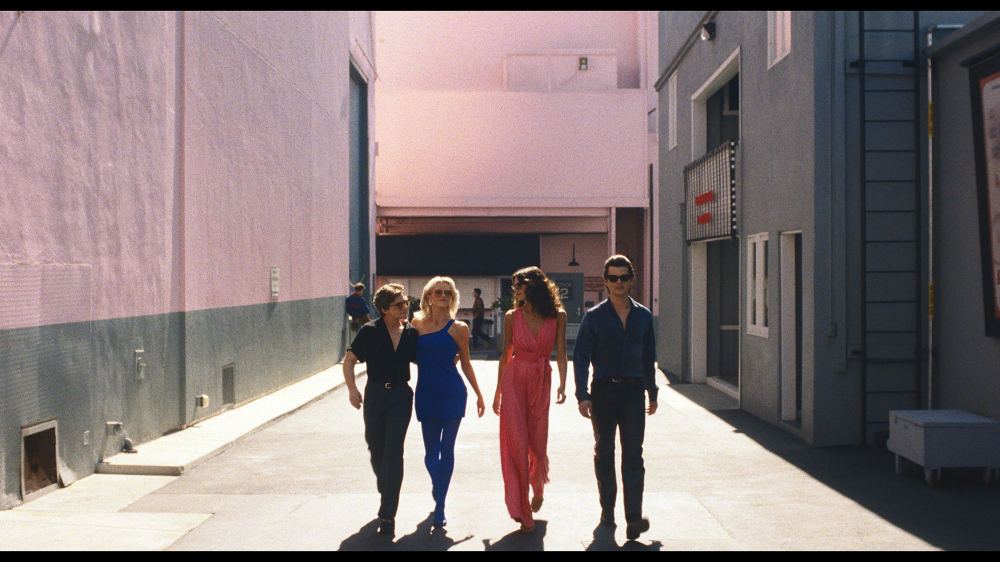
The teen murder mystery recreates the iteration of Los Angeles that we know and love best.
On Location peels back the curtain on some of your favorite films, television shows, and more. This time, we ask: where was The Shards filmed?
The Shards , FX’s new adaptation of American Psycho author Bret Easton Ellis’s 2023 autofiction thriller, opens with protagonist and narrator Bret (Igby Rigney) driving to the Bruin Theater in the Westwood neighborhood of Los Angeles . He buys a ticket at the booth out front and sits down to watch The Shining in 70-mm. His present-day voice-over floats in, remarking on how strange it was to see a movie in 1980, without distractions like smartphones and social media. While waiting, he glances at the ornate Art Deco ceiling, taking note of every gorgeous detail. In reality, the Bruin is now shuttered; there was never a ticket booth out front, and the ceiling featured in the show is from the Fox Theater across the street. But thanks to production designer and native Angeleno Cat Smith, Bret’s day at the cinema feels as true as memory.
Memory is central to The Shards , as a fictionalized Ellis recounts how he and his elite prep school pals were targeted by a serial killer nicknamed “The Trawler” during their senior year. While Smith was thankfully never the subject of a manhunt, she did go to an LA prep school in the ‘80s, and it’s her ultra-specific memories of the time that flesh out such an authentic and believable backdrop for the show. I spoke with Smith about The Shards , the city so integral to its story, and how she went about recreating such a distinct version of it, here are some excerpts from our conversation.
Bret is our entry point into the tawdry prep school world of '80s Los Angeles.
The Shards is so intrinsically LA that it feels like a character. When you began this process with Ryan Murphy and Bret Easton Ellis, what was the main thing they asked of you in curating the vibe of the city?
I’m a local, so I know the city really well. And I also went to a private school in Los Angeles, kind of in the period just about when Bret wrote his book. So I had a really intrinsic memory of that, and we just try to get as close to the actual as we can. Ryan’s influence from the beginning was American Gigolo , and what’s great about that movie is that it was filmed in 1981. He takes walks through areas of Los Angeles that are completely authentic to the time because it wasn’t a period piece, and it’s amazing what he sees. The entire Westwood Village was there. Ryan thought of a very muted palette, grays and whites, and this is ‘81, so it’s not the height of ‘80s design, just the edge. You’re turning into the ‘80s from the late ‘70s, where you would have those browns and reds, while the ‘80s were those pastels and stronger colors that came later. So it was kind of a combination of those two distinct eras.
Through his eyes, we get a healthy dose of nostalgia for such places as Westwood Village.
Are there any places in the city that have stayed in that same design style as in American Gigolo ?
We did shoot in the Westwood Village, and the Bruin and Westwoods theaters are the same because they were built in the ‘30s. Although the theater [Bret] went into was closed temporarily, and it didn’t have a concessions booth outside, so we had to build that. But when you come outside, we were able to copy the street from Westwood at the time. When you pass by the theater and you look behind, all of those are façades we put up, but that street was mainly still the architecture of that time.
There’s this beautiful shot of the ceiling of the Bruin Theater in the pilot. Why are design details like that so important in your storytelling?
Right! Because that’s what you’ll find in LA, those theaters kept those details. That’s something that either we, as a city, thought was worthwhile, or they renovated it. In this particular case, it’s actually the Fox Theater interior. We cheated it. They really loved the way the Bruin looked on the outside, but the inside of the Fox was in better shape. There’s certain things that people find important, that they keep. And one of those things that they don’t keep is shopping malls.
There's also a good amount of mallrat behavior, here, Bret and Robert Mallery (Homer Gere) take the escalator at the Galleria.
No. The Galleria, even though it still exists under that name, is not what you would see then. They shot Fast Times at Ridgemont High there, and that’s what it would’ve looked like at that very time. I had to find something that looked like the Galleria in 1980, and there’s not a lot in Los Angeles that would give you that. I mean, the most memorable thing was this amazing skylight that covers the whole ceiling and glass elevators and escalators that go up three stories. So we went to the South Coast Plaza, and they do have all of that, but the problem is, of course, they’ve renovated it probably more than once. Now it would be a shopping experience that’s recognizable to you today: it’s all glass, the signage is either very subtle or completely crazy. And the stuff they have is so specific to today, like they have this weird virtual reality room. None of it is appropriate for the ‘80s, so we had to go there and figure out exactly what our shots were, and then redo the facades of like ten spaces. We did the movie theater, Orange Julius, Licorice Pizza, Swensen’s Ice Cream, although you never saw that one, and we did Vince’s Pets. All those existed in the Galleria. We did a Casual Corner, Judy’s, this horrible place called One Potato, Two Potato. It was so much fun. We weren’t given a huge budget, but I wanted it to recall that very strong memory I had of shopping in the Galleria and going to movies in that theater.
How do you think your experiences as an LA native helped create such an authentic depiction of that time period without feeling forced?
Debbie (Hayes Warner) and Bret dance on a retro competition show.
It’s very insular. I always worry that when people come to LA, they’ll be very lonely. It’s hard to meet people, you have to get around by car. There’s people who already have a community who don’t allow new people to be a part of that community. But the interesting thing about LA is that there’s so many layers here, I’m never bored looking around. I’ll look around and see the craziest detail. It’s such an ambiguous place that the detail stands out, because you’re not looking in a sea of that. You’re looking at a sea of blankness when this beautiful thing appears that tells you something about life situations. And we’re living in a time that’s very similar to the 80s. I always told my son: “You shouldn’t love the 80s, it was a dark, depressing time.” There were a lot of drugs, a lot of gun violence, everybody was out for themselves. The rich were kings. Sound familiar? And then I left him this world that was identical.