VICTORIA HISLOP: I've been to 50 Greek islands and can guarantee you there's no better time to go than autumn. Here's my list of the very best
If there is a line between passion and obsession, I think my love for Greek islands has finally crossed it. This year I visited my 50th.
Published: 17:00 BST, 17 September 2026 | Updated: 17:49 BST, 17 September 2026
Daily Mail journalists select and curate the products that feature on our site. If you make a purchase via links on this page we will earn commission - learn more
If there is a line between passion and obsession, I think my love for Greek islands has finally crossed it. This year I visited my 50th.
What is it that draws me to these often waterless and barren rocks in the middle of the deep blue sea, some with populations of no more than a few hundred?
The answer is simple. Each one, however small, is unique and beautiful.
These days we group the islands with collective names such as ‘the Cyclades’ or ‘the Sporades’. Yet a few thousand years ago, they were individual and autonomous places. For this reason, every island had its own customs, dances, dishes, flora, fauna, archaeology, mythology, geology and even dialect. It is this variety, this opportunity for adventure, that keeps me addicted.
When I think of Greek islands, I think of lots of tiny countries. Yes, they are now part of the Greek state, but not so long ago they might have been under Italian, French, British or Ottoman rule, and these backgrounds form layers of Greece ’s complex history, leaving rich legacies.
Discovering the Greek islands is like being given a pirate’s chest that’s been pulled up from the ocean. You lift the lid and find glittering gems of every colour and size. And if you’re greedy like me, you want to grasp them all.
For me it all began with island-hopping in my gap year, sleeping on ferries or on the beach for days at a time, and living mostly on watermelon, tomatoes and bread. It was bliss then, and still is, and it makes me smile that the ferries have hardly changed since the late 1970s.
You still have the same smells, the same huge lounges with sprawls of plastic furniture and the same toasted cheese sandwiches which are the main fare, along with strong coffee. It's as though you're going back in time. Even the scent of diesel and doughnuts transports me.
Some islands also have airports now, but the real pleasure of Greek island travel is arrival by boat: standing on deck to watch the anchor being dropped and enjoying the chaotic merging of disembarking and boarding passengers.
There are islands on all sides of mainland Greece, and I have favourites in every part. Most are best visited after high season and my top months to go are September and October. Even up to the end of November, though, swimming is wonderful.
Every philhellene (Greece lover), like me, has their favourite islands. It’s all terribly subjective, so often about an emotional response, a feeling you get when you step off the ferry, a cat you see literally pulling fish from the sea with its paw, a tasty dish, a kind welcome.
My memories of every island, bar a few, are positive and warm, and I still have many more to find. I can hardly wait for the next one.
Beautiful Ithaca has trees down to the water’s edge, a safe natural harbour and very clear waters
This was the island of Homer’s Odysseus, and when I approached by boat I understood his need to return. It is almost painfully beautiful, with trees down to the water’s edge, a safe natural harbour and the clearest waters I have swum in. Everything is small-scale, intimate and welcoming, with pretty double-fronted houses and scores of visiting yachts.
The quality of the tavernas is high, and the boutiques next to them are irresistible. At one, I purchased a beautiful ring inscribed with a poem by Giorgos Seferis: ‘The secrets of the sea are forgotten on the shores.’ It’s a lovely souvenir.
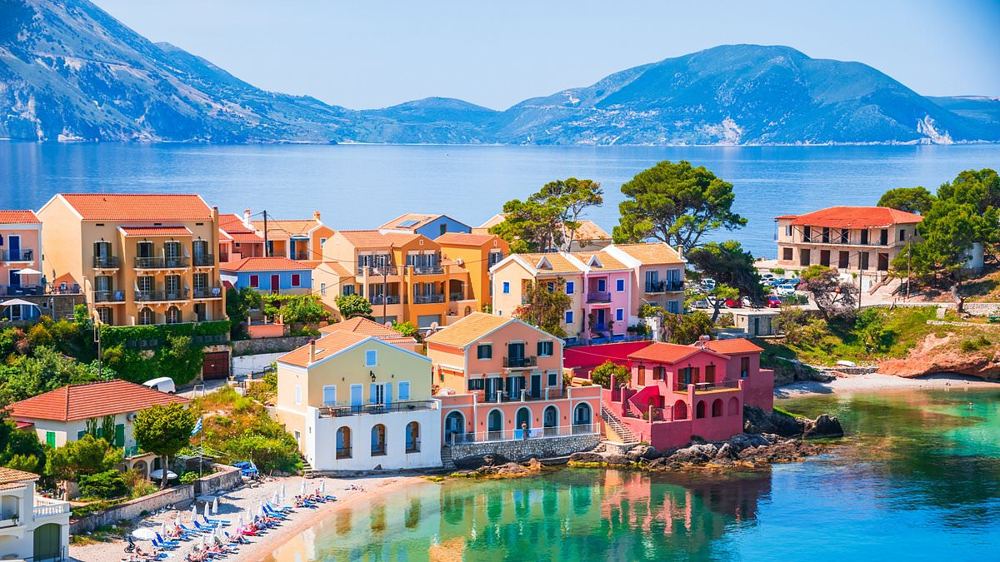
Villages in Kefalonia are pristine and bougainvillea-covered, and the most glorious of them is the little port of Assos (pictured)
Adjacent to Ithaca, Kefalonia is much bigger, but I was drawn there by another writer: Louis de Bernieres. The novel Captain Corelli’s Mandolin had just been published when I first visited, and reading it enriched my understanding of what Greece suffered under Occupation in the 20th century. Tourism came afterwards to transform many islanders’ lives, lifting locals out of poverty.
This island enjoys one of Greece’s best beaches, Myrtos, a huge semi-circle of pale sand by the clear Ionian sea. Villages are pristine and bougainvillea-covered; the most glorious of them is the little port of Assos.
Chios, with its lovely medieval villages, was once home to many of the powerful Greek shipping families
Over on the far eastern side of the Aegean, so close to Turkey you could almost swim there, is Chios. Untouched by tourism, this island provided much inspiration for my new novel, The Wine-Dark Sea, which is set there. It’s home to an indigenous tree that yields a special health-giving mastic (known as ‘tears’) as well as the site of the first leprosarium in Europe. Chios, with its lovely medieval villages, was once home to many of the powerful Greek shipping families whose mansions still stand. It is a place overflowing with drama in both history and landscape, and said to be the birthplace of Homer.
The island of Oinoussa is guarded by a mermaid perched on a rock
This tiny jewel of an island is next to Chios, rich in stories of ship-building, with its own Maritime Academy and museum of shipping history. When I approached the little harbour in a caique, I was welcomed by the island’s guardian, a mermaid perched on a rock, and when I left I heard the valedictory sound of a fog horn being sounded (charmingly arranged for me by the mayor). Though inhabited by a permanent population of a few hundred, with one shop, I would happily live there for the time it took to write a novel.
Evdilos village on Ikaria. The island is one of the world’s few ‘Blue Zone’ locations, where healthy lifestyles result in an unusually high proportion of healthy elderly people
Ikaria is one of the world’s few ‘Blue Zone’ locations, where healthy lifestyles result in an unusually high proportion of healthy elderly people. I was sceptical until I saw the number of sprightly octo- and nonagenarians with full heads of silver hair, bright eyes and smooth skin.
The island feels stress-free: shops do not open until late in the morning, and you can relax in healthy, mineral-rich hot springs. A mysterious boulder off one of the beaches is supposedly where Ikarus, after whom the island is named, fell into the sea when the wax that attached his wings melted away.
Tinos features sculpted marble architectural touches almost everywhere you look; the island has a rich source of the gleaming white stone
Tinos, within the circle of islands known as the Cyclades, features sculpted marble architectural touches almost everywhere you look; the island has a rich source of the gleaming white stone. Even houses in tiny villages have elaborate lintels, while ornate fountains are commonplace.
Tinos is home to a school of sculpture and was the birthplace of the great artist Chalepas. Expect ancient footpaths, deserted beaches in autumn and many ‘pigeoniers’, pretty cream towers housing pigeons (helpfully providing farmers with fertiliser). Simple tavernas offer the freshest fish; my favourite is in Agapi, a village whose name translates as ‘love’. Where could be more alluring?
Micra Anglia (Little England) is an elegant boutique hotel converted from one of the shipowners’ houses on Andros
Distinctive for its grand pastel-painted homes where shipowners lived in the 20th century, Andros, also in the Cyclades, is a delight, especially if you stay at Micra Anglia (Little England), an elegant boutique hotel converted from one of the shipowners’ houses. The other big draw is the Museum of Contemporary Art, with its collection of marvellous modern sculptures by Michalis Tombros, born on the island. There are also works by Rodin, Picasso, Matisse and Toulouse-Lautrec, astonishing to discover on this small, remote island. Stretch your legs on its well-maintained network of pathways.
Milos was formed by volcanic activity and its astonishing rock formations are other-worldly
Milos, another Cycladic island, is dramatic. There’s no other way of describing it. It was formed by volcanic activity and its astonishing rock formations are other-worldly. At Sarakiniko, you can dive into the turquoise waters from the acres of smooth, undulating white rock, but the island also has dozens of divine beaches too, none overdeveloped. It’s a swimmer’s paradise. Culturally it’s rich too. Milos was where the sculpture Venus of Milos was created, currently in the Louvre, although there’s a replica in a local museum, plus many authentic objets from antiquity including clay animals and painted pottery.
Kimolos feels like a private island, and has a charming restaurant. 'If I ever decide to be a hermit, this is where I’ll go,' says Victoria Hislop
This feels like a private island. It’s a few minutes’ boat ride from Milos, even more picturesque and with a charming restaurant. A short walk from where the ferry drops you is one of my favourite Greek museums, so small there’s only really room for two people at a time. How life was lived here in past centuries is beautifully evoked by the tools and the household utensils on display. Kimolos feels like a place where you could happily survive self-sufficiently. If I ever decide to be a hermit, this is where I’ll go.
When you visit the Cycladic island of Naxos, you are welcomed by a mighty temple to Apollo
When you visit Naxos, yet another Cycladic island, you are welcomed by a mighty temple to Apollo. It’s more than 2,500 years old and the scale is extraordinary, a reminder of human insignificance in relation to the divine. Naxos is home to the best cheese on the planet (something like a parmesan but creamier). And hidden away on two different hillsides are two monumental uncompleted statues (due to cracks discovered in the marble). The main town is home to a superb museum in the old castle, with simple statuettes created 5,000 years ago. Their original use remains mysterious but their beauty inspired modern artists such as Picasso and Giacometti.
The landscape of Karpathos is rugged, with hilltop villages enjoying dramatic sea views
I like to embark on a mini odyssey in Greece every summer and the more remote the island, the better. Karpathos in the Dodecanese is a case in point. It’s reached by the occasional ferry or flight from eastern Crete, and its isolation means it has preserved much of its culture. The landscape is rugged, with hilltop villages enjoying dramatic sea views. There’s a strong Italian influence; the island was under Italy’s control for two centuries from 1304, and another 20 in the early 20th century. Many islanders speak perfect Italian and the delicious local signature dish, served in tavernas, is hand-rolled pasta with a sauce of caramelised onions and grated sheep’s cheese.