China installs 59% of new factory robots as EU installations fall 11%
Factories around the world installed 603,000 industrial robots in 2025, up 11%, and China accounted for 354,000 of them, or 59%. The figures come from the International Federation of Robotics (IFR), which published its World Robotics 2026 report on Thursday. The number of robots at work in factories rose 9% to a record 5 million, […] This story continues at The Next Web
Factories around the world installed 603,000 industrial robots in 2025, up 11%, and China accounted for 354,000 of them, or 59%. The figures come from the International Federation of Robotics (IFR), which published its World Robotics 2026 report on Thursday.
The number of robots at work in factories rose 9% to a record 5 million, more than double the figure seven years ago, the IFR said. The federation is a non-profit that represents more than 3,000 organisations, including robot makers. Its president, Jane Heffner, is also a global vice president at Teradyne Robotics.
“The strongest growth is taking place in Asia, followed by Americas. Europe is moving ahead more slowly,” Heffner said.
China’s installations grew 20% in 2025, beating its previous record by almost 60,000 units. Chinese brands sold 195,000 of those robots, up 15%. That gave them 55% of their home market, down from 57% in 2024, as foreign suppliers grew faster, by 27%.
Electronics makers were the biggest buyers, with 96,400 units. Car makers installed a record 78,900, up 38%, and the metal and machinery industry 78,700, up 44%. Not every new market held up. Food and beverage installations fell 37% after rising 86% in 2024, and textiles dropped by 92%.
“China’s success in modernising its industrial system is based on its national robotics strategy, which was initiated ten years ago,” Heffner said.
The latest update of that strategy is part of the 15th Five-Year Plan for 2026 to 2030. It points China’s AI research at physical uses, with robots as the main drivers of growth, Heffner said in the IFR’s China report . The federation expects the Chinese market to grow by 5% to 10% a year until 2029, because an ageing population is leaving factories short of workers.
The United States installed 38,400 robots, up 12%, and overtook Japan as the second-largest market. It was the third-strongest year on record for the US, behind 2018 and 2022, the IFR said in its US report .
“Growth came from the food industry and sectors like warehousing, logistics or medical. At the same time automotive has stayed stable as the largest customer,” Heffner said.
Car makers installed 13,500 robots in the US, down 1%, and food and beverage companies 2,900, up 30%. Most robots in the US are still imported from Japan and Europe, according to the IFR.
Japan installed 36,219 units, down 19% and its lowest total in a decade. South Korea stayed fourth with about 30,000, down 1%. India rose to sixth place with almost 10,500, up 15%.
The EU installed 60,500 robots in 2025, down 11%, the IFR said in its EU report . Asia installed 457,315, up 14%, and the Americas 57,044, also up 14%. The number of robots working in EU factories still passed 700,000 for the first time. At 712,000, it is more than 80% higher than in 2015.
Germany remains the largest market in Europe and the fifth-largest in the world. It installed 24,842 robots, 41% of the EU total, but 8% fewer than in 2024. The IFR noted that Germany remains in recession. Italy installed 7,800, down 11%, France 4,500, down 8%, and Spain 4,300, down 15%. Across the EU, car makers cut their installations by 25% to 14,900.
Chinese suppliers are also moving into the EU, and the first have set up European distribution hubs, the IFR said. Trade restrictions in other key markets such as the US might speed that up. European companies are building their own hardware too, such as the robot compute modules planned by NEURA and SECO.
The IFR expects global installations to rise 9% to 655,000 in 2026 and reach 806,000 in 2029. It forecasts 11% growth in Asia this year, 2% in the Americas and none in Europe. From 2027 to 2029, it expects Europe to grow by 6% a year, ahead of the Americas at 2% but behind Asia at 8%.
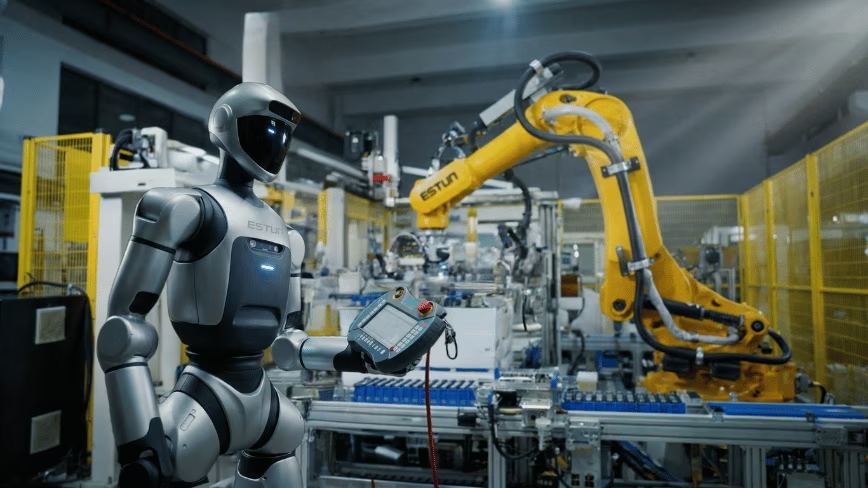
Humanoid robots remain a small part of the market. Nearly 7,000 full-size humanoids, taller than 140cm, were sold worldwide in 2025, according to the IFR. It counts 174 humanoid makers, more than half of them in China, and many were founded only recently, like the Japanese startup O-ID, which is building modular humanoid robots .
China’s data regulator plans standards for embodied AI data , and Beijing is reportedly slowing humanoid robot IPOs . The IFR said humanoids are still making the leap from laboratories to pilots. Safety, reliability, a lack of training data and the lack of a viable business case all stand in the way, it said.