Restorers expose trove of 16th-century nude murals in Rome that were covered by disapproving nuns
Hidden for 300 years, the paintings inside Italy's Villa Silvestri Rivaldi are by some of the leading artists of the day
On Rome’s Via dei Fori Imperiali, the main road leading to the Colosseum, a rundown-looking building partially covered with scaffolding attracts barely a glance from the tourists streaming through on a midsummer day. There are no indications that it contains one of the most significant historical discoveries in Italy in the 21st century so far, a cache of exquisite 16th-century murals by some of the leading artists of the day that were plastered over by nuns who found them offensive in the 17th century.
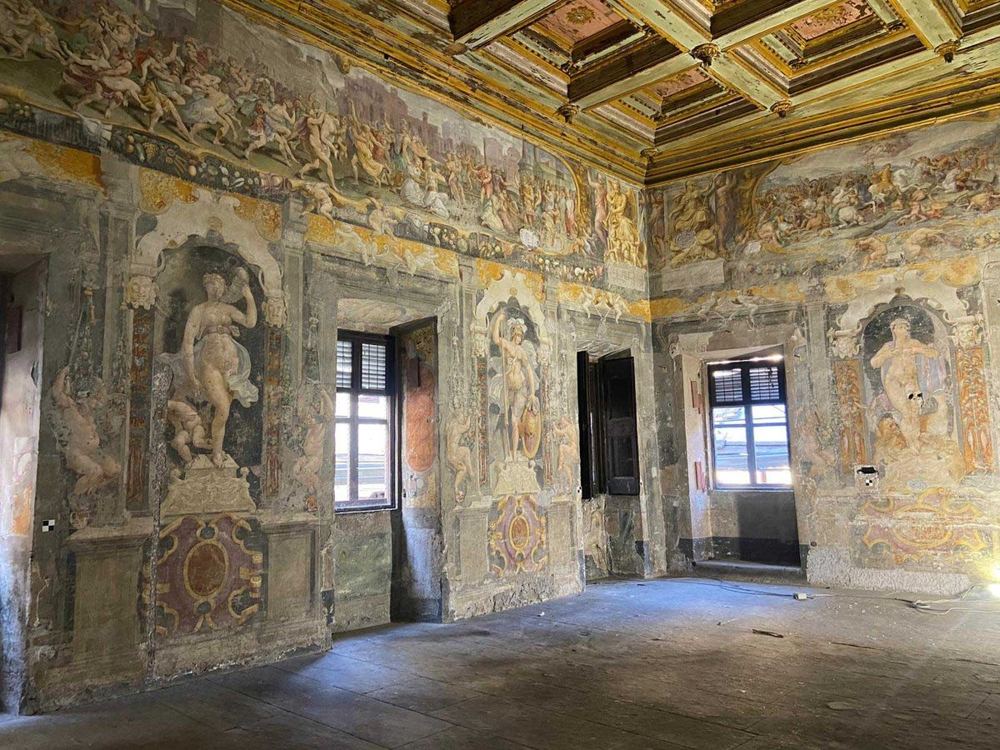
The building, the Villa Silvestri Rivaldi, was one of Rome’s finest residences in the 16th century. Today, the cavernous inside of the villa is festooned with platforms and spotlights, and a team of researchers is hard at work. Many of the walls of the rooms are still covered in plain brown plaster, but here and there you see an arm, or a suit of armour, or a cascading line of putti.
But in other places, whole scenes have been revealed: battle scenes with marauding soldiers, a series of gods and goddesses standing tall and zodiacal symbols. The pose of the figure of Jupiter echoes that of Christ in the Last Judgement in the Sistine Chapel, painted by Michelangelo under the patronage of Pope Paul III, whose right-hand man, Eurialo Silvestri, was the wealthy prelate who built this villa.
Paola Mezzadri, a conservator and restorer at the Istituto Centrale per il Restauro and one of the research leaders, shows a small section of wall where, between 2002 and 2006, attempts were first made to pare back centuries of overlaid paint. “We were sure there was a mural there, and we did a cleaning test,” she says. “And it was clear that there was a lot to uncover. But at the time the building was owned by a religious order, and they didn’t have the funds to restore it.”
Silvestri built the villa in the mid-16th century, hoping a grand building would fan the flames of his campaign to become a cardinal. His strategy failed, but the villa went on to belong to many other illustrious figures, including the future Pope Leo XI; they continued to embellish the place, and its position overlooking both the Colosseum and the Forum encouraged them to commission works referencing ancient Roman mythology.
Its gardens were a highlight, comprising an elaborate nymphaeum with 12 tinkling fountains, alcoves decorated with shell mosaics and adorned with statues, and scented orange trees. Inside the villa, heraldic symbols and coats of arms above doorways and on ceilings paid homage to its illustrious owners, including members of the Medici and Colonna families.
From 1660, though, the building became the property of a religious institution, the Conservatory of the Mendicant Spinsters, who ran a girls’ school and an orphanage there. A bequest from a Monsignor Ascanio Rivaldi to the nuns is how his name came to be associated with the villa.
The nuns took offence at walls covered in nude figures from non-Christian mythology, which is why the murals were painted over. They owned the villa for 300 years; under their ownership it was, for a time, one of Rome’s leading textile workshops. After the nuns left around 1970, it became a centre for community arts and political activism. For a while, it was a squat. Alongside the 16th-century murals, the research team has also uncovered 20th-century graffiti.
In 2024, the Lazio region acquired the property at a cost of €25m. This year, restoration work began in earnest. Some of the most exciting discoveries are taking place in the villa’s Hall of Divinities, says the art historian Gianni Pittiglio of the Istituto Centrale per il Restauro. He shows frescoes of goddesses on the walls there: they are monumental semi-nudes, a feast of oranges, yellows and greens, with flowing robes, some holding armour and weapons.
“Work at the British Library in London has helped identify the probable artist as Prospero Fontana, we found drawings there that link him to these paintings,” Pittiglio says. “But before Fontana, the frescoes were probably created under the direction of Perino del Vaga (1501-47), a pupil of Ghirlandaio, whose work is also in the halls of the Castel Sant’Angelo.”
Restoration work is ongoing in the adjacent Hall of the Emperors, where battle scenes on depict foot soldiers, cavalry and even a lion, as well as portraits of emperors including Titus and Hadrian. “We’re still finding out about the Hall of the Emperors. I come in here every few days and there are always new things to see and discover, it’s the most exciting project for me in the last 25 years,” Pittiglio says. Another space, the Hall of Cupid and Psyche, is also yet to be properly investigated.
Progress will be slow, in part for funding reasons. It is not possible yet to predict when the villa will be completely restored, how it will look or how it might be used, Mezzadri says. Community involvement, she stresses, is part of the operation: the research team are involving local people who remember it in the mid-20th century.
“We’re also working as much as possible without chemicals, using ‘green’, water-based techniques to clean the overpaint, and also lasers,” she says. “But one day, this will again be one of the most important places to visit in Rome, similar to the Villa Borghese, or the Castel Sant’Angelo. It’s a remarkable project to be working on, we feel very fortunate to be part of it.”