Flying With Gamma-Ray Counters: Another Test Or Two Of The Radiacode Zero
Flying With Gamma-Ray Counters: Another Test Or Two Of The Radiacode Zero Yesterday I traveled all day, moving my family back to Lulea from Padova. The trip is long because there is no direct connection from Venice to Stockholm (Norwegian has one, but I pre…
Yesterday I traveled all day, moving my family back to Lulea from Padova. The trip is long because there is no direct connection from Venice to Stockholm (Norwegian has one, but I prefer to avoid them as they canceled my flight recently). So it's Venice-Copenhagen at 9AM, followed by Copenhagen-Stockholm, and then finally Stockholm-Lulea, reaching destination at 8PM. With two 9-months infants and a small dog, plus all the stuff you need to answer their daily needs, it is a physically extenuating experience; fortunately, I have a gold card with Air France that at least allows me to enjoy lounge access and priorities from SAS, which is the company that brought us from south to north Europe.
Of course, I kept both the Radiacode Zero and the Radiacode 103 switched on while travelling. These instruments are two really nice radiation counters that are designed to record x-ray and gamma rays in the energy range of relevance for radioactive decays of unstable elements -making them invaluable both for surveys and for emergency response. I described the instruments in previous articles in this column, and in particular I showed a few times energy spectra of gamma rays recorded by the Radiacode 103 during flights of various length and direction, giving me a chance to highlight several interesting features. So naturally I did the same this time with both instruments, but this was the first flight with the Radiacode Zero.
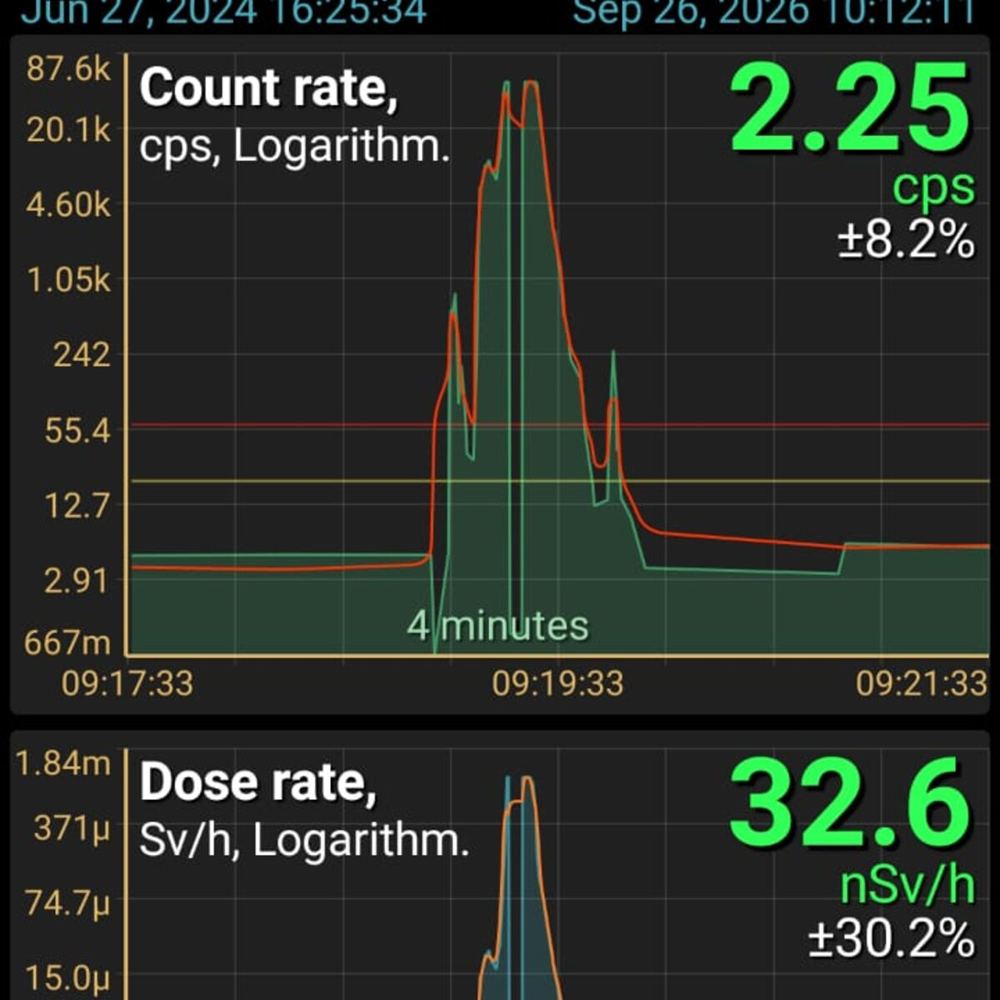
Before the flight, anyway, there is another occasion to test x-ray counters: they naturally get screened under the scanners at the airport. The scanners produce significant radiation fields, so that is a good occasion to see if the Radiacode 103 saturates while the Radiacode Zero continues to report accurate readings. And indeed, I have evidence that this is so: compare the graphs below.
[Above: the dose rate and count rate readings reported by the Radiacode 103. A peak of 1 microSievert/hr is visible.]
[Above: the dose rate and count rate readings reported by the Radiacode Zero, which was traveling side by side with the Radiacode 103 inside the bag being scanned. In this case, the peak measures about 100 milliSievert/hr, roughly 100 times higher than that reported by the other instrument.]
As you can see, the Radiacode 103 reports seeing not much more than 1 microSievert per hour at peak, when it traveled on the belt inside the x-ray scanner. In the same trajectory, the Radiacode Zero reports readings of up to 100 microSieverts per hour. The Radiacode 103 cannot sustain the large flux, as its measurement of radiation is "count-based" - a too high flux makes its counting capabilities ineffective. This confirms my expectations, as well as the claims made by the company.
It should be understood, before we discuss the results of the flight tests, that the two counters are meant to detect x and gamma rays, not any kind of ionizing radiation. There is a very good reason for this: the large majority of potentially harmful sources of radiation damage on Earth emits these rays, either exclusively or in combination with the other possible particle species. In addition, any x- and gamma-ray detector will respond rather faithfully to electrons and positrons, which can be emitted by so-called "beta emitting" radioactive sources. However, this does not exhaust the possibilities: there are protons, neutrons, muons out there, but they are much less important as sources of radiation hazard because of their relative rarity. So it is important, if you pick up a radiation detector, to realize that it cannot perform a measurement of any kind of radiation effectively: if targeting x and gamma rays it will do a good job on those, a decent job with electrons and positrons, and a poor job with other sources. If you want a neutron detector you should expect to spend a large amount of money and travel with something bulkier and more specialized; for muons, you probably want large area (muons mainly come from cosmic rays, at low rates on the ground).
That said, let us discuss the results of my test. The trip gave me three separate flights on which to compare the counters' response to the radiation field at cruising altitude, and in slightly different conditions - as you move north, the composition of the radiation spectrum you are exposed to changes not insignificantly (while remaining largely unpredictable due to the influence of solar weather, magnetic effects, and so on). Previous tests (see my previous articles here and here) showed that on the ground the two instruments agree remarkably well, both with ordinary environmental radiation and in my tests with radioactive sources.
This is by itself an interesting observation, as the Radiacode 103 and the Radiacode zero are on two very different missions - the first is a precise spectrometer which targets low-to-medium radiation field conditions; the second is primarily an emergency instrument that will not cease to work in those extreme, harmful conditions that require clear directions on how to escape to safer areas. The Radiacode 103 does this with a 1 cm^3 CsI scintillator, the Radiacode zero is instead endowed with a 2.8 cm^3 plastic scintillator; and the two instruments have different readout and calibration methods, with the Radiacode zero remarkably capable to switch between two different detection methods based on the dose rate.
So, what happens during flights? In the aircraft the situation changes dramatically, as during cruise at high altitude the Radiacode zero typically indicated dose rate readings of about 5-6 µSv/h, whereas the 103 showed only readings of about 1-1.1 µSv/h. The difference was roughly reproducible on the different flights, so it seems worth trying to understand what might be happening.
[ Above, the Radiacode 103 response for dose rate over the three flights .]
The first thing to remember is that, as mentioned above, radiation at 10-12 km altitude is very different from the relatively simple photon fields we normally encounter on the ground. Primary cosmic rays, mostly energetic protons and heavier nuclei, strike atoms high in the atmosphere and produce cascades, or “showers,” of secondary particles. By the time these showers reach aircraft altitude, the radiation field contains not only gamma rays, but also electrons and positrons, neutrons, protons and muons, in proportions that depend on altitude, geomagnetic latitude and solar activity. Small commercial instruments such as the Radiacodes are primarily calibrated as gamma- and X-ray dosimeters; they are not general-purpose instruments designed to reconstruct the dose produced by an arbitrary mixture of all these particle species. The flight therefore provides an interesting black-box experiment: what happens when two rather different detector technologies are exposed to a radiation environment for which neither was specifically designed?
The answer appears to be: they do respond quite differently. During one representative cruise interval, the Zero measured about 6.4 µSv/h from an average of only 5.8 counts per second, while the 103 measured about 0.98 µSv/h from an average of 17.5 detected counts per second. The 103 also reported a large increase in spectral “hardness,” from about 0.9 on the ground to roughly 5 in flight, confirming that the radiation it was seeing had become much more energetic at high altitude. The sensitive materials of the two instruments have very different responses to high-energy charged particles and especially to neutrons.
A muon, electron or proton crossing the plastic can deposit several MeV directly, while a fast neutron can produce a recoil proton that also generates scintillation light. The Zero must then translate such pulses using a calibration devised for photons, and that conversion need not remain accurate for these other particles. This does not mean that the Zero is “wrong,” nor that the 103 is measuring the complete radiation dose: each instrument is simply responding to a complicated mixed field through its own detector physics and calibration assumptions. The factor-of-several disagreement at high altitude is therefore best viewed not as evidence of a malfunction, but as an instructive demonstration of how differently two gamma-oriented instruments can behave once they leave the comparatively simple radiation environment for which they were designed.
In conclusion: both instruments perform very effectively and with the factory specifications. Ionizing radiation, on the other hand, is a complicated phenomenon and its measurement is a very tricky business. To thwart radiation hazard, measuring x and gamma rays is all you need in almost any conceivable situation (save, say, being in an area hit by a neutron bomb, or being in outer space). If you want a precise measurement of radiation, however, you should first explain what kind of measurement you want to perform: do you want to know what is the dose rate you are exposed to from gamma and x rays? Or from neutrons ? Or from a mixture of other particles ? Of course, the latter situations will produce biased results from instruments that are calibrated to give a precise reading from photons only. This is one of the reasons why radiation measurement is usually regarded as an "expert-only" practice. It does not mean, though, that you cannot equip yourself with one such instrument, and protect yourself from harmful situations. And in doing so, you may learn one or two bits from the fascinating physics of subnuclear particles!