‘This is a big achievement for me, to see the audience crying and talking about their parents’
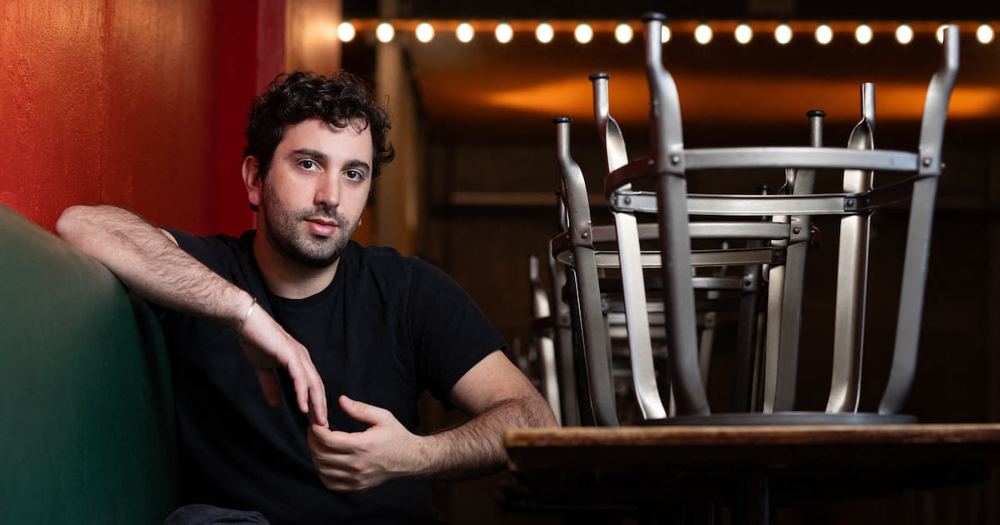
Dublin Theatre Festival 2026: The acclaimed director Mario Banushi on his play Mami, a follow-up to his hit Romance Familiare trilogy
T wo decades ago, as a child playing with a puppet theatre at his grandmother’s house, Mario Banushi made teasing plays about his family. He summoned relatives into the garden to watch his lighthearted impersonations of them. “That’s the start, to be honest,” he says.
The Albanian director, who is now in his mid-20s, has over the past four years made an extraordinarily personal trilogy about his family, called Romance Familiare, or Family Romance, which contains real, painfully complicated stories of divorce, absence and grief.
Those works have toured Europe. Now Banushi is bringing his play Mami, a stirring follow-up, to Dublin Theatre Festival .
Banushi lived with his grandmother in a village on the outskirts of Tirana until he was five. The Albanian capital was experiencing the political instability and economic collapse of the postcommunist era. Banushi’s parents had emigrated to Greece and divorced shortly before he was born. His mother, a nurse, remained there with his two sisters, working several jobs. His father returned to Tirana, where he remarried and opened a restaurant, Taverna Miresia, whose name means Restaurant of Kindness.
When he was living with his grandmother, who had little money, Banushi didn’t go to plays or see much television. “This is how it started, without a reference from theatre or television,” he says about the version of theatre in his mind when playing in his grandmother’s garden.
“The biggest reference was my family. This is what I keep doing in my works now as a director. In a way it is connected to this child trying to talk about his family.”
Banushi joined his mother and sisters in Athens when he was old enough to start school. A local theatre occasionally hosted productions touring from the ancient theatre at Epidaurus. He sneaked in to watch performances, then went home to rave to his mother and write fan letters to the actors.
As a teenager developing an interest in theatre, Banushi also liked reading books about body language. (Often nonverbal, his productions are woven together by dreamlike images.) “I really loved how you can understand and put down how some people move,” he says of the books. “I started watching how people move, and trying to understand what they say with their movement.”
He even considered a career as a dancer, taking classes for two years while at drama school. “I felt it didn’t allow me to move as I want. I understood directing was always what I used to dream. When I was a kid in the house, asking my sisters to do this and that, I loved creating things.”
At 21, after he had finished at drama school, he was knocking on doors of theatres and galleries across Athens, looking for a venue. “I wanted to start from somewhere, even if this was your garden or your rooftop,” he says.
He takes out some rehearsal photographs of him with a multigenerational cast of female performers, who are weaving between gestures of childbirth and eldercare, from the beginning of life to its end.
A hotel in the upscale Kolonaki neighbourhood of the Greek capital was allowing its rooms to be used for an arts festival, and Banushi secured a room to present fragments of Ragada, the play that would become the first part of Romance Familiare.
The full production, whose name, Greek for “stretch mark”, is a reference to his midwife mother, eventually premiered in May 2022, in a house in the southern suburb of Ilioupoli owned by this colleague Chryssi Vidalaki, who has worked with the Italian avant-garde director Romeo Castellucci and would go on to appear in all three parts of Romance Familiare.
Such was the buzz that programmers from the National Theatre of Greece came to see Ragada; they offered him a slot for their experimental stage. He developed Goodbye, Lindita for it, and the play confirmed Banushi as a sensation.
“We were meant to show it for two weeks. We ended up showing it for three years, twice per day from Thursday to Sunday. All the dates were sold out. All of Athens saw it,” he says.
Banushi was making art from grief. Goodbye, Lindita, inspired by his late stepmother, presented painful loss as a kind of folk horror, weaving an otherworldly spectacle from Balkan funeral rites. The final part of Romance Familiare, about his late father, took as its title the full name of the Tirana restaurant, Taverna Miresia, Mario, Bella, Anastasia, which referred to Banushi and his sisters.
For that play Banushi retrieved his father’s restaurant sign from Albania to use as part of the set, a re-creation of his parents’ separation playing out under its neon light. “It was not the easiest thing,” he says about bringing the sign back. “I don’t mean practically. It was not easy emotionally.”
Artists from Virginia Woolf to Eugene O’Neill and Alison Bechdel have put their parents in their art. (“I used to think about him & mother daily; but writing The Lighthouse laid them in my mind,” Woolf wrote in her diary.) “It is a relief to be personal,” Banushi says, “but it’s not an easy relief, because it’s not the easiest road to take. When you have a difficulty in your life, you see how beautiful sometimes it is sharing it, even if it’s difficult.”
In Ragada, the only explicit reference to Banushi’s mother is a short scene in which he has a live telephone conversation with her. The titles of Goodbye, Lindita and Taverna Miresia may nod to his stepmother and father, but he prefers that their sequences of images not be considered literal re-enactments.
“I transform my family memories through my work. It’s not a documentary piece where I show my family and say how I lived my life,” he says.
The director ultimately prefers abstraction and its infinite readings. “Sometimes people who come see my performances say, ‘I liked this moment. I understood this mother did this: am I right or wrong?’ I’m, like, you’re always right. Who am I to tell you you’re wrong?” he says.
“I want to leave it open so the audience create their own stories through my images, to leave it to others to decide what they want to feel and what they want to think of.”
Some have reacted very strongly. “This is a big achievement for me, to see the audience being so personal, and crying, and being emotional, and sending messages talking about their parents and their lives,” he says.
That may have something to do with his plays’ point of view: is Banushi depicting his parents as they were in their early days of parenthood, and so how they look while inhabiting his oldest memories?
“I don’t think I represented my family onstage in a way I see them now,” he says. “I think I represent them in the way I used to see them in my child eyes.”
For adult audiences with their own distant, perhaps buried memories of their parents as younger people trying to get by, Banushi’s plays perhaps resemble a kind of roaming through the fog of recall, finding something otherwise forgotten.
After Romance Familiare, Banushi says, he felt that theatre festivals expected him to make “something new”, but all he could think about was making a play about mothers growing old and their sons having to take care of them. Mami, the resulting play, sounds like a speculated future: “Maybe it’s a fear, or something I know might happen. My mother, I hope, will become an old woman. And me, I hope I’ll become stronger.”
Unlike the Balkan interiors of Romance Familiare, Mami takes place on an otherworldly country road at night, where figures float in and out. Banushi was attracted to playing with and upending expectations of different bodies and ages, so he has, for example, pairing the tall male dancer Fotis Stratigos with the veteran choreographer Angeliki Stellatou.
He seems to be anticipating an exchange of roles when mothers grow old and sons become their carers. “The main idea was, who is the protector? Who is not the protector? Who will protect me now?”
Mami is at the Samuel Beckett Theatre, as part of Dublin Theatre Festival , on Saturday, October 10th, and Sunday, October 11th