Parisian Rumors
The biggest drag in Paris is all the talk about who’s potentially leaving a brand for a better gig and maybe who ought to leave.
The traffic in Paris has been so bad this week, something to do with road closures and the pope’s recent visit, that by the time I got to the Marais, where Zara was presenting John Galliano’s new collection in a mansion, I had only about ten minutes before I had to leave for Rick Owens’s show. And when the Zara rep led me along a winding passage to “a library” of reference images, so I could understand the “mind” of Galliano, I practically bit the dude’s head off.
“I know the mind of John,” I snapped. “Just take me to the clothes!”
Galliano had staged a similar display of garments and books following his triumphant Maison Margiela show, in January 2024, underneath the Alexandre III bridge. Galliano loves a bit of mise-en-scène. But since the first shows I attended of his, in London, in the late ’80s, and then in Paris for “Princess Lucretia”, about a Russian aristocrat on the run, and the great show in São Schlumberger’s vacant mansion, and all through the Dior years, I feel like I’ve spent a fair time in John’s brain. And I would never presume to understand him except that he’s besotted with history and time, with English humor, and those down on their luck. Remember: Chaplin’s Little Tramp is a touchstone of his.
Looking at the Zara line, which is impressive in its depth and detail, especially the knits and deconstructed tailoring, I was reminded again of his influence on at least two generations of designers. I remember the faces of American retailers, frozen in disgust, during a show many years ago for his own label, when the models looked like deranged dolls. Yet how many collections have we seen that are wildly assembled from flea markets or sex shops or childrenswear, like the white cotton playsuit that appeared in the Vaquera show this week or the silk undies at August Barron? It was Galliano who helped to dissolve those limits, along with Martin Margiela, Jean Paul Gaultier, and others.
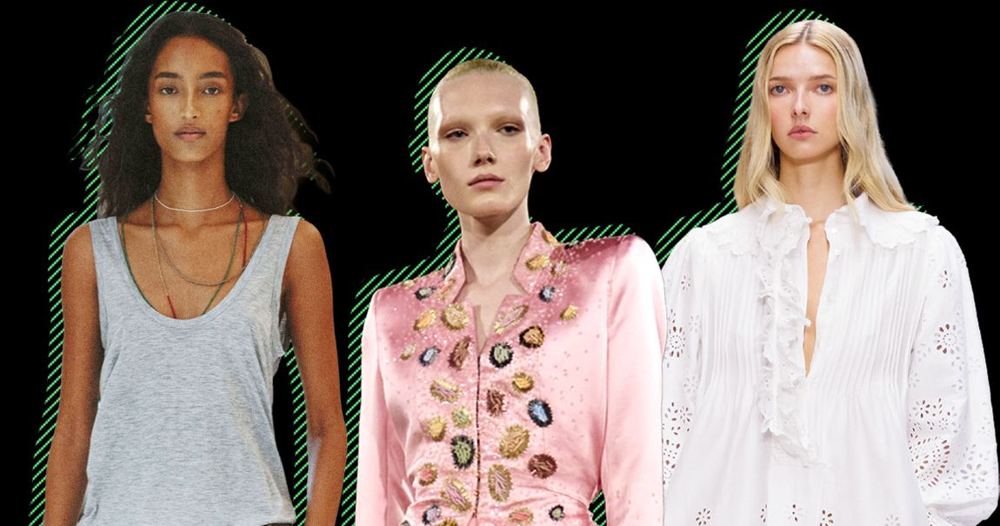
I was thinking of their influence, particularly Margiela’s, while watching The Row, in the pristine mansion of Mary-Kate and Ashley Olsen. They opened with an ordinary gray tank top and slim masculine trousers with a belt that looked like a vintage floral scrap. There followed a big white cotton men’s shirt with pants, a plain scoop-neck white shift, and styles finished with a collar or a layer of what seemed to be antique household linen.
The Olsens also showed draped or front-knotted sleeveless tops in vintage-looking textiles, with pants or a long black skirt. Of course, Margiela is famous for using vintage materials, and one of his early collections had simple sleeveless tops twisted in front.
But copying a designer’s work isn’t really the problem here. Rather, it is that the Olsens have the resources, and the following, to attempt more interesting design than they are doing. Customers already know about big white shirts, and there must be hundreds of sources for tank tops. Phoebe Philo is also attuned to women’s lives and a practical wardrobe, but the difference is she’s always moving her designs forward, giving something. She’s no slacker.
The trees in Paris have begun to change color. By the time I got to Owens’s, around 5:30 p.m., the sky was a cloudless blue, and all the Rick freaks were out. We were again on the plaza of the Palais de Tokyo, with a wide steel runway over the fountain, as for the spring men’s show in June, and jets shooting water into the air.
I loved most of the collection, especially the long and loose dresses that opened the show. I can’t remember Owens ever doing anything as dainty as pin-tucking! And I liked the rough glamour of some boxy jackets in oyster-colored matte satin, with raw edges, worn over matching long skirts and T-shirts with a design punched out in tiny holes and with rhinestone-embellished sandals.
But I wish Owens would move on from the water-and-smoke theatrics. He has done it enough times for it to become an Elvis-in-Vegas act. In fact, what if he were to change venues altogether? Two years ago, he did a spectacular show in his own rambling apartment. Well, I miss that intimacy, and those lovely pin-tucked dresses may have needed it.
The biggest drag in Paris is all the talk about who’s potentially leaving a brand for a better gig and maybe who ought to leave. Balenciaga needs a new creative director. Pierpaolo Piccioli showed 72 looks at the Tennis Club, and suffice to say, he sent out a bit of everything, embellished sheer white tunics with fuzzy fringe, balloon pants, leather jackets with peplums, and T-shirts with peplums. But it didn’t add up to a memorable collection. There are designers working at other houses, who love their jobs, but, still, they’d kill to do Balenciaga, to give it the impact it needs.
Chemena Kamali, Chloé’s creative director, may or may not be headed to Saint Laurent. There are lots of rumors around, and she seemed to suggest in her sentimental press note that this might be her last fling at Chloé. It was certainly a very romantic if one-note collection with dresses and separates in plain and tasseled broderie anglaise.
“I hate tassels,” a colleague whispered at first sighting. Moi aussi! Still, her caftans and floaty gowns were dreamy along with her cutaway lace and sheer tops that closed her show before she received a standing ovation that felt a bit orchestrated. Maybe by all those rumors.
Daniel Roseberry put on a smart show for Schiaparelli, transforming a big show venue into an intimate, dark nightclub. His aim was to bring the style of ready-to-wear more in line with his couture collections, and he really did that with a bunch of great revenge dresses in black, lightweight jackets with moderately ruffled edges shown with pants vented at the sides to suggest a skirt, and close-fitting knit separates that keep to his lean silhouette.
“Easy and stretchy,” as Roseberry said of those graphic looks, adding, “Our customers want a piece of the couture, not something different.”