‘Vibrant, design-led and surprisingly green’: why the Dutch city of Eindhoven is perfect for a relaxed arty break
After electronics giant Philips left, the city reinvented itself as a multicultural hub for creativity and innovation, and the home of Dutch Design Week A baggily clad skateboarder’s wheels clatter across concrete floors, the noise bouncing off exposed pipes and iron girders. Vaulted skylights set in high ceilings illuminate the industrial space and its central kitchen, from which my main course – a silky lemon risotto, spiked with samphire, rhubarb, garlic, baby onions and basil – has just been transported. I’m in the Dutch city of Eindhoven, in North Brabant, famous for its historic connecti
After electronics giant Philips left, the city reinvented itself as a multicultural hub for creativity and innovation, and the home of Dutch Design Week
A baggily clad skateboarder’s wheels clatter across concrete floors, the noise bouncing off exposed pipes and iron girders. Vaulted skylights set in high ceilings illuminate the industrial space and its central kitchen, from which my main course, a silky lemon risotto, spiked with samphire, rhubarb, garlic, baby onions and basil, has just been transported.
I’m in the Dutch city of Eindhoven, in North Brabant, famous for its historic connection to Philips, the one-time electronics giant. The restaurant, Radio Royaal, is housed in what was once their engine room, in the Strijp-S neighbourhood. Today, Strijp-S buzzes with concept stores, an indoor food market, MU Hybrid Art House and the Area 51 skatepark. The broader area, Strijp, was where the company was largely headquartered: its zones are named S, T and R. In the late 90s, Philips withdrew from the city where it had started in 1891, and the letters I, J and P were never assigned.
Philips had employed about half of the region’s working population, so its departure for Amsterdam inevitably left a huge hole. Fortunately for Eindhoven, this was short-lived, and within a decade the city had reinvented itself as a multicultural hub for design and innovation, so much so that Dutch Design Week , the largest event of its kind in northern Europe, has been held here since 2005.
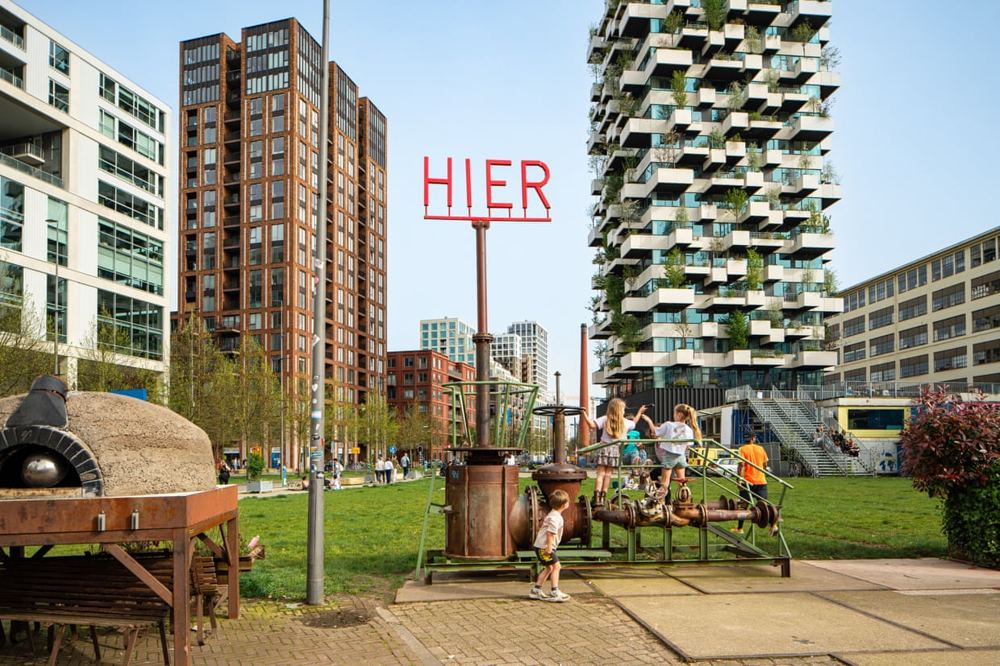
Completely off-limits during Philips’ heyday, Strijp-S is perhaps the liveliest example of Eindhoven’s reinvention, with innovative businesses making the most of the industrial spaces. It’s distinguished, too, by the Trudo Tower, a 19-storey building where facade planters froth with more than 70 species of greenery. Purpose-built in 2020, these eye-catching apartments were designed to provide affordable housing for low-income residents.
Despite the city’s industrial past, about 40% of Eindhoven’s landscape comprises greenery. Walkways, complete with bat boxes, run alongside the Dommel river, while larger spaces, such as Karpendonkse Plas and Philips de Jongh park, provide walking and biking opportunities. This, plus an average commute time of 15 minutes, helps to explain why Eindhoven was named the world’s least stressed city last year.
As you walk from the UFO-shaped Evoluon (now functioning as an exhibition space and conference centre, and given by the company to the city on its 75th anniversary) on the edge of the Het Ven neighbourhood towards Strijp-R, the area becomes both green and residential. Ahead of the times, Philips saw the correlation between nature and healthy, happy employees. As early as 1910, the company started building workers’ accommodation with large gardens, which today are a mix of social and private housing.
Strijp-R’s primary allure, however, is the RK Complex. Formerly a Philips ceramics factory, it was bought by renowned Dutch designer Piet Hein Eek and opened in 2010. Other designers have workshops here, too: the idea, said Hein Eek, was to give young creatives an affordable space to work. The concept obviously works: in more than 15 years, only five of the 25 studios have changed hands.
Visitors flock here year-round to check out Hein Eek’s eco-forward scrap wood furniture and for glimpses into the studios, the cavernous exhibition space and the shop, packed with smaller design objects, ceramics, books, jewellery. The onsite Green Restaurant favours local, seasonal ingredients in hearty portions; it’s attached to the boutique Piet Hein Eek hotel , also one of the designer’s innovations. It has 14 rooms, each featuring a distinctive design style, with doubles from €135.
What makes a stay in Eindhoven even more interesting, however, are the myriad ways this impulse towards repurposing spaces, reusing materials and thinking sustainably shapes the visitor experience. I stayed at Hotel Mariënhge (doubles from €83) in the centre, a former monastery characterised by clean lines and cheeky art, its interiors effortlessly blending old and new.
From here, it’s a short walk to the retail district, where vintage stores range from the highly curated Yatva Vintage to a Salvation Army ReShare store. Near Strijp-R, I happen upon Luna & Lore , owned and run by Luna Hartogs. “Lore is about wisdom passed on from previous generations, and I learned to sew from my grandmother,” she explains, as I rifle delightedly through rails of upcycled vintage clothing. “For me, it’s also about passing things on for people to enjoy.”
“Eindhoven gets called ‘Vintage Valhalla’, a paradise,” Erik van Gerwen of Eindhoven 365 tells me over dinner at Fifth NRE, itself housed in a former gas factory. “There’s the Philips legacy, but the presence of the Design Academy also ensures a lively community, passionate about innovatively making use of what already exists.”
Creating opportunities is a recurring theme in Eindhoven. I see it again at New Order of Fashion , a nonprofit organisation providing makers with resources to experiment with, as well as a sellers’ platform. It’s also a lab, researching the future of fashion from a regenerative perspective, and a public space aiming to inspire visitors to think about their consumer choices.
I loiter outside the Muziekgebouw concert hall: since 2024, its facade has featured a massive mural of a street musician and classical concert violinist embracing. Named Echoes of Harmony, it was commissioned by Eindhoven city council to represent music’s ability to bridge barriers, and since named best mural worldwide by Street Art Cities.
On the city’s north-eastern edge, graffers can legally unleash spray cans in Berenkuil, a two-level roundabout and now the country’s largest open-air graffiti zone. Ramps and rails make it a beeline for skateboarders, too; again, I hear wheels grinding on concrete. There are no dibs here: the art lasts mere days before it’s sprayed over by someone else, but that, I’m told, is the point. In Eindhoven, perhaps more than anywhere else, the idea that everything is ephemeral, yet also renewable, seems entirely at home.
The trip was provided by the Netherlands Board of Tourism and Conventions