US Army aspires to create Indo-Pacific manufacturing hub in Korea
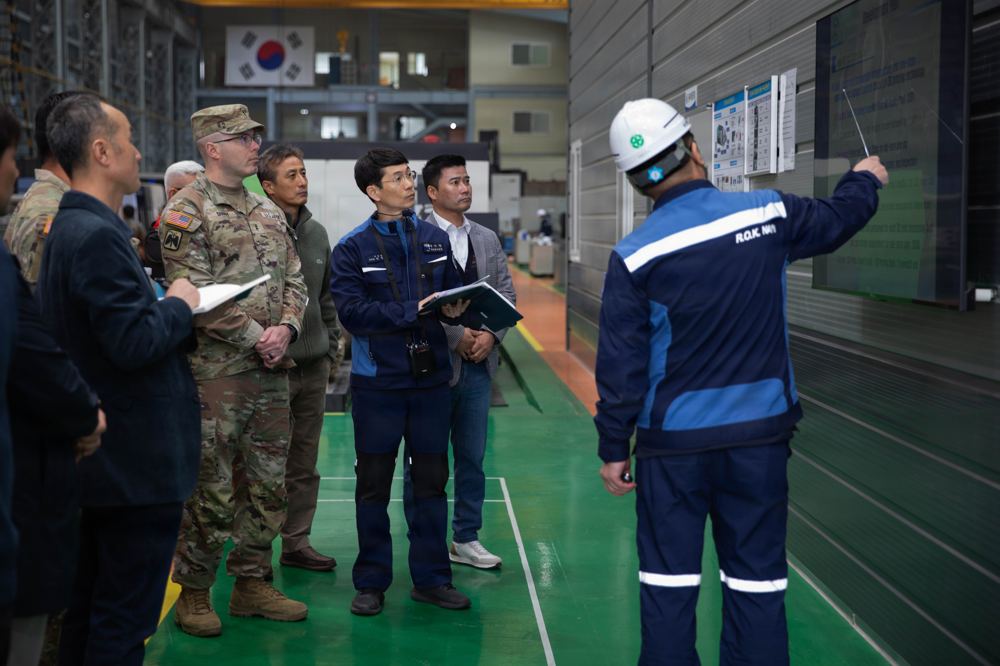
As the Army builds out its logistics capability in Korea, it’s investing in manufacturing to supply local forces — and troops across the Pacific region.
In the Pacific, a single bolt can become a giant headache and the source of months of delay. The bolt that Col. Scott Carpenter held up Monday during the Association of the United States Army’s annual meeting belonged to a Common Remotely Operated Weapon Station turret, and it is back-ordered until February 2027.
At U.S. Army Materiel Support Command, Korea, the unit Carpenter commands, soldiers built the bolt through the drill-out process of subtractive manufacturing for a cost of $1.27, avoiding months of delay and saving more than $300 in the process.
As the Eighth Army in Korea builds out its logistics capability, it’s investing in advanced manufacturing with an eye to supplying spares, not only to local Army forces, but also to troops across the Pacific region .
“I want to be the advanced manufacturing center for INDOPACOM,” Carpenter said at an engagement with reporters at the AUSA meeting. “That’s my goal.”
Eighth Army officials spoke earlier this year about how establishing a Korea-based regional sustainment hub, or center for logistics, maintenance and supply, could cut down the burden and cost of long-distance sustainment. At a roundtable event Monday, Eighth Army Commander Lt. Gen. Joseph Hilber indicated the force was moving out to build that sustainment hub.
The Eighth Army has already resourced maintenance support teams that cross service and regional boundaries, departing the Korean Peninsula to support the III Marine Expeditionary Force in Okinawa, Japan, and to Hawaii to support Army rotational units, Carpenter said.
Through additive manufacturing, or 3D printing, and subtractive manufacturing, or cutting a part out of a solid block of metal, the Eighth Army is manufacturing an increasing number of critical parts, Carpenter said. The materiel support command recently acquired a metal 3D printer and is now building out infrastructure to house it.
“But we think come January, February, the metal 3D printer [will be] in, and my goal is … I would like to get to a point where I can 3D print the bolt,” Carpenter said.
By next summer, he said, the Eighth Army is set to receive $3 million worth of advanced manufacturing machines, with some $10 million worth of additional machinery set to be requested in the Army’s fiscal 2028 budget.
“I’ll be able to print bumpers; I’ll be able to print doors,” Carpenter said. “These are not just desktop printers.”
Recently, he said, a Guam-based military unit requested an assembly that would have cost $36,000. The Korea-based team built it through subtractive manufacturing for $82.
Through a request system, Carpenter said, any joint forces member can now request a part and get routed to the Army’s logistics hub in Daegu, South Korea.
“If you’re the Marines operating in Okinawa and you need this bolt … I get this bolt back over to the Marine at a fraction of the cost, and a lot quicker than if they were to order through the supply system,” he said. “So again, we’re maintaining combat power inside the First Island Chain.”
Hilbert said some hurdles remained for the Eighth Army, including intellectual property restrictions with manufacturers; data-sharing to ensure the advanced manufacturing processes deliver components that are up to spec; and seamless connection into existing Army logistics systems not designed for these new modes of parts production.
“We’re continuing to work through those pieces to enable us to fix faster,” Hilbert said.