Why it took Genesis 10 years to break even on tour
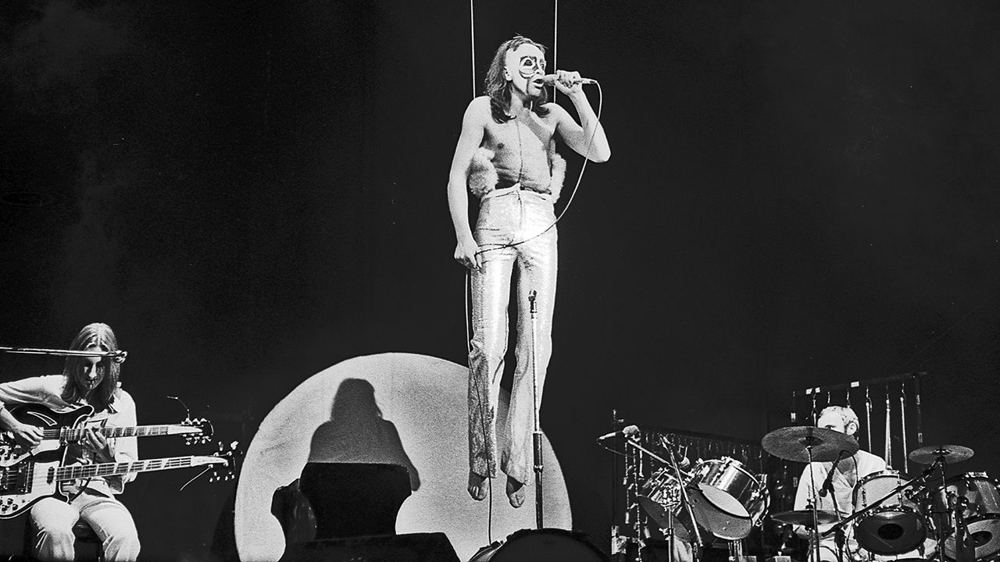
With and without Peter Gabriel, the prog giants worked had to connect with crowds – and while recordings exist, they believe you really had to be there
In 2009 Genesis re-released their live back catalogue in a box set. To mark the occasion Mike Rutherford and Tony Banks told Prog about their onstage highs and lows.
Genesis have returned to the public eye as they release their new box set, entitled Live 1973-2007. It comprises their recorded live output, lovingly remastered and re-presented in 5.1 surround sound. It’s for good reason.
“Throughout our career we were mainly a touring band,” says Mike Rutherford. “We had hit singles towards the end and radio presence, but really I would say our career was based on our live performances. Live audiences, rather than record sales or how we’re doing in the charts, have always been our strength.”
It’s clear the band enjoyed hitting the road again with their reunion tour in 2007. “We just thought, let’s enjoy ourselves, which wasn’t very hard,” says Rutherford. Although it was somewhat more taxing for Tony Banks, who took a lead in role in overseeing the rehearsals and musical direction.
“The whole operation took about a year,” says the keyboardist. “With rehearsing, it took a long time to get back into the swing of playing some of that material, especially the earlier and more complex stuff. But a lot of it was also about the instruments, the sounds I was using from the early 90s, we weren’t really using any more. So that tour posed the question: how do you use modern instruments to recreate the old sounds? That was quite fun, the new instruments are really good.”
Of course, it wasn’t always that way. They had to start somewhere, and the pair remember their first gig. “Not counting a friend’s party, it was at Brunel University in London,” says Rutherford. “We’d been rehearsing in a cottage in a circle, so when we got the venue we were like, ‘How do we set up?’ It hadn’t occurred to us!”
That wasn’t the only problem. “We got onstage and had no idea how to structure a set,” says Banks. “But we did a few songs and an encore and the crowd seemed to like it. It was fun, even though we didn’t know what to do at all. It was very nerve-racking at the time.”
“It was all our own stuff, though,” adds Rutherford. “Songs like Going Out To Get You , which was never recorded [although it has been bootlegged]. I remember the night, but I can’t remember the rest of the set!”
Rutherford does recall his favourite venue, the setting for Live At The Rainbow, 1973 , one of the most sought-after elements of the box set. “The Rainbow Theatre in London was a great venue; and it came at the start of two tours. 1973 was the first time we had a big production, and the second, in 1978, was our first gig as a three-piece with Phil up front and Chester Thompson drumming.
“We really had that special moment then. We were being challenged without Peter , and it’s amazing what change does. It brings energy, sometimes. Obviously we didn’t want Peter to leave, but when he did the band rallied round and found a new strength.”
Banks agrees about the 1973 Rainbow gig. “There was a very visual element to the show. It was all coming together and it took us to another level, I think.” Probably that was something to do with Gabriel’s increasingly self-confident, if eccentric, stage presence and between-song banter.
But as we all know, it wasn’t to last. Fans may feel that Genesis lost something on record after Gabriel’s departure, but Rutherford and Banks are united in naming their favourite live era, and it was long after their original frontman had gone.
If I felt rough, got a cold or wasn’t well, I rose to the occasion at the gig and felt great afterwards
“I can’t think of anything bad about Invisible Touch ,” says Rutherford. “It was one of those enjoyable year-long tours. My family came out to Australia, and there’s something nice about touring the States in the summer. I suppose it applied to our entire live career, but if I felt rough, got a cold or wasn’t well, I rose to the occasion at the gig and felt great afterwards. It’s the reason for being there. I enjoyed the camaraderie too. We had a lot of laughs, always.”
“ Domino has always been an exciting song to play live,” Banks adds. “It’s not one of the things you hear on the radio. It’s kind of a live classic and lends itself to a lot of visual interpretation. We’ve always done a big number on that with screens and lights. It always tends to come near the end of the show when everyone’s gathered momentum, so you can relax a little bit. The complicated stuff like Afterglow and In The Cage is out of the way.
“Although it’s quite exciting playing the complex stuff, there have always been lots of keyboard bits that were tough to play. It was exciting to get through it all, but sometimes you don’t know whether you’re going to get through it. We’re a live group, the only tapes we use are rhythm machines. Everything else is played live.I think it’s fun to see people actually doing the job.”
It was a long slog to reach the scale of Invisible Touch style tours, especially in the face of the punk scene in the late 70s. But some countries were always good to Genesis. “In the early days Italy was the only country that liked us!” says Banks. “Germany has been very strong for us and the States always make a lot of noise. One of my own favourites was the Montreal Forum, where the noise was so loud you couldn’t hear yourself playing.
“We played a lot of stadiums over the years, but we also played the Marquee, Montreux jazz clubs… that’s when you have to get things right and be spot on, and to get it right is really nice.”
We played a lot of stadiums the clubs… that’s when you know you have to get things right
Naturally, it didn’t always go to plan: “My worst gig was at Drury Lane in 1974,” Banks continues. “We were doing five nights or something like that, and I needed a grand piano but I only had an electric piano on stage. It didn’t have as many octaves on it, so I had to adapt. One night it was going along quite well, I’m thinking, ‘I’m quite enjoying this’, but I forgot to drop the octave, so my hand was off the keyboard and I had no sound at all!
“I thought, ‘Shit!’ and ground to a halt, threw my hands in the hair, and everyone looked at me. But Phil counted ‘three… four.…’ and we went into the song proper. My father was in the audience and had earplugs in; he thought I was taking a bow and was very proud!”
Even now, Banks struggles to describe what makes the perfect gig; you sense that the perfectionist in him makes him feel that he he’s never experienced such a moment. “Often the combination of playing well onstage and getting a reaction from the crowd don’t come together,” he says. “You’ve got to appreciate that when an audience comes to see a show, they’re probably already converted, they know quite a bit of the music, want to see the group, and want to have a good time. If there are a few gaps in the performance, they can probably fill those in.”
These days, downloads and CD sales generare very little income for musicians, while live gigs can rake in a fortune. “Gigs weren’t a way to make money, not for us,” says Rutherford. “We tended to do big, hopefully incredibly interesting stage productions, which cost a lot of money. When we did a tour we simply couldn’t get the figures wrong.
“But ticket prices were nothing, really, whereas nowadays they’re huge. I like the genuine reaction from an audience, when between the band and the crowd there’s a real contact. It’s really not about cash.”
Banks agrees: “Live shows were a promotional tool in the earlier days. We were losing money on tour. When the live shows got massive they did make a profit, although we lost money on the Calling All Stations tour in 1997. We were prudent on the road from the start but it still took at least 10 years to break even. The records were what financed the whole operation; they brought in the money.
I think the albums are the only legacy you have. With the live concerts, nothing can capture the performance
“With our last tour our brief to the manager was that we wanted to do it and we wanted to make a bit of money. Originally we didn’t think we were going to do big shows at all, we thought we’d play Earls Court size places.”
Genesis almost certainly don’t need the money, but it’s understandable they didn’t want to tarnish their legacy. The 5.1 box set is a series of snapshots that capture a live band at work. “I think if you have the right set-up, surround sound certainly helps recreate the live ambience,” Banks says. “In the studio you can be a little more gimmicky, move the vocals around, whereas live you tend to keep things a little straighter. But 5.1 becomes a more natural way of hearing it.”
That said, Banks agrees that no amount of technology can make up for actually being there. “I think the albums are the only legacy you have. With the live concerts, nothing can capture the performance. Anyone who’s seen us at any gig will have their own opinion about that. Although it was exciting on stage, I was always into the actual composition, which is best represented on the studio albums.”
Please logout and then login again, you will then be prompted to enter your display name.