Blockades, checkpoints and court action: fending off Brazil’s biofuel giants in the Amazon
After decades of violent displacement and land theft, the country’s quilombola communities are fighting back For most of his 39 years, Josias Dias dos Santos, known as Jota, has endured degrading cycles of displacement as a quilombola , a descendant of Black people once enslaved on Brazil ’s sugar cane and coffee plantations. He says his and other quilombola families subsisting in the rainforests in Pará, northern Brazil, were first forced out of their settlements by violent loggers, then by ranchers and miners. Yet, they say the worst came with the arrival of the palm oil industry in what is
After decades of violent displacement and land theft, the country’s quilombola communities are fighting back
F or most of his 39 years, Josias Dias dos Santos, known as Jota, has endured degrading cycles of displacement as a quilombola , a descendant of Black people once enslaved on Brazil ’s sugar cane and coffee plantations. He says his and other quilombola families subsisting in the rainforests in Pará, northern Brazil, were first forced out of their settlements by violent loggers, then by ranchers and miners.
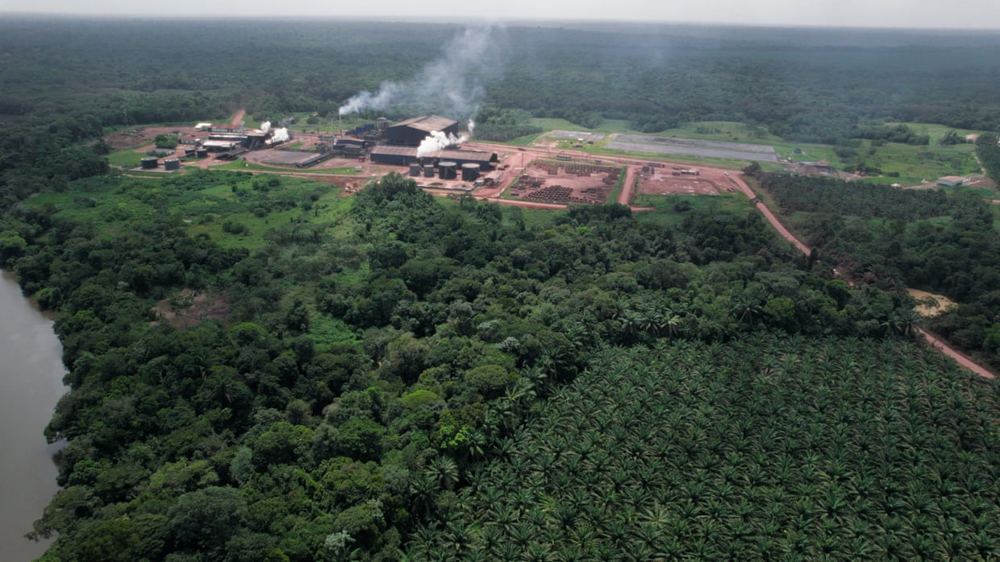
Yet, they say the worst came with the arrival of the palm oil industry in what is now the country’s most deforested state . Palm oil companies producing biofuels and supplying global customers, subsidised by the federal government, have laid claim to ever larger tracts of traditional quilombola territory over the past two decades.
Since then, Dias dos Santos says, the companies have put up mazes of fencing , guard towers and security checkpoints , sometimes cutting communities off from their family cemeteries. Leaders who attempted to speak out for their land rights and against toxic industrial waste were often either jailed or gunned down in ambushes that went unprosecuted.
Now quilombolas fear the second round of Brazil’s presidential elections will heighten the threat to the forest and its people. Many say a victory for Flavio Bolsonaro, the son of the imprisoned former president Jair Bolsonaro , would make securing the formal recognition of their land rights “impossible”.
Dias dos Santos was barely seven years old when loggers forced his and other quilombola families to flee their homes near an abandoned sugar mill, where their enslaved ancestors once worked.
After the loggers came the palm oil industry. With government encouragement , the industry set out to acquire large tracts of land in northern Pará. Today, about 202,000 hectares (500,000 acres), much of it near the Acará River, are used to produce palm oil for biofuels and a wide range of foods.
For years, quilombola communities complained that the companies were squeezing them off their traditional lands. They also claimed their families were being affected by a toxic chemical byproduct of palm oil production, which also plagued the Acará River with bloated, dead fish.
Quilombola activists who led protests and failed attempts to reclaim land met violent ends. One leader, Artemio Gusmão, was decapitated and dismembered ; another was shot 16 times in the back. “We were frightened,” Dias dos Santos says.
Tensions between the quilombolas and the palm oil companies increased in 2020 after Brasil BioFuels (BBF) took over a large operation in the region. It built a complex of fences, gates and watchtowers guarded by private security guards and began systematically filing more than 1,000 police reports accusing quilombolas of making threats, damaging property and stealing its equipment.
While many displacement cases in the Amazon end with companies forcing traditional communities off their land, the Acará quilombolas were different. The community acted to reclaim what they said was their land with a human blockade, then established borders that made it impossible for a palm oil company operating there to enter.
Behind their own security gates, the quilombolas began reforesting and restoring biodiversity to lands once degraded by palm oil monoculture. They built schools, community centres and hundreds of homes, despite a campaign to evict them.
In one incident in late 2021, BBF’s security chief, Walter Romero Ferrari, led scores of armed men to break up a demonstration against the company. Court records say that the armed men tied protesters’ hands behind their backs and used pepper spray on them. Ferrari and another BBF executive were eventually charged with torture (the case is still pending).
That event convinced the quilombola community members to pursue more radical forms of resistance: they planned to block BBF’s main entrance, a controversial move that many feared would lead to arrests.
On 24 February 2022, Dias dos Santos and others arrived at BBF, padlocked the gate, and refused to move, despite their lack of weapons against armed guards. BBF representatives later accused them of threats, which they deny. The quilombolas declared they would no longer allow the company to harvest palm fruits and insisted they owned the land behind the gate.
Over months, accusations of violence and theft arose, but the blockade endured, with the community expanding checkpoints and building infrastructure using income from selling palm fruit.
Finally, the courts have not only refused to enforce most of BBF’s land claims, but one key government body has already ruled that the quilombolas have a valid right to much of the land they have reclaimed.
They have also rejected eight of nine requests by BBF to lay criminal charges against Dias dos Santos. The exception, a charge of theft for allegedly disarming a BBF security guard and then turning the guard’s gun over to local police for safekeeping, is being contested.
In a 2024 interview, Milton Steagall, BBF’s chief executive, portrayed himself as a job creator and an environmentalist, combating deforestation by planting palm trees.
He rejected the idea that BBF had stolen land, saying that it acquired another palm oil company that had operated in the area for more than a decade. Steagall also presented the company as the victim of fraudsters who were falsely claiming Indigenous identity as a ruse to justify land theft.
“Imagine that I’m being accused of something that was planted 10, 12 years earlier and I’m responsible for having planted it in an Indigenous or quilombola area? Does that make sense?” he asks.
By 2024, BBF was struggling to pay its employees, and a court in Pará declared it bankrupt and put it into a corporate rescue procedure last year. New palm oil companies are leasing BBF’s former plantations next to the Acará community’s land.
In a statement, BBF’s lawyers said Steagall maintained his 2024 position that “the company entered into a palm cultivation activity that had already existed in the region for years”, and that this did “not mean that there are no territorial claims or controversies over areas in the region.
“The location, boundaries and legal status of each property require individual examination of the documents and the procedures conducted by the competent authorities,” the statement said, adding: “BBF respects the rights of communities and maintains that no accusation regarding a specific area should be treated as an established fact without such verification.”
The campaign marked the quilombolas’ first victory against biofuel companies in the region. About 2,300 community members have gained control over nearly 32,400 hectares formerly cultivated by BBF.
Yet, in the region, conflict between local communities and the palm oil industry is not limited to the quilombola communities or the Acará municipality. The Tembé and Turiwara Indigenous communities in Tomé-Açu, Moju and Tailândia also face another large producer operating on 22,972 hectares, 18,203 of which the quilombolas claim.
In a provisional ruling , the local court has already ruled partly in favour of the communities, finding that 72% of the disputed land overlaps with areas belonging to quilombola and riverside communities. The ruling has also led to the cancellation of 24 land registrations.
Independent reports by the Pastoral Land Commission (CPT), a Catholic advocacy organisation, indicate that at least four deaths, attempted murders, and 14 death threats have been recorded in the region.
For all these reasons, the Acará community says victory is far from assured. Dias dos Santos fears for his life and says they continue to repel violent attempts to evict them and are still awaiting formal property titles.
“I know that the risk of being killed is very high,” says Dias dos Santos, who travels in three-vehicle convoys for protection and relays his movements to other community members, who track him using a GPS app for security reasons.
The future may be uncertain, but for now, Dias dos Santos and his people are confident. “Our grandparents decided not to fight because they would die. Now, if we fight back, we run the risk of dying, too. But we have a mobile phone, where we can learn about our rights and report things,” he says. “So we have a chance of staying alive.”