Tour de France 2027 routes revealed with British stages, time-trials and a volcano
Next summer’s men’s and women’s race will start in Edinburgh and Yorkshire respectively
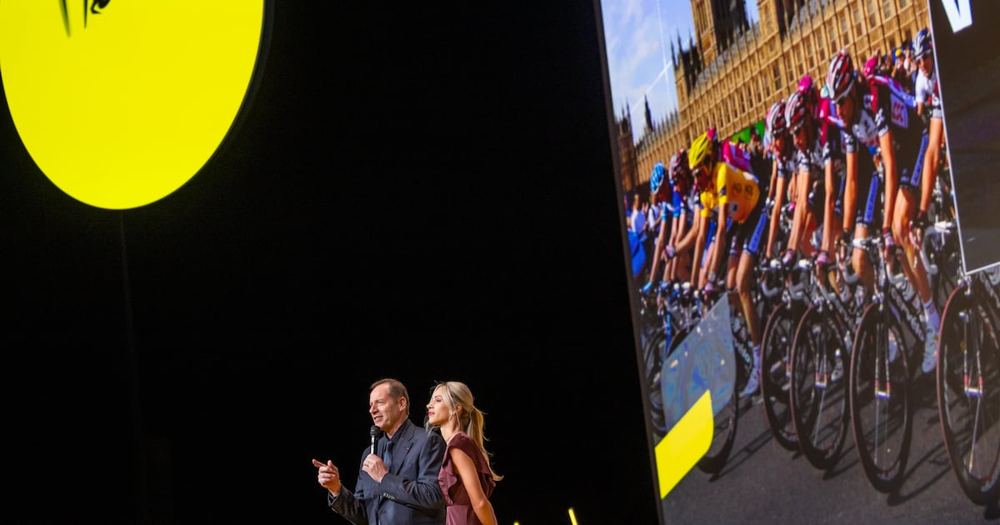
The most ambitious Grand Départ in the long history of the Tour de France was unveiled in Paris on Thursday as race organisers fleshed out the details of next summer’s men’s and women’s race starts in Edinburgh and Yorkshire.
Over six days of racing, Scotland, England’s Lake District and Peak District, Lancashire and Yorkshire, Wales and central London will be taken over by the snaking race caravan on a route that is expected to lure millions to the roadside.
Christian Prudhomme, the men’s Tour director, said he expected “a warm and massive welcome for the champions”. “From the start at the foot of Edinburgh Castle, the northernmost in the history of the Tour, to a team time trial in London, Great Britain offers us a symbol that further ties the two races together,” he said.
The sports minister, Stephanie Peacock, confirmed that £65m (€78m) has been allocated to fund the six stages and said the Tour’s visit would “shine a spotlight on women’s cycling like never before”.
The men’s race starts in Edinburgh on July 2nd and finishes in Paris on July 25th, with a final stage that maintains the tradition of racing up and over the cobbled streets of Montmartre.
Paul Bush, managing director of Grand Depart GB, has big ambitions of his own for the race. “One of my aspirations will be to turn the UK yellow next year, for two weeks, so everybody is in yellow,” Bush said. “Now that would be pretty special.
“Now that would beat 2014. Not that I’m looking to beat 2014, because it’s not a competition. But if we could encourage everybody, workplaces, communities, old age pensioners’ homes, schools, everything to become yellow, I think that would really embrace the thing.”
In fact, the men’s Tour will begin and end on cobblestones. From the Royal Mile to the Champs-Élysées, the peloton will cover 3,479km of racing and take in two individual time trials, three summit finishes and a denouement in the climbs of the Pyrenees.
The first British stage, from Edinburgh to Carlisle, will head through Midlothian and the Borders, while stage two, from Keswick to Liverpool, will cover 223km and take in Lancashire’s Trough of Bowland before finishing on Liverpool’s waterfront.
After the transfer across the Channel, the peloton races across central France, from Cherbourg to the Jura, for the first summit finish on the Grand Colombier, followed by mountain stages to Sallanches and Les Saisies.
From the Rhone Valley, where the furnace conditions that characterised this year’s race are likely to return, the convoy heads into the Cévennes and the Tarn for finishes in Mende and Albi.
The second time trial is centred on Toulouse and comes before two brutal Pyrenean stages, the first crossing the fearsome Col du Tourmalet before a finish on the Col du Portet, and the second, to Laruns, taking in four major ascents and almost 4,500 metres of climbing.
The Tour de France Femmes begin in Leeds on July 30th, 13 years after the men’s race staged its 2014 Grand Départ, with an opening stage from the Headrow to a likely sprint finish on Deansgate in Manchester.
The next day’s challenge, from Manchester to Sheffield, includes both Winnat’s and Snake Pass on a route which features almost 3,000 metres of climbing and which race director, Marion Rousse, saw as the cornerstone of “the hardest opening in the history of the women’s race”.
But the showpiece stage will be in central London, with an 18km team time trial, routed from Westminster to The Mall, taking in Tower Bridge, St Paul’s Cathedral, Trafalgar Square and Buckingham Palace.
London’s mayor, Sadiq Khan, said the Tour’s visit would “not only cement London’s status as the undisputed capital of women’s sport, but also inspire more people to take up cycling, as we build a better, greener London for everyone.”
After the transfer to northern France, the women’s peloton heads south, via Calais, Magnanville and Bourges to a first mountain finish at La Loge des Gardes, before a hilly penultimate stage through the Auvergne to Clermont-Ferrand. The nine-day race climaxes on the steep volcanic Puy de Dome, after a stage that includes almost four thousand metres of climbing.
Both routes were unveiled at Porte Maillot even as curfews remained in place in some parts of central Paris, including Place de la République and Les Halles. The French media described the nation as sinking “deeper into crisis”, but in the aftermath of the Covid pandemic and the controversies of climate change, the Tour has become well-versed in facing down adversity and threats.
However, disruption, due to both civil unrest and extreme temperatures, remains possible. Race organisers ASO faced a similar situation in July 2023, when climate activists and rioting threatened the race. That year, Prudhomme said the Tour was “in constant liaison with the state” and would “adapt if needed”., Guardian