How one of Europe’s most polluted cities became a blueprint for nature restoration
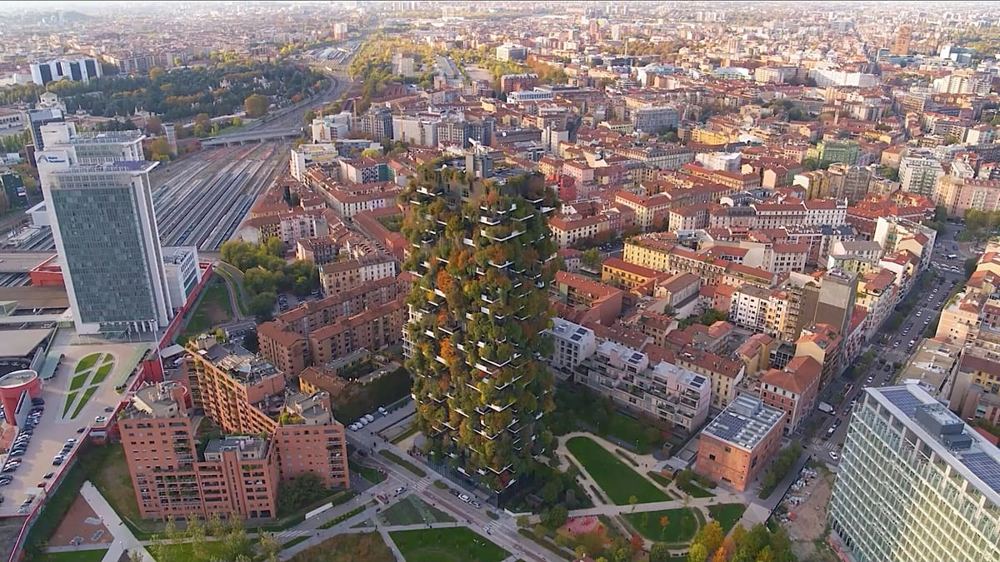
350 football pitches’ worth of degraded urban areas have been restored.
One of Europe’s most polluted cities is getting a verdant makeover. Three million new trees and shrubs will take root in Milan over the next four years, helping to purify its smog-cloaked streets.
An October air quality ranking placed the Italian metropolis seventh in the world’s top 10 most polluted cities, the only European entry on IQAir’s list . This is partly down to its location in the low-lying Po Basin, which limits air circulation, combined with intensive agriculture and emissions as it is an industry-heavy region.
Fondazione Forestami, the organisation behind the project, says more greenery on streets, rooftops and facades is the cheapest and most effective way to filter fine dust, cool the city and improve residents’ wellbeing.
Since it began in 2019, the urban reforestation project has planted nearly 640,000 trees and shrubs, earning its creator, Italian architect Stefano Boeri who built Milan’s famous vertical forest, a European Lung Foundation (ELF) award for his work and commitment to improve air quality.
Now, the project has gained a new accolade: status as a UN World Restoration Flagship. The honour was announced on 29 October during the UN Biodiversity Conference (COP17) in Yerevan, Armenia.
The UN Environment Programme (UNEP) says the title recognises Milan’s efforts to bring nature back into “one of Europe’s most densely populated and polluted metropolitan areas”, by “planting roughly one tree for every resident” and restoring about 350 football pitches’ worth of degraded urban areas.
“The initiative is expanding access to green space, engaging schoolchildren and restoring sites including former industrial areas, parking lots and storage yards,” said UNEP in an announcement.
“The World Restoration Flagships… recognise ambitious and promising examples of large-scale, long-term restoration and contribute to global commitments to restore one billion hectares of degraded ecosystems by 2030.”
Forestami was one of just five projects to receive the title at COP17, and the only one in Europe.
Other recipients include Colombia’s wetland restoration initiative, Urban Nature Reborn; the Green Seattle Partnership, a scheme to restore and maintain the US city’s parklands; Ethiopia’s Great Rift Valley Renaissance, reviving one of the Horn of Africa’s most degraded forest landscapes; and China’s Blue Bay Restoration initiative, a large-scale effort to restore the country’s coastal and marine ecosystems.
On the same day as the Milan announcement, UNEP published a landmark assessment of global ecosystem restoration progress.
It found that 252 million hectares across 149 countries are being restored, the largest documented global restoration effort to date.
“Today, we are witnessing the makings of one of the largest movements for nature in recorded history,” says Inger Andersen, Executive Director of UNEP. “Yet, at the halfway point of the UN Decade on Ecosystem Restoration, we are still not restoring nature at the scale or speed required.”
There is mixed progress towards the ‘ 30x30 ’ goal to protect at least 30 per cent of Earth’s degraded land and sea by the end of the decade.
Restoration of terrestrial ecosystems has reached nearly half the global target, while progress in freshwater, marine and coastal ecosystems, which are degrading at the fastest rates, is lagging . Annual restoration finance, meanwhile, must more than quadruple.
Ecosystem restoration is essential for food and water security, climate resilience and human health.
Restoring just 15 per cent of global priority areas could capture and store 30 per cent of carbon dioxide equivalent emissions since the industrial revolution and help avoid 60 per cent of species extinctions.
Reaching global targets could also generate up to an estimated 32 million new jobs worldwide by 2030, according to UNEP.
“We cannot expect to fix nature with one hand while we destroy it with the other one,” says Astrid Schomaker, Executive Secretary of the Convention on Biological Diversity (CBD) Secretariat, which co-published the report. “Governments must address the drivers of ecosystem degradation and invest in monitoring mechanisms to ensure the durability of the restoration movement to date.”
The report says governments now need to look beyond individual projects and build “restoration economies”, where sustained recovery also supports jobs and livelihoods in the long run.