The Mad Lover review, eccentric charm and baroque brilliance as duo move from Eccles to Indiana Jones
Smith Square Hall, London Part of the London Festival of Baroque Music, lutenist Thomas Dunford and violinist Théotime Langlois de Swarte’s concert struck a balance between freewheeling music-making and precise virtuosity The Mad Lover was a 1616 play with incidental music by the English composer John Eccles. But, as the lutenist Thomas Dunford explained, we didn’t really need to know that: he and the violinist Théotime Langlois de Swarte just liked the title. You can imagine it fitting many more programmes this duo might play together in the future – as they surely should, judging by the amou
Smith Square Hall, London Part of the London Festival of Baroque Music, lutenist Thomas Dunford and violinist Théotime Langlois de Swarte’s concert struck a balance between freewheeling music-making and precise virtuosity
T he Mad Lover was a 1616 play with incidental music by the English composer John Eccles. But, as the lutenist Thomas Dunford explained, we didn’t really need to know that: he and the violinist Théotime Langlois de Swarte just liked the title. You can imagine it fitting many more programmes this duo might play together in the future, as they surely should, judging by the amount of fun they were having here.
The two recorded this 75-minute programme of music by Eccles and his 17th-century contemporaries back in 2020, but this performance of it was their first in London. It was part of the week-long London Festival of Baroque Music, the last before a two-year break while the festival’s venue, Smith Square Hall, is refurbished, and struck a balance between freewheeling music-making and precise virtuosity.
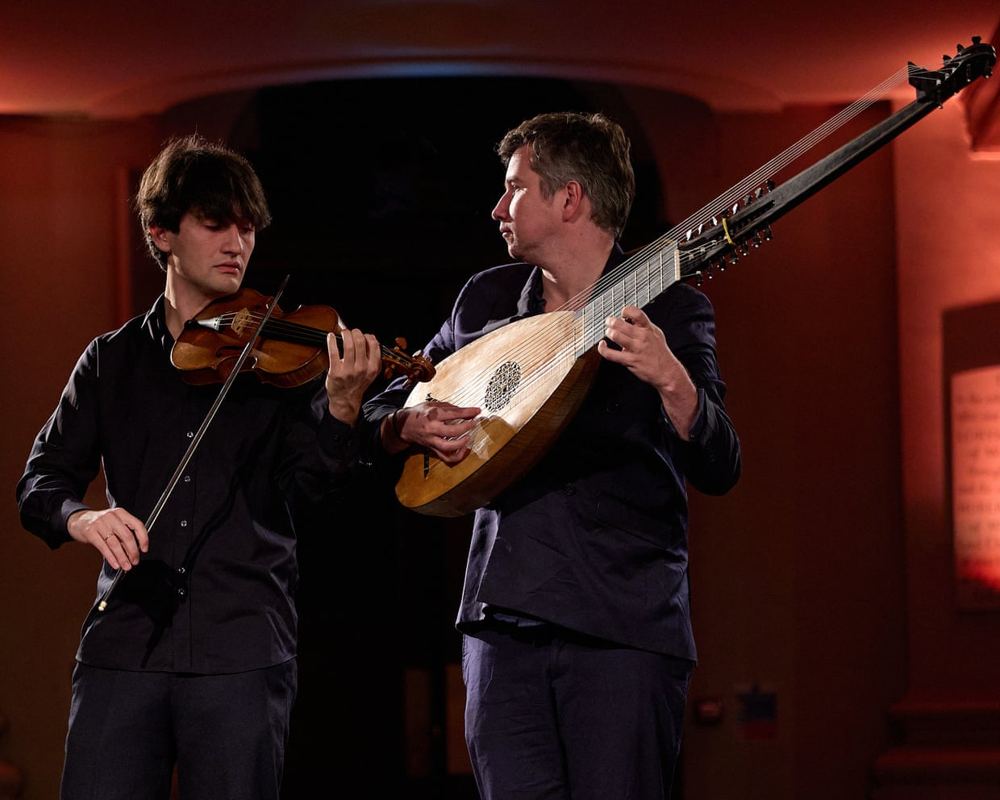
The hall was set up with a low platform in the centre, the audience on all four sides. The musicians walked in playing, the neck of Dunford’s lute swinging over our heads, Langlois de Swarte’s violin tone muscular yet sweet. An Eccles Aire gave way to a sonata by Daniel Purcell, then to an improvisation from Dunford, one of many: sometimes authentically baroque, sometimes expressing a more modern melancholy. Dunford also played the troll, throwing in snippets of Indiana Jones or Radiohead to make his colleague laugh.
One of Dunford’s reveries morphed into the familiar repeating harmonies of La Folia, the 12-bar blues of the baroque period, here in a piece by the obscure London composer Nicola Matteis. The Fantasia in A minor by his son, Nicola Matteis Jr, was a web of chords delicately seesawing back and forth across the strings, and should be every violinist’s next encore. In Matteis Sr’s C Major Suite, one of Dunford’s lute strings unfurled, but he worked around it so skilfully that you could barely tell.
Finally, Dunford persuaded an unusually willing audience to sing, thus providing harmonies first for a Henry Eccles piece drawing on a tavern song, then for a mystery encore based on JS Bach: the Beatles’ Blackbird, a song that can’t help being beautiful, and a fitting sign off given this concert’s eccentric charm.