A Freak Outside the White Cube: Meet Kolya Nemoi
Artist Kolya Nemoi on his REFERENCE Festival collaboration with Munky of KoЯn, moving between painting, tattoos and merchandise, and why he feels like a freak outside the white cube. The post A Freak Outside the White Cube: Meet Kolya Nemoi appeared first on …
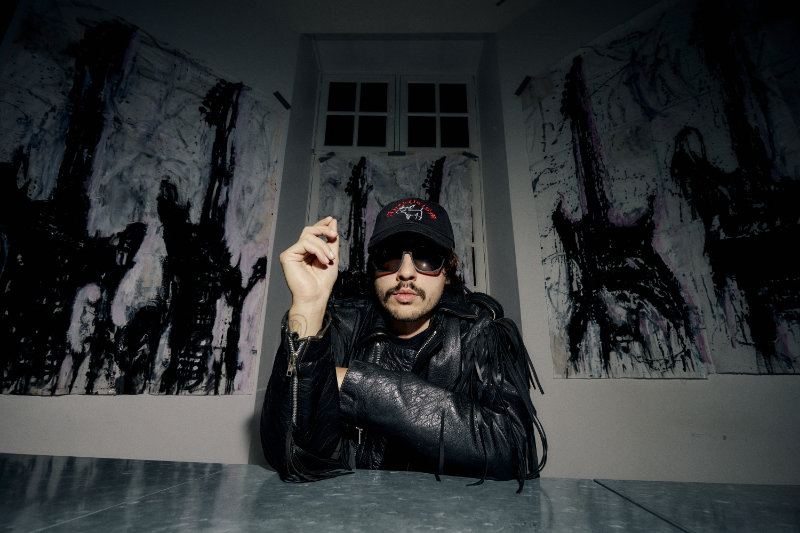
We met artist Kolya Nemoi in Paris during the REFERENCE FESTIVAL , where he showed his work at Dover Street Market, alongside a meet-and-greet and merchandise signing with Munky , guitarist of nu metal band KoЯn , whose latest merchandise features designs by Nemoi and Norwegian artist Bjarne Melgaard. The encounter brought together worlds that have long shared a visual language, from the graphic intensity of heavy music to the imagery and aesthetics of underground art. Nemoi’s presence at the event offered a starting point for a conversation about the connections between creative disciplines and the personal ties we share. While music merchandise served as a canvas for artistic expression for this particular collaboration, it made me wonder, in the city full of pieces that have marked their place in history, what the place of art within contemporary and/or underground culture is and looks like today from the perspective of one young artist.
You started exploring art at a young age growing up in Ukraine. Your practice moves between painting, drawing, tattoos, fashion, and other forms of visual expression. Looking back, which experiences do you think shaped you the most? Is there a version of yourself from those early years that you still recognize in your work today?
The biggest influence on me was the fashion boutique where my mother worked. I used to spend my time there after kindergarten, surrounded by clothes, mirrors, and this almost empty space. My job was to fold the clothes. I see it all as a really cool leather jacket, where every chapter of artistic expression adds its own layer of wear. Who the fuck needs a new leather jacket anyway? I feel like I got stuck in that version of myself, where I’m still the same young boy looking at everything with wonder and childlike curiosity. It’s a gift.
Your work often explores darker imagery and the more mysterious aspects of human experience. What draws you towards these subjects?
I think these subjects resonate with the time I found myself living in, so they feel quite organic to me. The funny thing is, they don’t really seem dark to me. I find them rather cute. I remember the feeling of being scared for the first time. It was an incredible feeling, allowing me to imagine and experience something that would normally be impossible, without actually being harmed by it.
For a long time, I was paving a path by making hundreds, and now thousands, of drawings. At some point, I started noticing certain patterns repeating themselves. These repetitions became a starting point for connecting my work to art history, my personal experience, and the environment in which I was formed. In a way, the subconscious slowly unfolded itself through repetition. But I really love the fact of unexpectedness. Something will always go differently than we expected it to.
Music has always had a close relationship with visual culture, from record sleeves and band merchandise to the imagery surrounding entire musical movements. What place does music occupy in your life, and how has it influenced your visual language?
I used to collect a lot of CDs, and I was especially fascinated by the booklets inside the cases. I think they had a certain influence on me. I was a vocalist in a punk band and an MC in a nightclub, so music has always been a part of me. For three years, I didn’t listen to music at all. It was a period when I shifted towards the visual. Still, I see my visual language as mute. It exists in silence.
Are there particular musicians, bands, or music scenes that have shaped your way of seeing things?
I was heavily influenced by the sound of Dirty South and Memphis rap, as well as Kyiv’s electronic music scene, especially electro and dark EBM sounds. When I was 12 and skateboarding with my friends, we were fucking obsessed with Death Grips!! When I started tattooing at around 16, I discovered more metal music. I made cover art, drew designs, and made banners for concerts for some people. One of my more recent discoveries was Jimmy Smack, the founder of Deathrock, who a friend introduced me to.
You collaborated with Munky from KoЯn on merchandise featuring your designs that were presented at Dover Street Market Paris as part of FREIE KUNST. How did this collaboration come about?
I was on FaceTime with Mumi Haiati and showed him the broken guitar sculpture, along with my sculptures dressed up like metalheads. Mumi had the idea of showing my work to Munky, and it resonated with him. The pieces we included in the collaboration with Munky felt like a continuation of elements that were already there in my work. It felt like a shared synchronization, as if we had found the same BPM. The whole process felt very organic, and I was given the freedom to do my thing. This summer, we also collaborated with Show Me The Body and HO99O9. I really enjoy working with these guys. These musicians are incredible, crazy, and have good souls.
When your artwork moves from a painting or a drawing onto something people can wear, does its meaning change for you? Your work tends to be portable; everything looks like it can be rolled up or folded up.
I rarely transfer my paintings onto clothing, because once an image is on a garment, it starts a dialogue with its surroundings. I see prints as an echo that can be heard in a particular moment, carried by someone passing by. Merchandise is also about belonging to a group of people. When you wear a band’s or musician’s merch, you’re showing your affiliation, love, or admiration. For me, clothing has become a way of communicating, an opportunity to start conversations and spread a message, like with my main print, End All War.
I don’t like keeping objects in one place. I like when they move around. My latest discovery has been painting on fabric, or what I call banners. This became especially interesting to me through the latest series presented in collaboration with Bjarne Melgaard. I’m fascinated by the idea of nomadic art-making. The war has left its mark on me in this way: I feel that at any moment, I might have to move somewhere else, so everything needs to be mobile. I think galleries should also start thinking about this.
Do you think the boundaries between art, fashion, music and design still have any real meaning today, or are they becoming increasingly artificial or is there still a certain elitism in the art world?
Oh yes, elitism in the art world is very tangible. You can feel it even when you leave the white cube. I sometimes wonder how art can claim to be about freedom while maintaining these boundaries. For me, tattooing and making merchandise were ways to survive while continuing to be an artist. They were incredible tools for letting people know that you exist, for showing people that you are here. I never wanted to put my practice on hold while waiting for the art world to knock on my door. I had to find my own way.
Do you feel as an artist you have a responsibility to challenge the way people see the world, or should the work be free from that expectation?
I see it more as my proposition, an opportunity to experience my universe. I wouldn’t want the viewer to be strapped to a torture chair like Alex in A Clockwork Orange.
You are now based in Lausanne; what is your relationship with the contemporary art world? Do you feel connected to the institutions and structures that define it, or do you find more freedom in the spaces that exist outside them?
I feel like a freak and an outsider here, and I think it’s an ideal environment for new ideas. At first, this used to bother me a lot, but now I feel like this path might actually be more interesting. This summer, I was supposed to curate a show for a bigger gallery in Zurich, but the gallery owner scammed me, or at least that’s how it feels. I guess that’s part of the reality too.
What are you currently exploring that feels unfamiliar to you?
For a long time, I used to leave a single figure in my work. It created a feeling of isolation and being marked out in some way. These days, I’m really interested in scenes with figures that create a dialogue within the space. I’m also working a lot with empty locations, with this feeling that a figure has suddenly decided to leave the space. I don’t have many painting skills, so if I manage to paint fire or light that actually glows through the paper, that would be a success for me hahaha. Just like Prometheus.
Finally, if you could spend a day inside the mind of another artist, musician, or creative figure, living or dead, whose mind would you choose?
Sometimes I struggle to deal with my own demons, so I’m not sure I’d want to face someone else’s as well. But I think it would be fascinating to spend a day inside the mind of Screamin’ Jay Hawkins.