World’s biggest wave machine tests resilience of salt marshes
Dutch researchers discover sections of coastal wetland suffer remarkably little erosion after 21 hours of powerful waves Researchers in the Netherlands have investigated how salt marshes withstand powerful storms using the world’s biggest wave machine. As sea levels rise and storms become more powerful, salt marshes could play an increasingly important role in coastal protection. A crucial question is whether severe storms will wash away vegetation and sediment from salt marshes and reshape the coastline, or whether marshes can act as a barrier. Continue reading...
Dutch researchers discover sections of coastal wetland suffer remarkably little erosion after 21 hours of powerful waves
Researchers in the Netherlands have investigated how salt marshes withstand powerful storms using the world’s biggest wave machine.
As sea levels rise and storms become more powerful, salt marshes could play an increasingly important role in coastal protection. A crucial question is whether severe storms will wash away vegetation and sediment from salt marshes and reshape the coastline, or whether marshes can act as a barrier.
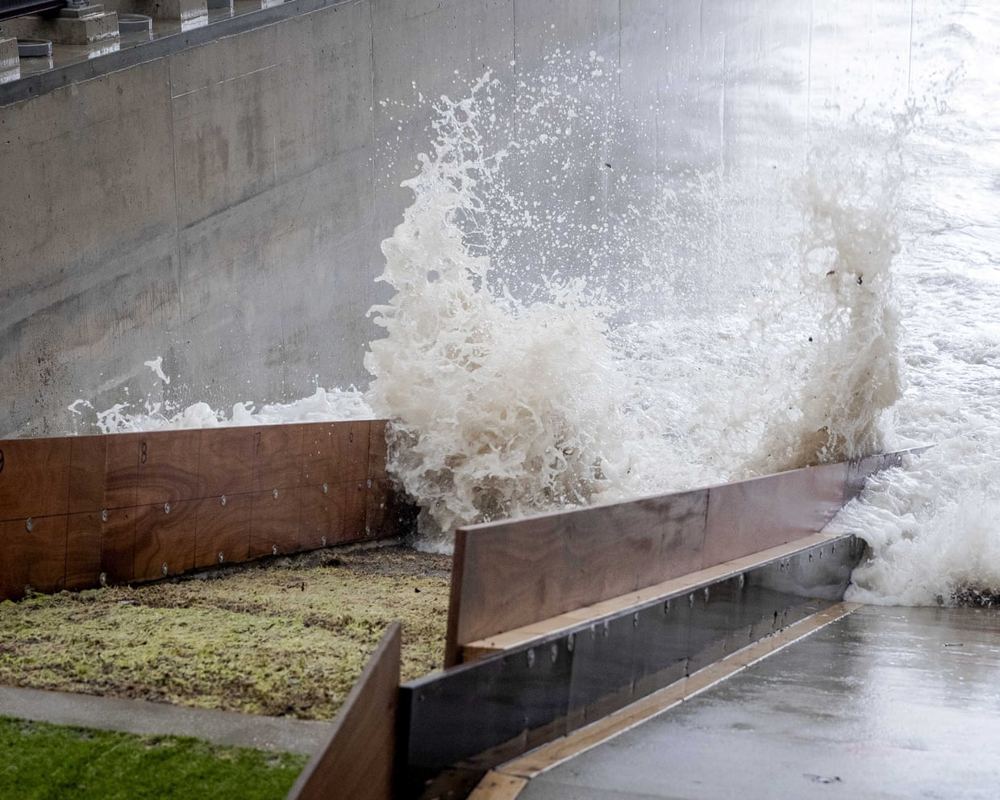
The Delta Flume, just outside Delft in the Netherlands, is a hydraulic testing facility with a concrete trough 300 metres long, 9.5 metres deep and 5 metres wide. At one end, four big pistons drive a wave board backwards and forwards, producing waves up to 4.5 metres high.
For the experiment, researchers transplanted intact sections of salt marsh into the Delta Flume and exposed them to waves of increasing power. After 21 hours of wave action, the surface had been eroded by an average of about 7mm.
Up to two-thirds of the vegetation also survived the battering. Researchers were surprised at how little damage the plants sustained, and how effectively they reduced the energy of the waves.
The findings, due to be published in Nature, suggest that salt marshes can provide important coastal protection from huge storms.