What is the EU-UK youth experience scheme and when will it start?

The agreement will allow young people between 18 and 31 year-olds to travel, work or study in the EU for up to three years.
The UK and EU have agreed a youth experience scheme which will allow a limited number of 18 to 31-year-olds to work, study or travel in the European Union for up to three years.
Every year, 100,000 Britons will be able to participate in the scheme, with a reciprocal arrangement for 100,000 EU citizens.
A joint EU-UK statement says the scheme is due to launch no later than January 2030.
The numbers for both those coming to and from the EU will be allocated among the member nations according to each country's population.
UK participants will initially be able to apply to travel to one particular EU country but can later switch to a different one, staying in a total of three countries during their three-year stay. However, they must spend 12 months in one country before switching.
Visas issued by the EU or the UK will initially be valid for two years, with an option to extend for one more year.
Neither UK nor EU citizens will be able to access benefits while abroad or bring dependants such as children.
Participants will need to pay an application fee and prove they have enough money to support themselves during their stay.
There are currently no details on what application fees UK citizens will have to pay, but the EU currently charges â¬90 (£75) for short-term visas. Numbers vary between countries for longer-term stays.
The UK charges £340 for its other youth mobility schemes, in addition to a £776 annual health surcharge.
The UK government has not said how much money an EU or UK national needs to have access to in order to take part but for similar schemes the figure is £2,530.
The UK already has youth mobility schemes in place with other countries, including 45,000 places for Australians, 8,500 for New Zealanders and 1,000 for Icelanders.
In 2024, 24,400 out of a possible total of 81,100 youth mobility scheme visas were issued by the UK.
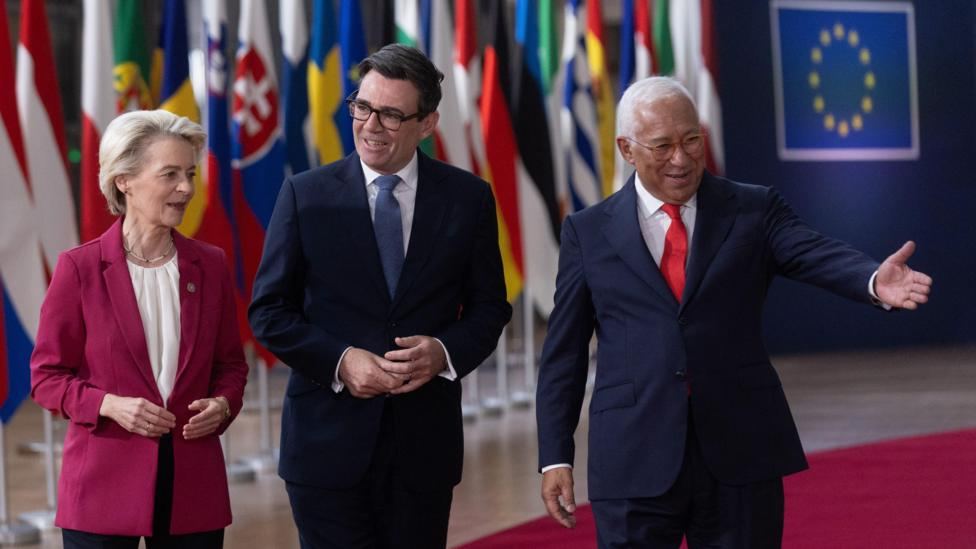
Speaking at a joint press conference with EU leaders, Prime Minister Andy Burnham said: "These opportunities open horizons, and they create friendships that will last a lifetime.
"So it's a very emotional moment because these are the young people that will shape our future."
One sticking point in the negotiations had been tuition fees and the EU's request that Europeans studying at UK universities should pay the same as British students.
A typical undergraduate degree in the UK (excluding Scotland) costs up to £9,790 a year for a domestic student, while the cost for international students, including those from the EU, can vary from around £11,000 to £38,000.
If the UK did agree to reduce fees for EU students, British higher education institutions could lose out financially.
British students at European institutions pay non-EU rates, but these tend to be lower than in the UK, ranging from â¬1,000 to â¬20,000 per year.
The UK and EU have not reached an agreement on the issue, but the joint statement says the two sides will continue working towards a deal and conclude negotiations by May 2027.
The two sides have also agreed to continue discussions about the UK's participation in the Erasmus + programme.
The initiative provides funding for students, teachers, youth workers and sports professionals to study or do work experience in the EU.
The UK left the scheme in 2020 but last year the government re-joined for the 2027/28 academic year only, making a £570m contribution to the scheme.
In the statement released on Friday, the EU and UK agreed to explore opportunities "beyond 2027".
Some UK politicians had argued that the youth mobility scheme would disadvantage young people in the UK.
Conservative Party leader Kemi Badenoch said: "I don't think it's fair because it means that more young people are coming here to compete with our young people who are struggling to get jobs."
Speaking in the House of Commons on Thursday, Reform UK's Suella Braverman asked: "Why...are the government proposing to open the doors to hundreds of thousands of young Europeans who will come here and work in our shops and restaurants?
"Is that not a total and utter betrayal of young people in this country?"
Defending the government, Work and Pensions Secretary Pat McFadden has argued that countries in the EU with greater freedom of movement than the UK had lower youth unemployment rates.
The Labour government has made tackling the large number of young people not in education, employment or training (Neets) a top priority.
Alan Milburn, in his government-commissioned report into Neets, expressed concern about an "over-dependence" on foreign labour in the last 20 years.
He said the recent fall in net migration had created "an opportunity for employers to reorientate back towards employing young people from their communities".
Burnham's first taste of EU deal-making unlikely to be his last
UK and EU agree new deal for food exports, youth mobility and emissions but student fee talks to continue