Hark! Errollyn Wallen’s glittering nativity opera A Christmas Miracle is a credit to Britten’s community vision
Orford church, Suffolk Performed in the venue where Noye’s Fludde premiered and based on the same text, this festive new work shines with exuberant young performers, distinctive singalongs, lustrous designs and the spirit of mucking in When Benjamin Britten wrote Noye’s Fludde, he essentially invented community opera. Bringing professionals together with enthusiastic local amateurs, everyone mucking in to play, sing and make sets and costumes, isn’t only great fun; done right, it fosters a love of music-making that can last a lifetime. Such projects, the composer declared with his best sociali
Orford church, Suffolk Performed in the venue where Noye’s Fludde premiered and based on the same text, this festive new work shines with exuberant young performers, distinctive singalongs, lustrous designs and the spirit of mucking in
W hen Benjamin Britten wrote Noye’s Fludde, he essentially invented community opera. Bringing professionals together with enthusiastic local amateurs, everyone mucking in to play, sing and make sets and costumes, isn’t only great fun; done right, it fosters a love of music-making that can last a lifetime. Such projects, the composer declared with his best socialist hat on, created works that were “useful to the living”.
For decades, Britten contemplated a nativity opera, which somehow never transpired. Now, Errollyn Wallen , Master of the King’s Music, has filled the gap. A Christmas Miracle, co-produced by Mahogany Opera and Britten Pears Arts, sets texts from the same Chester mystery plays that inspired Noye’s Fludde, and premiered in the Orford church that Britten chose in 1958.
The dramatisation of Christ’s birth in pungent Middle English is full of earthy theatrical ingredients, allowing audiences to laugh along with rustic shepherds, boggle at exotic wise men, grumble at oppressive tax collectors and cheer as wicked King Herod is dragged down to hell. Wallen’s wide-ranging score glitters with iridescent pianos and percussion and, it should be said, is chock-full of tricky corners. That close to 150 performers and production staff were able to pull it off, a few wobbles aside, was testament to the commitment and hard work this kind of project inspires.
The 10-strong Ensemble X, under the unflappable John Andrews, was supplemented by handbells, fiddlers and west African drums. Bristly harmonies and occasionally thorny vocal lines gave way to exuberant choruses for the younger singers. In true Britten fashion, Wallen incorporates distinctive arrangements of traditional Christmas hymns, several of which required the audience to sing along. O Little Town of Bethlehem and We Three Kings found us on solid ground. A medieval French carol was perhaps a bridge too far.
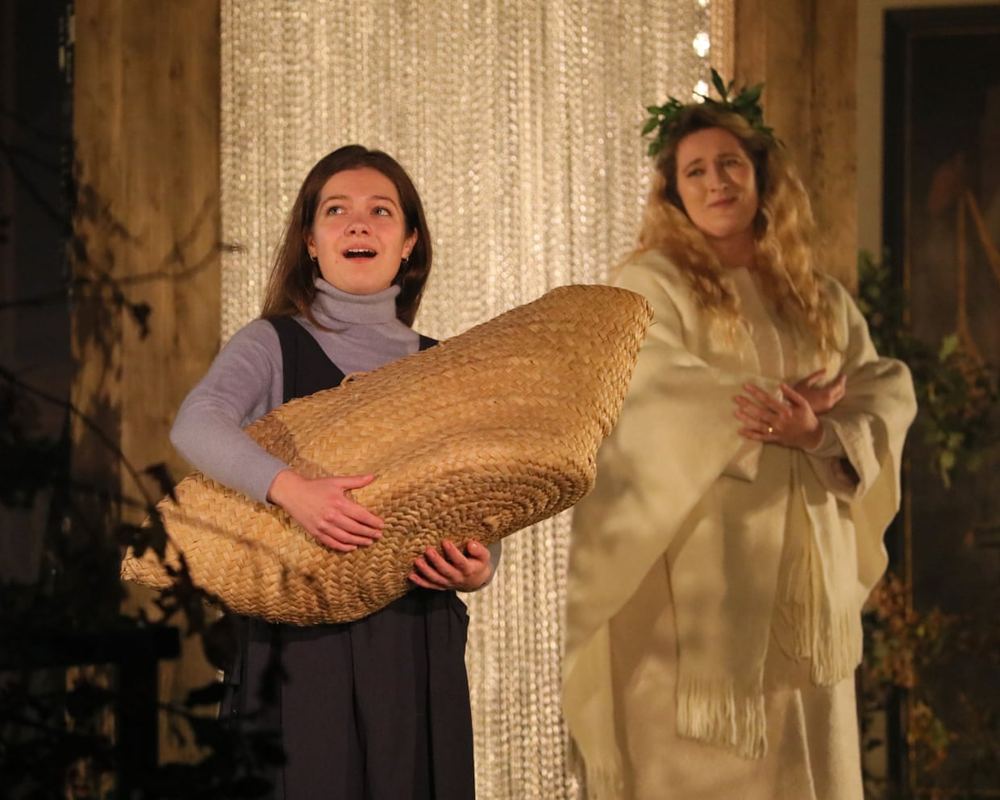
Frederic Wake-Walker’s staging was a Christmas miracle of its own. The holy family was variously aided and impeded by choruses of shepherds (from local youth group Jubilee Opera ), sheep, angels, midwives, mothers, knights, demons, camels, an ox, an ass and even a flock of sparrows (Ruth Paton’s mouthwatering designs included wicker animal heads and a lustrous star enrobed in mistletoe). Ensuring their safe progress around the body of the church was a masterclass in traffic control. On the minus side, the text was sometimes hard to grasp.
Among a plucky company, Hilary Cronin stood out as a strikingly authoritative Angel Gabriel, with sterling support from Alexander Semple’s forthright Ioseph, Angela Tait’s mild-mannered Mary, Andrew Watts’ fiendish Herod and a commanding trio of kings. Nick Mercer nearly stole the show as the snarling master of ceremonies. It was the young performers, however, who took that honour, singing with clarity and confidence and, in short, embodying the ebullient spirit of community opera.