12 Best Museums That Could Only Exist in LA
Trust us, the City of Angels is also a city of great culture—here's where to find it.
Despite its robust cultural and academic scenes, Los Angeles doesn’t have a particular reputation as an intellectual city, blame it on ‘80s movies and reality TV, but the bleach blonde-and-himbo reputation precedes it. (I mean, the beach is right there. ) But the abundance of museums is just one reason that the stereotype can’t be trusted. There's a museum here for every age and obsession, whether you're into film history, contemporary art, dino bones, or the mythology of the American West. In fact, some museums here are unlike any other in the world, institutions that couldn't exist anywhere else, rooted in the particular history, geography, and cultural mix of Southern California. Some are concentrated on the Museum Mile stretch of Wilshire Boulevard, others are farther flung in the hills. (There are even more than this list could contain, the Norton Simon, the Museum of Jurassic Technology, and the California Science Center, to name a few, that are still worth seeking out.) Oh, and if the sheer number of museums makes your wallet shiver, don’t fret: Many of the museums here are free.
Below are the best museums in Los Angeles, to prove this is not city of airheads.
Read our complete Los Angeles travel guide here , which includes:
LACMA is a concrete marvel by Peter Zumthor fronted by Chris Burden's “Urban Light” street lamp installation.
The Los Angeles County Museum of Art is one of the most important museums in the American West. “Encyclopedic”, as it describes itself, the museum takes a kitchen-sink approach: ancient works, contemporary masters, and everything in between. It recently reopened in the new David Geffen Galleries, a concrete marvel designed by starchitect Peter Zumthor, framing everything in just the right amount of California light. Before you head inside, snap a selfie with Chris Burden’s “Urban Light” (a dramatic cluster of old-timey street lamps) or steel yourself to walk underneath Michael Heizer’s “Levitated Mass,” a 340-ton boulder suspended over a narrow walkway.
CAAM admission is free, with access to three galleries, a theater, and a research library.
The California African American Museum is one of Los Angeles's most essential cultural institutions. Tucked near Exposition Park, a few steps from the Natural History Museum, CAAM packs serious range into three exhibition galleries, a theater, and a research library with over 20,000 artifacts and books. The programming casts a wide net: archival shows chronicling Black Californians in labor and queer movements, contemporary work from artists like Sadie Barnette and Awol Erizku, and a permanent collection featuring traditional African sculptures and masks to the work of California legends like Betye Saar and David Hammons. Best of all, admission is free.
For contemporary art in Los Angeles, all roads eventually lead back to MOCA. Founded by local artists in 1979, the museum's 8,000-piece collection, think Agnes Martin, Nam June Paik, Jackson Pollock, Mike Kelley, can go toe-to-toe with any major institution in the country. Start at the Grand Avenue location, reward yourself with lunch in Little Tokyo , then catch what's on at the Geffen Contemporary. The exhibition program has been humming lately, from Olafur Eliasson's dazzling light installations to the US debut of Wael Shawky's Drama 1882 , which was a showstopper of the Venice Biennale.
Inside The Hammer Museum, which is permanently free to visit
The Hammer has some of the city's most compelling art, photography, and design exhibitions.
Founded by oil tycoon Armand Hammer in 1990 to house his personal collection, the museum has since become affiliated with UCLA and evolved into one of LA's most exciting, cutting-edge art institutions. Permanently free, the Hammer trots out some of the most compelling art, photography, and design shows in the city, with a particular focus on local talent. Its signature biennial, Made in L.A. , is the closest thing the city has to an official state-of-the-city address, the eighth edition will arrive in 2027. The public events calendar , packed with free lectures and screenings, is one to follow.
The Autry puts the American West and its various mythologies on display.
The American West is one of the great mythologies of the world, in many ways, it’s what makes America American, and no institution wrestles with it more seriously than the Autry. Part art museum, part archive, part reckoning, the Autry doesn't shy from the complexity of its subject. Exhibitions like Creative Continuities: Family, Pride, and Community in Native Art center Indigenous perspectives, while deep-dive archival presentations like The Cowboy Gallery take on the romanticized, often maddening history of the frontier with a full-size chuck wagon and multimedia displays that trace the cowboy's evolution, noting the vaquero and Indigenous traditions implicit to the lore of the cattle-herder. It's the kind of museum that leaves you thinking about the land that you're standing on.
A piece by costume designer Amanda Maciel Antunes on display at Craft Contemporary
VPAM which holds horror legend Vincent Price's vast personal art collection in Monterey Park.
The Hollywood horror legend, yes, that Vincent Price, donated his vast personal art collection to East Los Angeles College in 1957, and the museum bearing his name has quietly become one of the most important localized Los Angeles institutions. Located in Monterey Park, it features everything from Japanese prints and impressionist paintings to artefacts from the Ancient Americas, with a specialization in Chicano art. Recent exhibitions have included 93-year-old artist Ofelia Esparza's large-scale alters, and artist and poet Luis J. Rodriguez’s photos taken of 1960s through 1980s Chicano life in LA. Free to visit and deeply rooted in the East LA community it serves, VPAM is the kind of spot that makes you feel like you actually know the city.
The Broad is the place for contemporary art's greatest hits, and that's not a dig. Diller Scofidio + Renfro's cruise liner-shaped Downtown landmark houses Edythe Broad and her late husband Eli Broad's contemporary art collection, and yes, it skews market-driven and blue-chip heavy. But when the hits are Ruscha, Warhol, Basquiat, Koons, Murakami, and Sherman, you're in good shape. The permanent collection is free and compact enough to breeze through without committing a full day. (Special exhibitions, like an exciting new Yoko Ono show, run $15, $20.) And then there's the main course: Yayoi Kusama's Infinity Room , a mirror chamber so disorienting it borders on spiritual.
The Natural History Museum goes back, way, way, way back. Fossils are in focus; they have them in abundance from the museum’s convenient agreement with the La Brea Tar Pits, where many of them come from. The Dinosaur Hall delivers big time: three T. rex recreations, Triceratops skulls, and a pregnant plesiosaur, the only known fossil of its kind in the world. Don't sleep on the permanent exhibition, Becoming Los Angeles , a sweeping walk through the region's timeline, from the Gabrieliño nation and Spanish missions to the sprawling metropolis it became, thanks in part to some nefariously acquired water rights that may ring a bell if you've ever watched Chinatown .
The Virginia Steele Scott Galleries of American Art at The Huntington
The Huntington is known primarily for its botanical gardens, yes, strolling the grounds is worth a visit in its own right. But the art galleries are just as impressive and tend to get overshadowed. The permanent collection spans British and French art from the 18th and 19th centuries, American art from the same period, and a newer wing dedicated to American modernism, with heavy hitters like Thomas Gainsborough's The Blue Boy , Mary Cassatt, and Edward Hopper anchoring the collection. The famed research library holds some of the most significant collections of rare manuscripts and books in the world, including a Gutenberg Bible and early editions of Shakespeare.
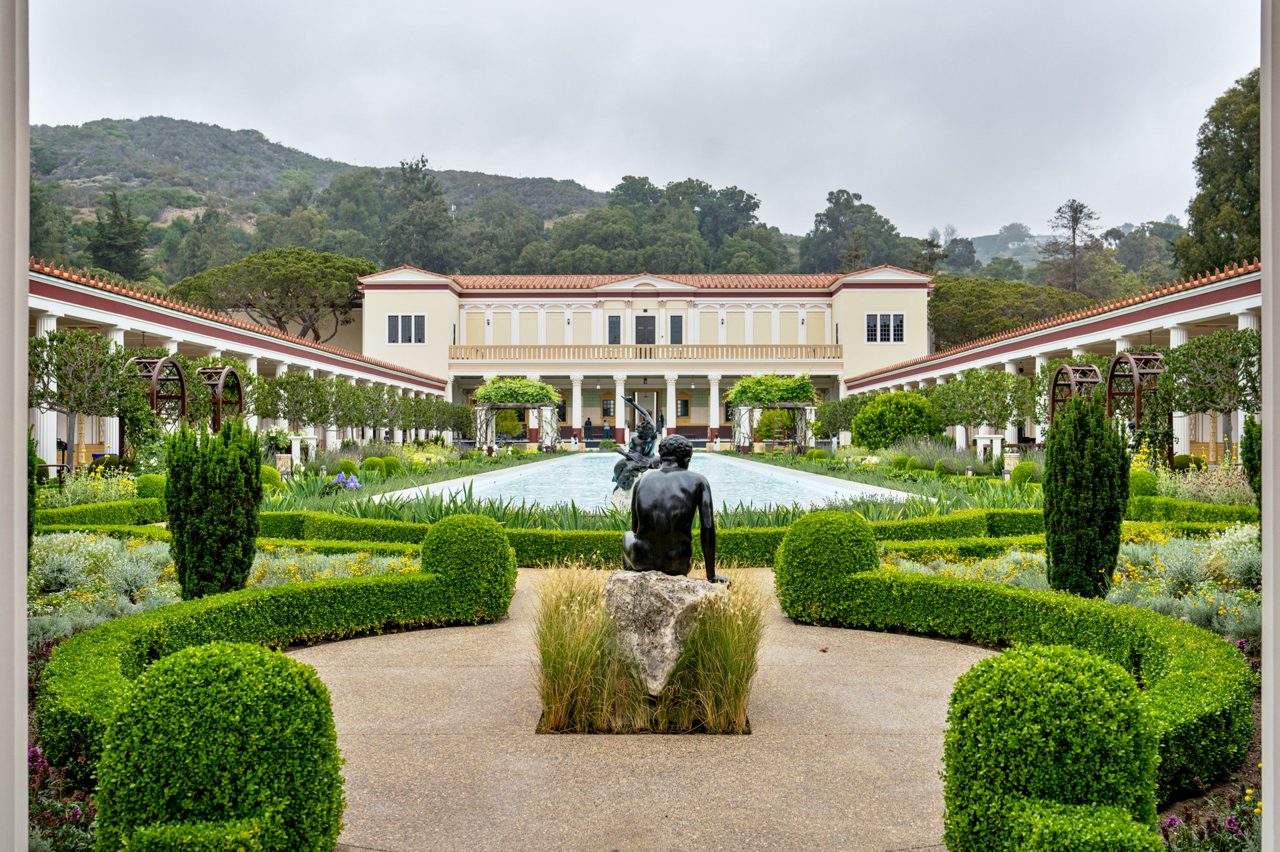
The Getty Villa is chock full of Greek, Roman, and Etruscan antiquities.
The seaside manse was never actually lived in by Getty and was built to be the museum that it is.
With the Getty Center set to close for nearly all of 2027 to make renovations for the 2028 Olympics, those craving something a little more classical will have to make the drive to the Pacific Palisades for the Getty Villa, a no-less-impressive outpost of the J. Paul Getty legacy housed in a seaside mansion. The Villa actually predates the Center, and it remains chock full of Greek, Roman, and Etruscan antiquities. While the Villa lacks the breadth (and research capacity) of the Center, it more than makes up for it in charm. While you can, seek out The Victorious Youth, a 2,000-year-old Greek bronze hauled from the Adriatic by fishermen in 1964, and currently the subject of an international legal battle with Italy. And don’t miss the Lansdowne Herakles , a 2nd-Century marble depiction of the Hellenic hero that stops you cold.
The Academy Museum is where to go for film history, which is the name of the game in LA.
Film and Los Angeles go together like peanut butter and jelly, so it only makes sense that there'd be a museum dedicated to the art of moviemaking here. It only opened in 2021, but it feels like it's been here forever, housed in the gorgeous Streamline Moderne Saban Building on Museum Row, with a Renzo Piano sphere addition housing the 1000-seat David Geffen repertory cinema that's become a landmark of its own (some call it the “Death Star”). The collection is perfect for those with stars in their eyes: Dorothy's ruby slippers, the only surviving shark mold from Jaws , and Bela Lugosi's Dracula cape. A Marilyn Monroe exhibition is currently open, and a major horror retrospective, The Horror Show , is set for later in 2026. Essential viewing.