Messi faces England as decades of World Cup rivalry resume
As England and Argentina prepare to go head-to-head in Wednesday's World Cup semi-final, BBC Sport looks at their footballing rivalry.
On Wednesday in Atlanta, defending world champions Argentina will play Thomas Tuchel's England for a place in the World Cup final. The match marks the first time Lionel Messi has faced England in his career. It is a meeting that revives one of international football's most historically charged rivalries.
The significance of the fixture extends beyond the pitch, largely due to the political shadow of the 1982 Falklands War. Argentine and British media have historically used the matchup to express nationalistic resentment, a dynamic that continues to influence how fans and players approach the game.
England leads the overall World Cup record between the two nations, winning three of their five previous meetings. However, the most defining encounters have often been mired in controversy. The modern rivalry is widely traced back to the 1966 quarter-final at Wembley, where Argentina captain Antonio Rattin was sent off after 33 minutes.
Rattin refused to leave the pitch for almost eight minutes, leading England manager Alf Ramsey to label the Argentine players "animals". Defender George Cohen later recalled the intensity, saying: "Tackling is fine. But it was some of the snidey things, the spitting and pulling the short hairs on your neck, pulling your ear." Rattin, who represented Argentina from 1959 to 1969, died on Saturday at the age of 89.
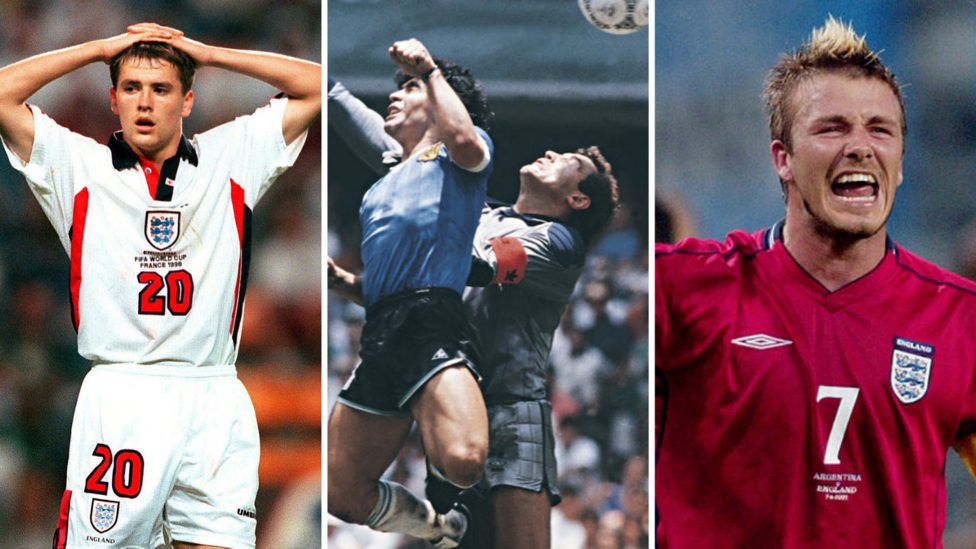
The disciplinary chaos of the 1966 match is widely believed to have prompted the introduction of red and yellow cards at the 1970 World Cup. The most notorious clash came at the 1986 tournament in Mexico, played just four years after the Falklands conflict. Diego Maradona punched the ball into the net for the "Hand of God" goal before scoring a second to secure a 2-1 Argentine victory.
Twelve years later in France, the tension boiled over again when David Beckham was sent off for kicking Diego Simeone during a last-16 match Argentina won on penalties. Simeone later acknowledged his role in the dismissal. "You could say that my falling transformed a yellow card into a red card," Simeone admitted.
The most recent World Cup meeting in 2002 offered a measure of redemption for England. Beckham scored the decisive penalty after Mauricio Pochettino fouled Michael Owen, securing a 1-0 group-stage win that eliminated Argentina. Wednesday's match offers a new chapter in a rivalry that has shaped the public memory of both nations for six decades.