Record low Rhine water disrupts German freight amid heatwave
Plunging water levels on the Rhine river are forcing ships to reduce loads and pushing up freight rates, adding economic strain to a Germany already battling extreme heat, water rationing, and uncontrolled wildfires.
Water levels at the Kaub measuring station in the Rhine valley hit 155 cm early on Wednesday, a record low for this time of year that falls below the 160 to 170 cm needed for fully-loaded vessels to navigate safely. Ships are consequently sailing with heavily reduced loads, driving up freight rates on a waterway that moves about 80 percent of Germany's inland water transport, mostly from Dutch and Belgian ports. These bottlenecks threaten to ripple across European supply chains as industries attempt to maintain summer output.
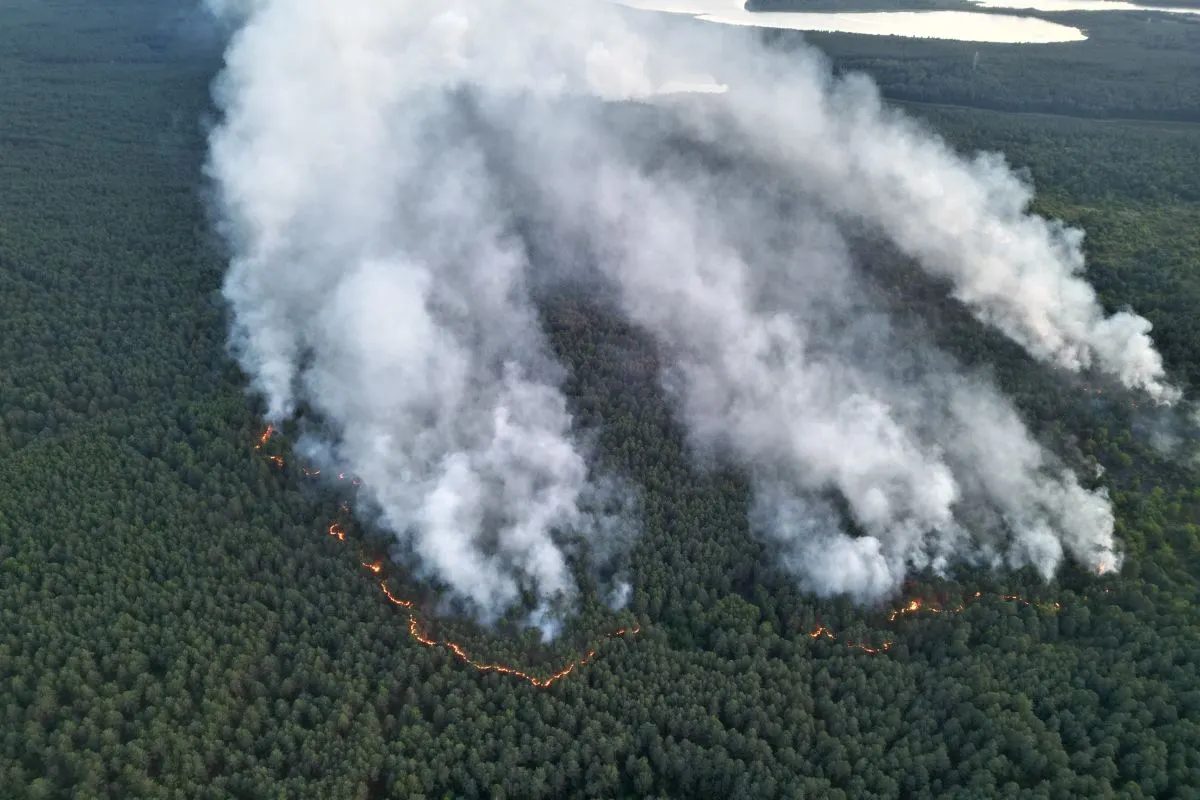
The infrastructure strain follows a severe heatwave that pushed Germany to its highest-ever recorded temperature just weeks ago, a pattern scientists attribute to human-induced climate change. The extreme conditions have sparked immediate public safety crises, most notably a spreading wildfire in Mecklenburg-Western Pomerania.
The blaze has consumed about 150 hectares of Müritz National Park and forced the evacuation of roughly 400 residents from the village of Granzin. Villagers had initially returned home on Monday after receiving an all-clear, only to be ordered out again on Tuesday as the flames advanced. About 200 emergency personnel have been deployed, but their efforts are severely restricted.
The forest sits on an abandoned military training ground, leaving the soil riddled with unexploded munitions. "Emergency services cannot actively put out the fire -- that's the problem," said district spokesman Marten Schroeder. Firefighters must maintain a 1,000-metre safety perimeter, rendering helicopter water drops ineffective because the aircraft would have to fly so high that wind would blow the water off course.
The water scarcity driving the Rhine to historic lows is also hitting urban centers. Munich declared a hosepipe ban on Tuesday, restricting residents to commercial carwashes for vehicle cleaning. Mayor Dominik Krause pointed to an "unusually dry winter and spring" as the root of the city's depleted water reserves.
Together, the paralysed firefighting efforts and the constrained river traffic illustrate the practical toll of shifting weather patterns on European infrastructure. As Germany confronts these simultaneous emergencies, businesses relying on inland logistics face prolonged uncertainty. Local governments, meanwhile, are being forced to ration essential water supplies to residents.