Toyota-backed Walden raises $300m for wheeled factory robots
A Toyota spin-out has emerged with $300m to build wheeled humanoid robots already working on assembly lines, a pragmatic approach that bypasses the legged-robot hype to tackle immediate manufacturing bottlenecks.
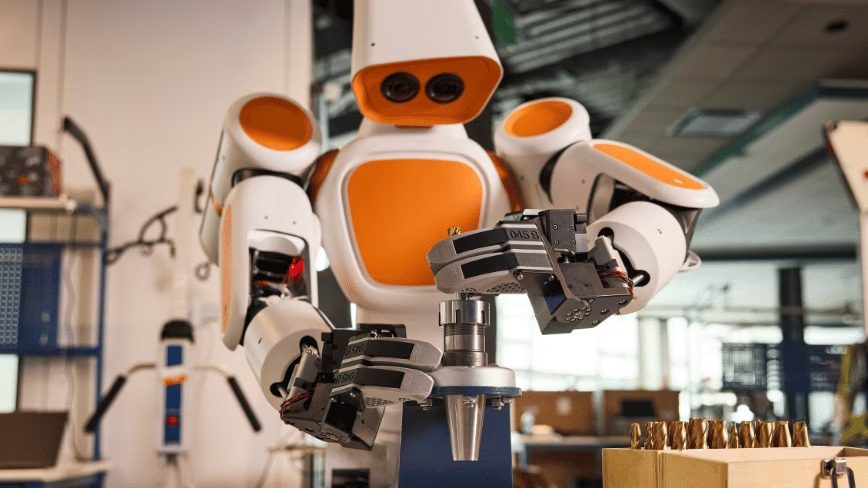
Walden Robotics launched from stealth on Wednesday with $300m in seed funding and a $1.1bn valuation. The Cambridge-based company, spun out of the Toyota Research Institute in January, builds humanoid robots for factories. Unlike most competitors, its machines pair a humanoid upper body with a wheeled base instead of legs.
The design choice addresses the practical bottlenecks of factory automation. Wheeled robots can slow and stop more easily around human workers, clearing existing safety rules without requiring costly facility overhauls. For manufacturers assessing automation investments, this focus on immediate integration and unit economics offers a contrast to unproven legged alternatives.
Walden is not pitching a concept. Its robots have been operating in a Toyota plant in North America since February, working eight-hour shifts alongside human teams. They handle repetitive tasks like loading car parts, cleaning machinery, and kitting assembly components. The company already counts customers in automotive, aerospace, semiconductors, electronics, logistics, and life sciences.
The machines run on Large Behavior Models, an AI class the team helped pioneer that allows robots to learn new tasks and improve through practice. The seed round was co-led by Toyota and Deviation Capital, with participation from Nvidia, Boeing, Samsung Ventures, and CoreWeave Ventures. That investor roster signals heavy corporate backing for a company barely six months old.
Walden enters a crowded field where rivals like 1X, LimX, and Booster are pouring billions into walking humanoids, while carmakers like Hyundai scale up Boston Dynamics’ Atlas. Morgan Stanley estimates the humanoid market could exceed $5tn by 2050.
Despite the vast projections, Walden’s leadership is preaching pragmatism. “If you listen to the people on the factory floor, they aren’t ready, and they don’t want them yet,” said Russ Tedrake, head of Walden, regarding legged machines. “Everyone recognises the magnitude of the opportunity and the technology feels ready, but success is not assured,” he added. “You have to think through the business case, the unit economics.”