Milan sculptor's World Cup trophy design endures as global icon
Ahead of the 2026 World Cup final, Milan is commemorating the local artisan whose 1970s design became football's most recognised prize, highlighting Europe's enduring role in global sports craftsmanship.
On Sunday, either Spain or Argentina will lift the World Cup trophy, a 36-centimetre, 18-carat gold prize designed over five decades ago in a Milan studio. The trophy, cast with two spiralling figures ascending toward an orb, remains the definitive symbol of global football. Yet few watching the 2026 final will realise it is the work of Italian sculptor Silvio Gazzaniga.
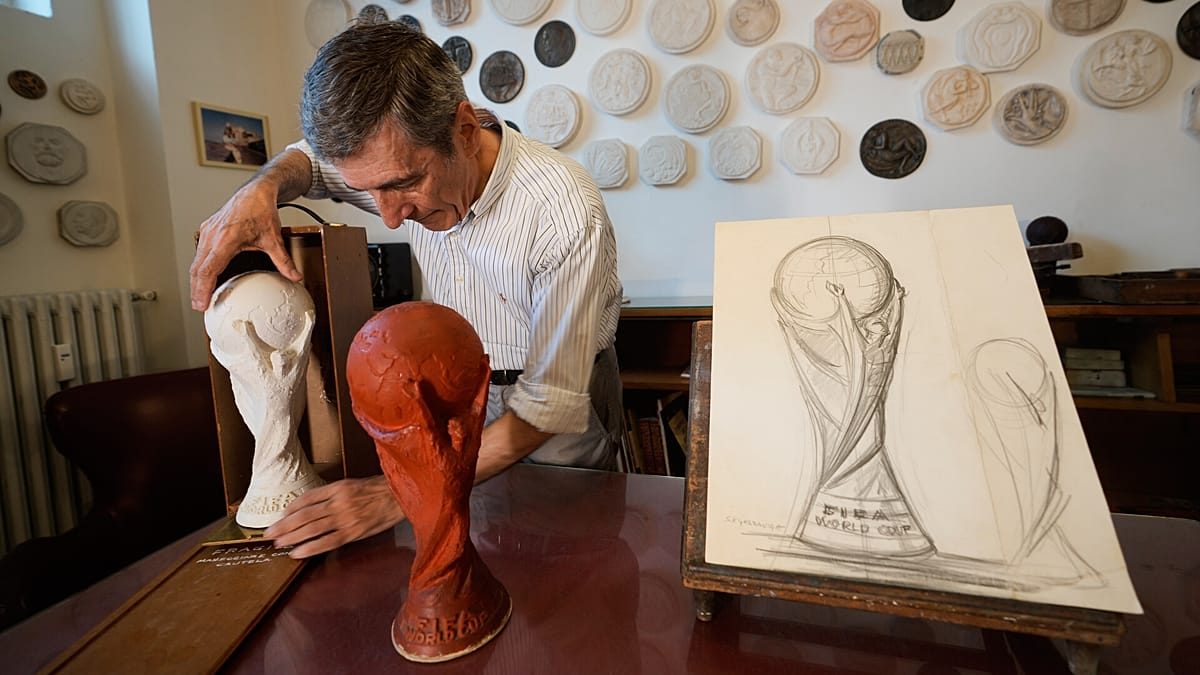
FIFA commissioned the current trophy in 1970 after Brazil earned permanent possession of the previous Jules Rimet Trophy by winning the tournament for a third time. Gazzaniga, working for Milanese trophy manufacturer G.D.E. Bertoni, entered the resulting open competition. Rather than relying solely on paper sketches, the 50-year-old sculptor produced a full-size plaster prototype, allowing judges to evaluate the piece as a finished object.
His design topped more than 50 submissions from artists across 25 countries. Giorgio Gazzaniga, the sculptor's son, recalled how his father developed the concept of “two DNA spirals, that are moving up” toward a representation of the Earth. The physical labour of the athlete is embedded directly in the metal. “The athlete’s body is rough, rugged, for it has suffered, had to fight, and struggled for victory,” the younger Gazzaniga said.
The victory is conveyed through arms resembling wings, meant to capture the jubilation of the fans as much as the athlete's triumph. The commission established Gazzaniga as the dominant figure in elite sports design. He subsequently created several of football's other major prizes, including the UEFA Cup, the UEFA Super Cup and the Intercontinental Cup. This portfolio underscores the continued reliance of global sports institutions on European artisanal manufacturing.
Gazzaniga died in Milan in 2016 at the age of 95, but the city has increasingly moved to honour his artistic legacy. In 2003, he received the Ambrogino d’Oro, one of Milan’s highest civic honours. Earlier this year, officials unveiled a commemorative plaque outside his former Brera neighbourhood studio on Via Alessandro Volta 7. His family has preserved his original FIFA prototype and drawings at a location in nearby Pioltello.
Despite its cultural value, the winning nation never keeps the original trophy. FIFA retains the 18-carat gold piece at its Swiss headquarters between tournaments, issuing only a gold-plated replica to the champions. The original, first lifted by West Germany’s Franz Beckenbauer in 1974, remains securely stored. This is a stark contrast to the Jules Rimet Trophy, which was stolen from Brazil in 1983 and is widely believed to have been melted down.