Germany news: Merz courts 'frugals' to trim EU budget
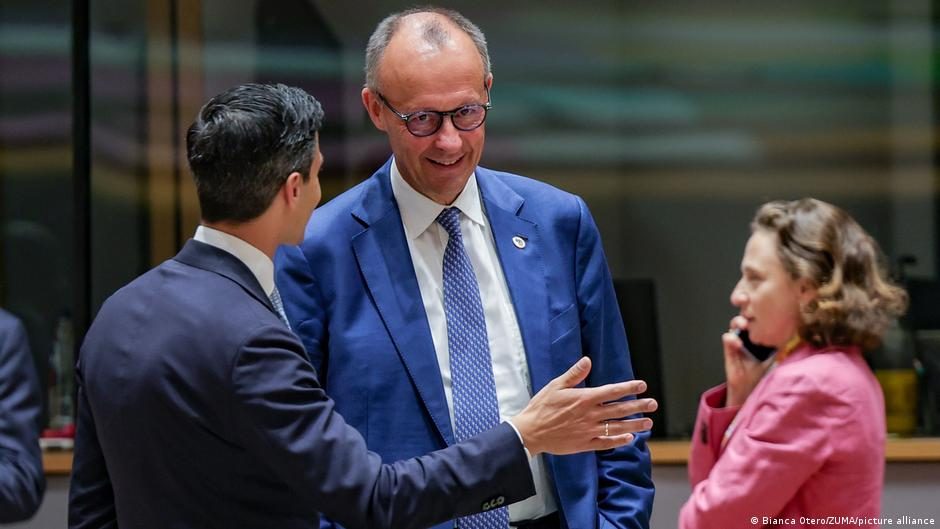
Chancellor Friedrich Merz is hosting leaders from several European Union net contributor countries as Berlin pushes for a smaller bloc budget. DW has more.
Here is a roundup of top stories from and about Germany on Monday, August 10, 2026:
Police in Brandenburg near Berlin say they are responding to a violent crime at a school together with other emergency services.
"After an act of violence a male person was provisionally arrested, who according to our current findings is connected to the crime. We are currently securing the crime scene," police wrote in a short statement online.
The German DPA news agency reported that a woman and a man had been killed, also reporting a male suspect being taken into police custody.
The school is located in the settlement of Gosen-Neu Zittau, not far southeast of Berlin, just across the state border into Brandenburg.
The AFP news agency cited a police spokeswoman in nearby Frankfurt an der Oder as saying that the incident was not thought to be an "amok crime," a German term for an indiscriminate mass-shooting situation.
The AfD is polling above 40% ahead of Saxony-Anhalt's election. What is driving support for the far right in this predominantly rural eastern German state?
Learn more about why the AfD is set for a strong showing in the upcoming election in this report.
German companies are planning fewer job cuts than before, according to a new survey by the Ifo Institute, although overall employment is still declining.
The economic research group's employment barometer rose from 93.0 points in July to 94.8 points in August, its highest level since May 2025.
Ifo economist Timo Wollmershäuser described the figures as a "slight upward movement."
However, he said that, overall, companies were still cutting jobs.
The employment barometer for industry rose to its highest level since March 2024.
Most industrial sectors are still planning staff reductions, according to Ifo.
Positive exceptions include manufacturers of data-processing equipment, electronic and optical products, as well as the food industry, where companies expect employment to increase.
The outlook also improved in retail and wholesale, although job-cutting plans still outweigh hiring intentions in both sectors.
Among service providers, expansion and job-cutting plans are broadly balanced, meaning overall employment is expected to remain stable.
To view this video please enable JavaScript, and consider upgrading to a web browser that supports HTML5 video
From key dates to rising football stars and changes, DW has the latest on the new Bundesliga season.
For the full low-down, read our full preview of the upcoming Bundesliga season .
German Chancellor Friedrich Merz has welcomed the leaders of Austria, Denmark and Finland to Berlin for talks on the European Union's next long-term budget.
Austrian Chancellor Christian Stocker, Danish Prime Minister Mette Frederiksen and Finnish Prime Minister Petteri Orpo arrived at the Chancellery ar around midday.
The four leaders are expected to discuss a common position on the EU's 2028-2034 budget.
Merz has called for substantial cuts to the European Commission's nearly €2 trillion ($2.3 trillion) proposal, describing it as "unaffordable."
Chancellery Minister Nina Warken has ruled out replacing Chancellor Friedrich Merz following September's state elections, despite weak polling for their center-right Christian Democratic Union (CDU) .
"Friedrich Merz will remain chancellor afterwards," Warken told broadcasters RTL and ntv on Thursday.
She said the government would continue implementing reforms agreed by the coalition, pointing to major projects involving pensions, long-term care and reducing bureaucracy.
Germany needed a government capable of acting and a coalition that worked together reliably, Warken said.
"We need a federal government that works together in a stable way, that moves the country forward and that now tackles the reforms together," she said.
"That is important, and that is what we want to do, after the state elections as well."
The CDU faces the prospect of heavy losses in Saxony-Anhalt's September 6 election, with polls suggesting it could finish far behind the far-right Alternative for Germany (AfD).
The CDU is also recording weak polling figures ahead of state elections in Mecklenburg-Western Pomerania and Berlin two weeks later.
The results could increase political pressure on Merz and his government if the CDU performs poorly.
German President Frank-Walter Steinmeier has called for a more critical debate about the risks of video games, warning about addiction, extremist content and depictions of violence.
Speaking during his first visit to Gamescom in Cologne , Steinmeier said the growing importance of gaming meant its negative aspects also needed to be discussed "objectively, honestly and in a nuanced manner."
He noted that gaming disorder is recognized as an illness by the World Health Organization and can have serious consequences for those affected.
"There are also some computer games in which young people are confronted with brutality and raw violence, with sexism, racism, with inhumane thinking and extremist ideologies," Steinmeier said.
The president said clearer rules were needed to prevent the glorification of violence and the spread of extremist and anti-democratic content in video and computer games.
That was particularly important, he said, "at a time when our democracy is also under greater threat and attack."
Despite the warning, Steinmeier stressed that he viewed gaming positively overall.