Israel calls Nato ally Turkey ‘the new Iran’. Europe’s answer? Three settlers and some oranges
Europe does not need to break with Israel. But it needs to stop pretending that three settlers and a fight over oranges are a position while the border with Lebanon moves north and a Nato ally, Turkey, becomes the enemy. The two no longer want the same things, and a vote in Jerusalem is unlikely to change that.
The US and Iran now have a peace deal . But one front in the war stayed open, and last weekend it nearly wrecked everything: Israel kept striking southern Lebanon, Iran’s red line, and braced for a salvo that never came. The war Washington is closing is not the one on Europe’s doorstep.
There is no argument about Israeli statehood or Jewish self-determination. But a colder reading of the map says: Europe and the present Israeli government no longer want the same things in the Middle East, or share the goals that once made them partners there.
The Knesset moved to dissolve in May, with an election due by autumn. But the way Israel reads its threats runs deeper than Benjamin Netanyahu and the ministers beside him. A new government might change the tone, not the divergence.
On 11 May, once Viktor Orbán’s veto vanished with his Hungarian government, EU foreign ministers finally sanctioned violent settlers: three individuals and four organisations in the West Bank. Three people.
It came a year after Brussels’ own diplomatic service found indications Israel was in breach of the human-rights clause of the EU-Israel Association Agreement.
More than a million people have been displaced, a fifth of the population, with 40,000 homes destroyed. Israeli troops have pushed up to the Litani, the deepest incursion in 25 years, with evacuation orders beyond it.
A depopulated strip, held by a foreign army, inside a sovereign state.
The official word is "buffer." On the ground it is occupation, and a border creeping north.
The occupation is only the nearest edge. Netanyahu governs with a cabinet built around Itamar Ben-Gvir and Bezalel Smotrich, men openly for resettlement and annexation.
Under them it has stopped guarding a border and started moving one: Gaza, Syria, now Lebanon.
In Jerusalem, this is a generational chance to remake the regional order. Europe has no reason to share it.
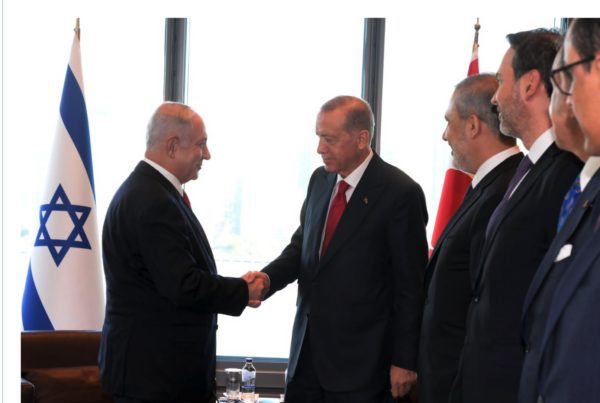
Watch the next line. Iran was the organising threat, and the February strikes that killed its supreme leader degraded it badly, so Israel is naming a successor. Former Israeli prime minister Naftali Bennett said it first aloud in February this year: “Turkey is the new Iran”.
By spring it was open insults, with minister of defence Israel Katz calling Erdoğan a "paper tiger" while Israeli and Turkish aircraft shadowed each other over Syria, where a clash no longer looks far-fetched.
Turkey's foreign minister says Israel is shopping for a "new enemy" and has cast Ankara for the part.
Yet Turkey is a Nato member, a difficult one but inside the alliance, holding Europe's southern flank.
To recast a treaty ally as an enemy is to ask Europe to treat one of its own as a target. Brussels has barely admitted the question exists.
Why three settlers and nothing more? Because everything more serious was refused. Spain, Ireland and Slovenia asked the EU to sanction Ben-Gvir and Smotrich by name; Germany and Italy said no . Suspending the trade chapters of the Association Agreement has been shelved indefinitely by the same two.
Europe removed the obvious blocker, Orbán, and learned the blocker had never only been Orbán.
Now measure the ambition left. As Alberto Alemanno argued recently, the boldest measure on the table is a ban on settlement-goods imports, €230m a year by Israel's own count, 0.002 percent of EU GDP, and the live question is whether it can pass by majority vote. He is right.
But look what the debate is now: the procedure for banning oranges.
The ceiling of the Brussels argument is the floor of the problem. And when EU leaders gather on Thursday (18 June), their diplomats expect condemnation and nothing else.
Someone always says the criticism runs one way. So, Hezbollah pulled Lebanon into this war, and Israel has a real problem on its frontier.
A union that spent four years building a case against Russia, the shadow fleet, the strikes on power stations, the contempt for borders, cannot board Russian tankers in the Baltic in the name of international law.
The same week, answer the occupation of a neighbour's south with three names and one word: "heavy-handed" .
Europe does not need to break with Israel. But it needs to stop pretending that three settlers and a fight over oranges are a position while a border moves north and a Nato ally becomes the enemy. The two no longer want the same things, and a vote in Jerusalem is unlikely to change that.
Divergence between allies is ordinary. Pretending there is none is not.
Miro Sedlák is an associate research fellow at the Institute for Central Europe and a doctoral candidate in security and defence studies at the Armed Forces Academy of General M. R. Štefánik in Slovakia.