Hundreds protest US Senate bill that would gut key section of National Historic Preservation Act
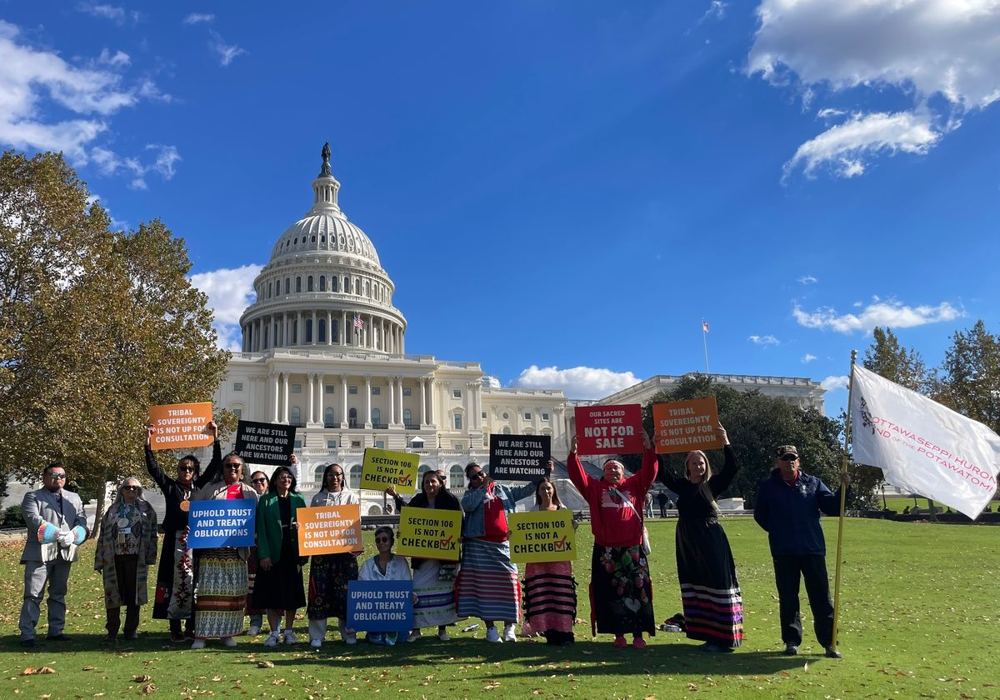
Organisers said around 800 people gathered on the grounds of the US Capitol on Monday in opposition of the Bipartisan American Affordability and Jobs Act
On Monday (9 November), hundreds of protesters gathered on the West Lawn of the US Capitol in Washington, DC, to protest the Bipartisan American Affordability and Jobs Act (BAAJA, or senate bill S.5653), which would gut a key section of the National Historic Preservation Act. Representatives from more than 100 tribal nations, members of congress, leaders from the Association of African American Museums, the DC Preservation League, the American Institute of Architects and the Archaeological Institute of America gathered to protest a bill that would remove the requirement for federal agencies to notify and consult with the public and tribal nations about potential harms to historic sites, as stipulated in Section 106, Title III of the National Historic Preservation Act.
The BAAJA, described by New Mexico congresswoman Melanie Stansbury at the protest as a “dirty deal”, was created without tribal consultation or public input. According to California representative Jared Huffman, the 500 new pages of legislative text, which he described as “the most sweeping legislation we’ve seen on energy and environmental policy in decades”, was released just 48 hours before the Senate was set to vote on it Monday evening.
“They scheduled this vote for tonight to try to prevent something like this,” Huffman told protesters gathered on the Capitol lawn; organisers estimated around 800 people attended. “To try to prevent the American people from having a say, from looking under the hood of this sweeping legislation and understanding what’s actually it, but you came anyway.” Holding signs with illustrations of President Donald Trump’s planned Triumphal Arch in flames and “Nix 106”, protesters gathered for over two hours to listen to more than 15 speakers who argued that BAAJA would seriously threaten US history.
Greg Werkheiser, a leader of the Section 106 Coalition and co-founder of Cultural Heritage Partners , kicked off the protest. “We gather at the seat of American democracy, where the laws of this nation are written, to affirm one simple principle: the people deserve a voice in decisions that affect the places that we love,” he said. “That is the promise we have come here today to defend.”
Along with removing the requirement for federal agencies to engage with the public, the BAAJA would also make consultation with tribal nations optional, narrow what types of activity trigger a federal historic preservation review, restrict the definition of what constitutes a historic site, and remove any consideration of sensory, indirect and cumulative effects of changes to historic and sacred sites, essentially allowing federal agencies to take over tribal and state historic preservation offices that do not abide by limits and deadlines that the new bill would set. The BAAJA would even restrict what legal action people and organisations can take against the destruction of historic and sacred sites.
“For tribal nations,” Arizona congresswoman Adelita Grijalva said, “the fight is more than historic preservation. It’s about sovereignty. It’s about self-determination. It’s about the fundamental right to protect our ancestral homelands, culturally significant sites, and traditions that have existed since time immemorial.”
In its current form, Section 106 of the National Historic Preservation Act requires federal agencies to consider the impact of federally funded building projects and requires that people receiving federal funds or permits consult with tribal nations. If passed, S. 5653 would make that consultation, the requirement that tribal nations participate in decision-making, optional.
“Our sacred places are living places of prayer, our responsibilities to them do not end at the reservation boundary,” Harry Antonio Jr, the governor of the Pueblo of Laguna in New Mexico, said at the rally. “You do not have to share our prayers to understand why those places deserve respect. Section 106 gives our governments a way to bring those concerns into federal decisions.”
Senators in favour of the bill have argued that its passage would lead to more economic opportunities. Articulating a position held by most rally attendees, Grijalva said: “Economic development does not require sacrificing our history, our culture or our sovereignty. We can create jobs without destroying sacred places. We can create jobs without sacrificing Mother Earth, our land, our water.”
Rashida Tlaib, the congresswoman from Michigan, said the bill would be used to fast-track projects with severe environmental consequences, including data centres and gas pipelines. “This bill strips away what little tools we already have to defend ourselves from corporate polluters,” she said.
The senate’s vote on the BAAJA coincides with Trump’s push to build a 250ft-tall arch between the Lincoln Memorial and Arlington National Cemetery. On 5 November, protesters gathered at its proposed site and spoke against it during a National Capital Planning Commission (NCPC) meeting. Although the NCPC voted to approve the arch, a Washington, DC judge then immediately blocked construction for 14 days.
“The court orders stopping construction of those projects would not be possible if this BAAJA legislation becomes law,” Huffman said. “If this becomes law, the administration will use that in those pending court cases to make it much, much harder to stop Trump from advancing those and other vanity projects.”
Speakers urged protesters to call their senators, and implored senators to vote down the bill or to table a vote until the newly elected members of congress are sworn in in January.