Advanced Russian jet fails to stop Ukraine’s record‑range drone strike on Omsk mega‑refinery(Ukraine Battlefield update, Day 1,594)
Zelensky’s drone commanders outwit Russia’s elite Su‑57s deep inside its own territory. Putin is left scrambling to defend refineries, keep fuel flowing and hide a spiralling logistics crisis from his own citizens.
What Zelensky means when he says this war will be won in the sky.
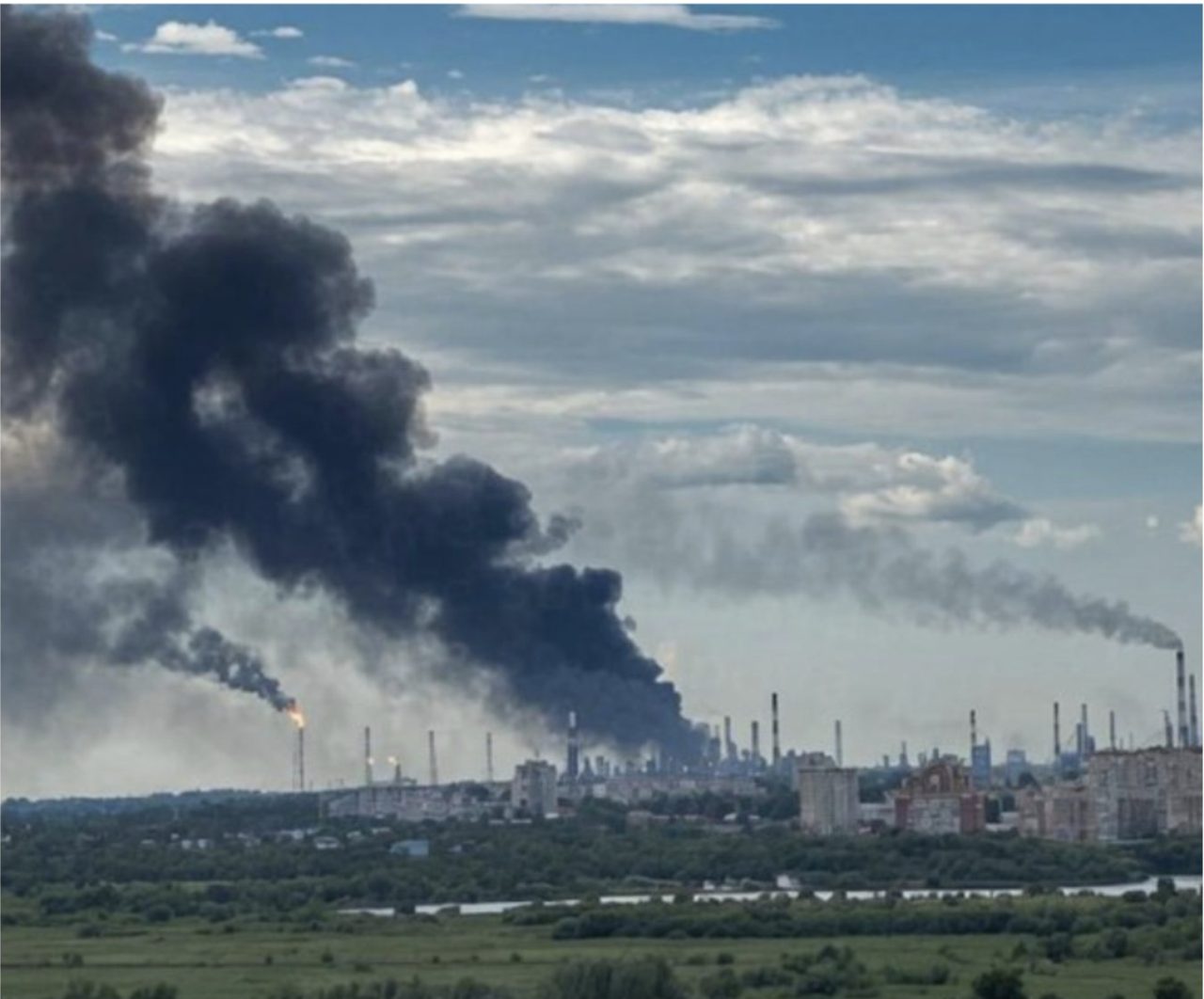
In its escalating pressure on Putin’s regime, Ukraine recorded another significant success against Russia when its long-range drones struck the key and largest refinery in Omsk on Monday.
What Zelensky and his drone units are aiming for. Whoever wins this war will win it in the sky, Volodymyr Zelensky said , and the videos of the burning refinery and several successful attacks from the same day (we analyse them below) are proof that Kyiv currently holds good cards.
And Donald Trump has started to notice this as well; to the Kremlin’s irritation, he has endorsed them in a similar way to Nato leaders. Today, they are meeting for dinner in Ankara. They see this as Kyiv’s pressure on Putin to abandon his unrealistic goals and to force him towards peace talks.
“Victory in this war belongs to the one who is smarter,” Zelensky said in an interview with the Financial Times, and he described what Ukraine has been trying to achieve in recent weeks: “If you stop the enemy on the battlefield, if you stop the war on land, and if you prevent it from having supremacy at sea, as we have done with our naval drones that drove out the Russian fleet, then the next battlefield becomes the sky,” the Ukrainian president said about the turning point in Russia’s war of conquest against Ukraine.
As he rightly added, in this contest it does not matter that much whose territory is bigger. Who, back in 2022, would have said that in this war Ukraine could compete with Russia in the air and even threaten on a daily basis its greatest asset, on which its economy is built?
In recent months, however, that is exactly what has been happening.
How Omsk was hit. “This is not just the last plant that had not been hit, but the largest among refineries of this type, out of a total of 11 such facilities, the one in Omsk is the biggest,” Ukrainian military analyst Olexander Kovalenko told Denník N. Its capacity is roughly 21 million tonnes of oil per year.
As NV wrote , the Omsk refinery produces a wide range of oil products, petrol (AI-92, AI-95 and G-Drive 100), diesel fuel that meets the Euro-5 standard, aviation kerosene and other petrochemical products. And it is an important source for the Russian army.
This strike, apparently carried out by two FP-1 drones, was very demanding purely because of the distance, which is why the media gave it the label super deepstrike . Ukrainian special forces claimed that the drones flew as far as 3,000 km, which is so far the deepest-reaching strike on the territory of the Russian Federation.
Ukrainians gained the ability to attack the Omsk refinery thanks to the modernisation of their own arsenal. One of the first to boast about the strike was Denis Shtilerman, co-owner and chief designer of the company Fire Point, who said their FP-1 drone was capable of flying 3,400 km.
Омський НПЗ зустрічає новий FP1!!! pic.twitter.com/yR61ciba7v
The Russian Su-57 fighter jet, which tried to save the situation, still did not completely prevent damage to the refinery.
2026 and it’s Su 57 (most useless jet in the world) against Fp 1’s😆 pic.twitter.com/Bz7PoznU2p
Only a few days earlier, a publicly available photograph of this fighter in an “anti-drone configuration” had appeared, according to NV . The aircraft was reportedly armed with four short-range air-to-air missiles, either R-73 or R-74.
Russian propagandists had high hopes for this, the Ukrainian website wrote, but so far no case is known in which it actually worked.
According to the photograph published by the Exilenova+ channel, the drone has atypical wings with less drag. The Militarnyj website noted that this allows it to generate lift more effectively across the whole surface, which has a positive impact on fuel consumption and therefore on range. The different layout also provides space for more fuel or a heavier warhead.
Already last week, as analyst Kovalenko said, Ukrainian drones flew over Omsk. That was a test phase, followed by the successful strike.
The footage of the burning refinery is thus a story of constant technological arms race. Ukraine first deployed FP-1 attack drones back in August 2024 against the Marinovka air base, where they destroyed at least one Su-34 fighter-bomber, according to the Militarnyj website.
What the Ukrainians are targeting. This was definitely not a symbolic attack, but a precise strike that will further deepen Russia’s logistical crisis in supplying fuel. Even before that, it had been spreading across the whole federation.
Residents of the Moscow region are also feeling problems buying petrol after the attack on the Kapotnya refinery, which is not supplying fuel, and according to the VChK-OGPU channel, repairs will take two to three months. “Even then, however, the refinery will not be able to reach full capacity, since one of the cracking columns has been irreversibly damaged.”
The Ukrainians did not target it by chance. In this part of the refinery, heavier hydrocarbons are cracked into smaller and more valuable molecules, gradually turning crude oil into petrol, diesel or aviation fuel. Cracking units are therefore strategically important targets for Ukrainian attacks. Damaging them limits fuel production more than hitting storage tanks.
And the problems are piling up. Two other main suppliers of petrol and diesel, the refineries in Yaroslavl and Ryazan, were also seriously damaged, and the plant in Noginsk again has insufficient capacity for the Moscow region. According to the channel’s sources, diesel production in Yaroslavl was completely shut down and this will last for a long time. Even help from Lukashenko is not enough.
The Russian independent website Meduza compiled an impressive list of the ten largest refineries by output that had been hit by Ukraine as of 6 July.
How bad is it, according to Khodorkovsky. Although Putin pretends this is not a serious problem, more and more analysts say that Ukrainians have cornered him.
The scale of the crisis was described by one of the most qualified observers: former richest Russian and former owner of the oil conglomerate Yukos, Mikhail Khodorkovsky, whom Putin’s regime stripped of his company and sent to prison twice for multiple years.
As he wrote on X , Ukrainian drones were attacking practically all major refineries in the European part of Russia. And although he thought that at least the Moscow refinery would be protected by air defence, even it did not escape an attack.
At stake now were issues such as the use of oil pipelines, freight transport, railways, state reserves, foreign purchases and the like. Petrol shortages were being felt thousands of kilometres behind the frontline, and there was no one able to take competent decisions. “Qualified people have left, scattered, or refuse to get involved,” Khodorkovsky wrote from his European exile.
He saw three possible solutions. If fuel prices were liberalised and jumped to $5 [€4.3] per litre, demand would collapse and supplies would start to pour in because transporting them would pay off. Within three to five months, the situation would stabilise, he argued. But, as he noted, the Kremlin could not afford that.
The second is an administrative solution, but effective assistance between regions in a non-functioning country is difficult to achieve.
And so Putin’s regime is reaching for a third option: it has lowered fuel quality standards to the Euro-2 level. This does destroy the catalytic converters of modern cars, but from the Kremlin’s point of view it is, according to Khodorkovsky, a small price to pay for a crisis that, in his view, will become radically worse in August. “If the attacks continue and half of the refineries in the European part of Russia shut down completely, no manipulation of the product will fill this gap. And the harvest season is approaching. Do not forget: today the crisis is about petrol, but the harvest runs on diesel.”
More Ukrainian trophies on the Crimean (penin)insula. The commander of Ukraine’s drone forces, Robert Brovdi, known by the nickname “Magyar”, on the same day the Omsk refinery went up in flames, mentioned several important attacks that are deepening the ongoing energy crisis on the annexed Crimean peninsula.
It is increasingly turning into a kind of island plunged into darkness.
On Monday night, Brovdi’s unit managed to attack two tankers in the Sea of Azov that were supposed to transport up to 7,000 tonnes of fuel from Taganrog. They identified them as Kapitan Barmin and Sanar-4, but it is not clear to what extent they were actually damaged. However, they were still burning yesterday evening.
The attacks also hit an oil depot in Kerch, where Magyar’s birds struck a Nebo-U radar station and two S-400 launchers, one in Crimea and one in the Bryansk region.
RAM-2X loitering munition strike on a Russian S-400 Triumph launcher in in Bryansk Oblast of Russia. https://t.co/CRPbJNoU5l pic.twitter.com/H0n5gHasQG
As the Russian outlet Insider wrote, that night all cities and districts of annexed Crimea were left without electricity.
At the Kerch airfield, which is only 5.5 km from the Kerch bridge, military intelligence drones destroyed two Russian Orion attack and reconnaissance drones. They were supposed to be used mainly for patrolling the Kerch Strait.
Putin is responding to the mounting problems by escalating attacks on Ukrainian civilians. After the attack in the night to Monday, at least 19 civilians were killed in Kyiv and dozens were injured. Just a few days earlier, on Thursday, 31 people were killed in the Ukrainian capital by Russian strikes.
The deadly damage was caused mainly by Russian ballistic missiles, since Ukraine’s air defences suffer from an acute shortage of missiles capable of intercepting Russian ballistic missiles. Out of 29 ballistic missiles, Kyiv’s air defence did not manage to stop a single one.