The story behind Grant Wood’s American Gothic and what made it go viral
The author of a new book on the famous painting tells us why even she was mistaken about who it portrayed
Grant Wood’s painting American Gothic (1930), the realist depiction of an austere rural man and woman posed stiffly before a modest white house with a gothic-styled window, has seeped into the public consciousness on a par with Leonardo da Vinci’s Mona Lisa and Edvard Munch’s The Scream . “I never stopped watching the ways American Gothic has transitioned into the iconic ‘couple with the pitchfork’ over the past six decades,” says the US art historian Wanda Corn, whose new book The Couple with the Pitchfork: American Gothic from Easel to Icon delves into the cultural history of the painting.
Over the decades, Corn says she accumulated an “immense archive of reimagined couples” and her publication “sheds critical light on the cultural forces that transformed an image with humble roots into a global icon whose reach and charisma extend far beyond the world of art”, according to the publisher, Princeton University Press.
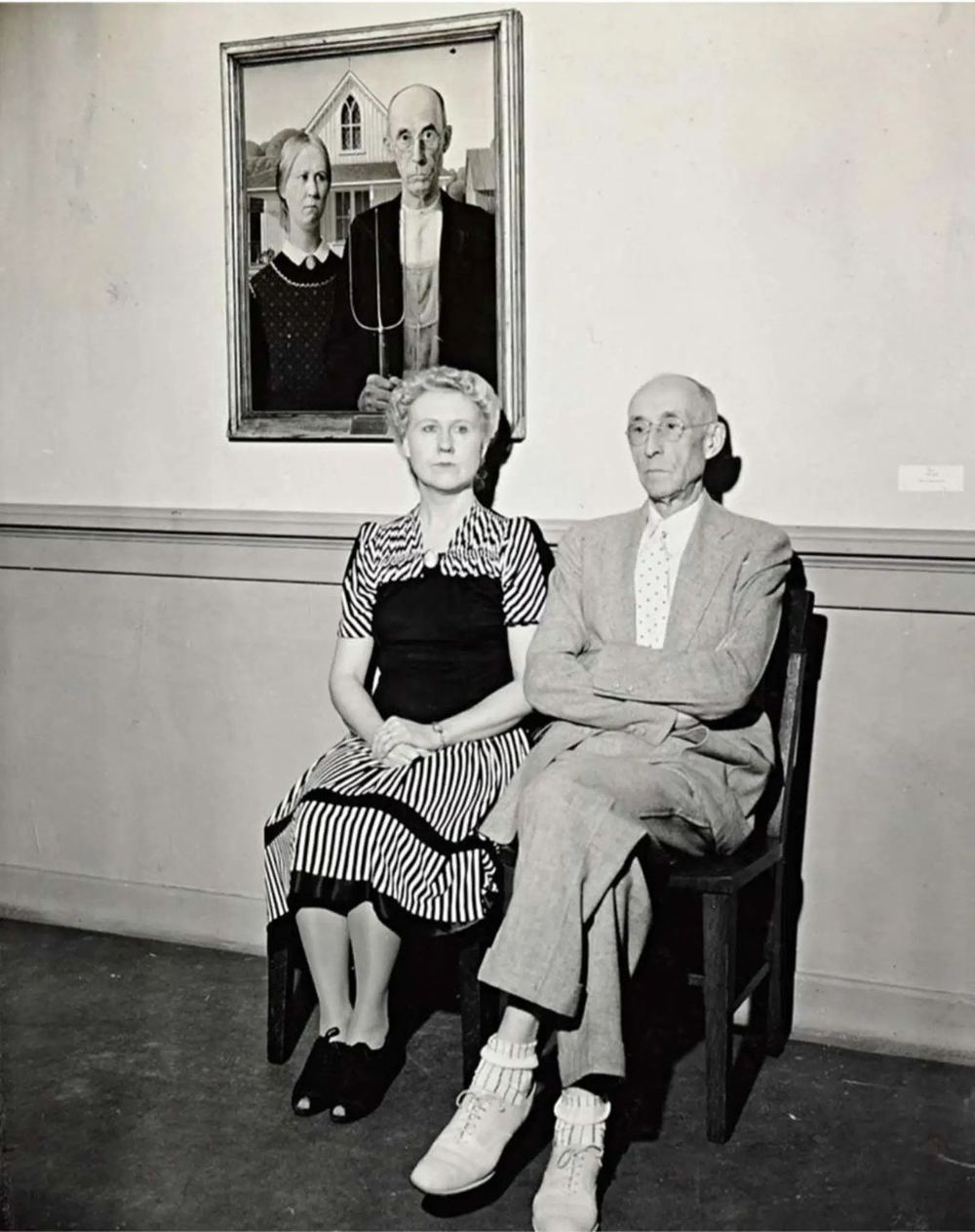
Corn, professor emerita of art history at Stanford University, outlines in detail how Wood picked his sitters: his 30-year-old sister, Nan Wood Graham, and his 62-year-old dentist, Byron McKeeby. “The two men shared a sense of humour, often chuckling over their ‘bridge for a bridge’ exchange; the dentist had provided the artist with a dental bridge and Wood paid him with a painting of a Paris bridge,” Corn writes.
Crucially the image has been misconstrued over the decades, with viewers interpreting the couple as married when in reality the pair represented a father and his daughter, according to the artist’s sister. “In Wood’s mind, the two people in front of the house represented a father and his aging daughter, a spinster, living in small-town America,” writes Corn. Wood and his closed circle described it this way repeatedly, she adds.
“Yet when the painting went out into the world, not one person saw the couple as a parent and child, nor did they see them as from a small town … this is one of the best examples in the history of art of how an artist’s intentions in a work can differ from the public’s reception of a painting.”
The person who corrected Corn about this widespread misconception was Wood Graham herself. “I too thought it represented a married couple,” Corn says. She explains that when she was photographed as the pitchfork couple with her husband in the 1970s, for a feminist work called Joe and Wanda Corn, Holiday Card (1975) by Keith M. Jones Sr, she was “under the assumption that [Wood’s sitters] were a married couple. But when I went to see [Wood Graham], I talked about them as a couple and she said in no uncertain terms: ‘They’re not a couple. It’s a father and daughter.’”
The image, and Wood’s achievements as an Iowa-based artist, were consistently lambasted and dismissed though. Early art historical texts initially ignored him, such as A History of Art (1962) by H.W. Janson, which only included the work in its seventh edition published in 2006. Corn’s survey of such texts establishes, she says, “how passive-aggressive the coverage of American Gothic was in this literature”.
The critical reaction to a Wood show Corn curated in 1983 was also brutal. “A writer of a Wall Street Journal article in May 1983 … labelled it the ‘Great Grant Wood Redemption Campaign’ and quoted the reaction of a well-known art dealer in town: ‘Flush it down the drain. It’s just cornball, provincial, nationalistic propaganda and it has nothing to do with art!’”
Corn’s 1983 exhibition of Wood’s work, Grant Wood: The Regionalist Vision , which launched at the Whitney Museum of American Art in New York, toured to other venues such as the Minneapolis Institute of Art (Yale University Press published an accompanying book). “The last landing of the exhibition was in San Francisco [at the de Young museum], and what better place to launch the first gay Gothic [work] on the walls of a major museum than in San Francisco,” she says, referring to the 1983 front cover of the gay magazine Frontiers that was included in the show.
The author unpicks the thorny issue of Wood’s sexuality, which has come under the microscope in recent years. “The upshot is that Wood today is seen as a far more complicated and tragic figure than he presented and for many years was understood to be,” she writes, acknowledging that two art historians, Tripp Evans and Sue Taylor, have contributed the most to recent psychosexual interpretations of Wood’s life and “the uncovering of his homosexuality”.
“I can see his struggles constantly,” Corn says. “But on the other hand, I also know people who found him just boundless fun to be with, lovable and endlessly creative, not dark and gloomy … we have to get a more balanced view [of him].”
How American Gothic came to be assimilated into the art history canon, across high and low popular culture is also explored through a wide variety of images including Obama Gothic (2012) by Mario Piperni, which shows Michelle and Barack Obama in front of the White House as the pitchfork couple, and Barry Kite’s photocollage Gothic Wave (2010) that draws on Hokusai’s famous 19th-century woodblock print.
“I actually could not have written the book I wrote now back then [in 1983] because I didn’t have the raw data,” Corn says. “I didn’t have this notion of the episodic uses of [the image] for everyday transient events and political events. I didn’t have any sense of what the computer was going to do to the image: the way it was going to translate it but also just make it a resource anybody could tap into.”
- Wanda Corn, The Couple with the Pitchfork: American Gothic from Easel to Icon , Princeton University Press, 312pp, $49.95/£42 (hb)