European defence firms race to build cheaper counter-drone tech
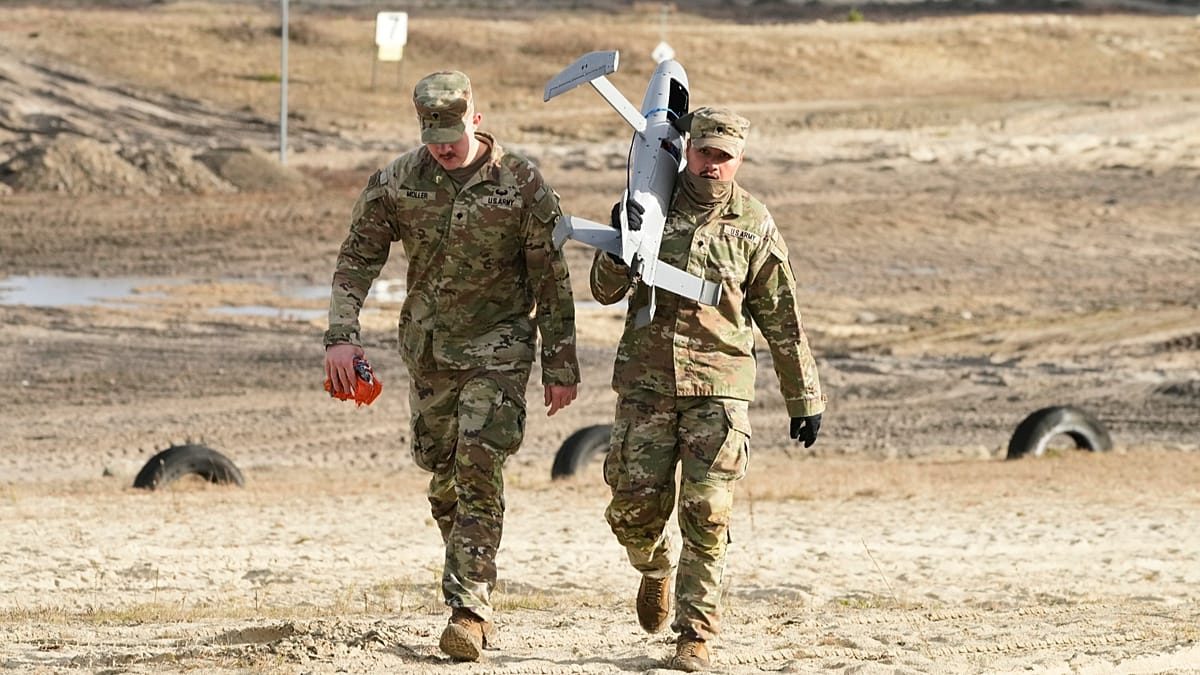
NATO is pushing European arms manufacturers to urgently develop affordable counter-drone systems as the cost of scrambling fighter jets against cheap unmanned vehicles becomes economically and militarily unsustainable.
At the NATO AIRCOM Industry Day in Ramstein this week, alliance officials and European arms manufacturers gathered to address a glaring economic and tactical mismatch: the soaring cost of using advanced fighter jets to shoot down cheap drones.
The financial asymmetry is stark. Scrambling fighter jets under the "Eastern Sentry" protocol costs more than €85,000 for a typical two-jet deployment before any weapons are fired. The unmanned targets they are sent to neutralise can be produced for less than €100,000.
This price gap is driving a rapid pivot in European defence procurement and creating a substantial market opportunity. Around 35 companies, including MBDA, Hensoldt and Aselsan, exhibited systems at the event. "There's not enough on offer. There will be too much demand," a representative for French firm Alta Ares noted.
Concrete contracts are already materialising from this shift. MBDA has developed a specialised counter-drone missile designed to defeat mass attacks, such as those involving Shahed-type drones. It is being integrated into Rheinmetall's Skyranger 30 air defence system, with the first units scheduled for delivery to Germany's brigade in Lithuania between 2027 and 2028.
The radar bottleneck
For European investors and defence planners, the primary technical hurdle is detection rather than destruction. Ukrainian Senior Lieutenant Oleksandr Vorobiov highlighted that existing radar systems often lose track of small drones for several seconds. "That's the biggest gap: reliable detection of these kinds of targets," he said, noting this prevents the deployment of fully autonomous interceptor drones.
Despite Ukrainian firms being barred from exhibiting at the NATO event, their battlefield experience is dictating European R&D. Companies like Alta Ares, which recently signed a memorandum of understanding with German drone maker Quantum Systems, are developing AI-powered interceptors with ranges up to 40 kilometres based directly on early wartime collaborations.
Turkish defence giant Aselsan similarly stressed that reliability and artificial intelligence are now paramount, as operators have only a few seconds to decide and act when a target approaches.
The urgency of these market demands highlights a structural problem for Europe's defence sector. Military requirements are currently evolving much faster than traditional procurement and acquisition processes. Lieutenant Colonel Steffen Bott noted that NATO itself does not enter contractual relationships with defence companies, meaning the alliance must rely on start-ups and established firms to accelerate the delivery of counter-drone technologies to bridge that gap.