Germany estimates 5,120 heat deaths as emergency services struggle
An estimated 5,120 people died during Germany's late June heatwave, a figure that underscores the mounting strain on a European healthcare infrastructure ill-equipped for rising temperatures.
Germany’s Robert Koch Institute estimates that 5,120 people died from heat-related causes between the start of 2026 and June 28. The vast majority of those deaths, 4,310, occurred in the final week of June alone, when a consistent heatwave pushed the weekly average temperature to 26 degrees Celsius.
Doctors rarely record heatstroke as an official cause of death, documenting an average of just 21 cases annually between 2004 and 2014. To calculate the true toll, the RKI compares mortality data from the Federal Statistical Office against temperature trends from the German Weather Service. Researchers model expected deaths at a baseline weekly average of 20 degrees Celsius and adjust for confounding factors.
The final week of June saw roughly 23,600 deaths, nearly 30% higher than the 18,200 average for comparable periods. Alexandra Schneider, a meteorologist and deputy director of the Institute of Epidemiology at Helmholtz Munich, called the estimate plausible. "It is based on a statistical correlation," she said, noting that because the heat was consistent, the methodology was less likely to underestimate the toll than in past years.
While cold still kills more Europeans than heat, the continental balance is shifting. "In Europe, cold-associated mortality is still far higher than heat-associated mortality," Schneider said. "But we are seeing a slow shift." Modeling shows that even under favorable climate scenarios, declining cold-related deaths will not offset the surge in heat fatalities. "the net effect, meaning the total number of deaths, increases," she said.
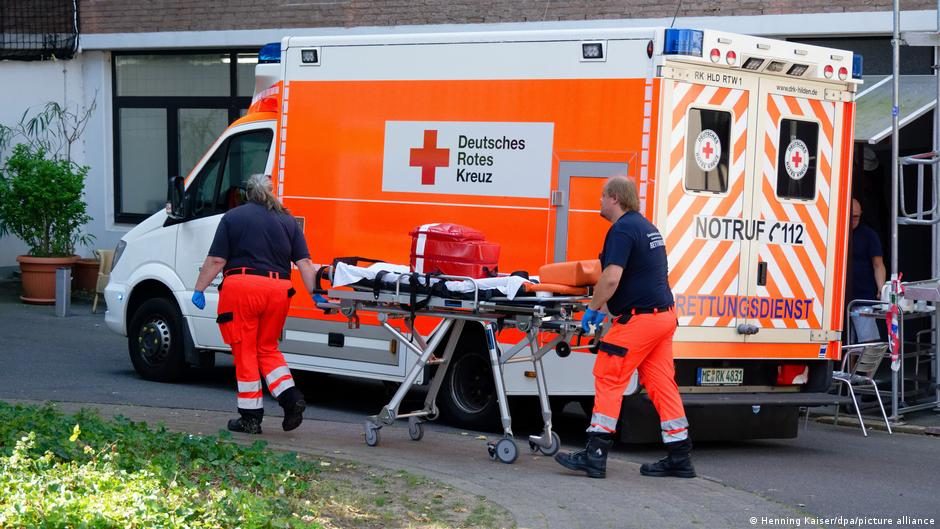
These mortality figures represent only part of the burden on public infrastructure. Heat exacerbates chronic conditions, with researchers demonstrating a strong link between high temperatures and heart attacks or strokes. This surge in acute emergencies is pushing medical systems to their breaking point.
Paramedic Jonas Sonnenstuhl worked a 24-hour shift in Teltow, Brandenburg, on June 28 as temperatures inside his ambulance stayed above 30 degrees Celsius. He noted that many hospital emergency departments and ambulance stations lack air conditioning, leaving staff struggling in heavy protective gear. "Both we and the hospital staff were at our limit," he said, adding that "for people whose job is to save lives, staying cool in an emergency is essential."