Capturing Notting Hill Carnival’s true spirit with photographer Ian Watts
As he celebrates 50 years of photographing Notting Hill Carnival with a free exhibition at London’s Outernet, BAFTA-winning photographer Ian Watts shares the stories behind 10 of his most treasured shots
The first time Ian Watts photographed Notting Hill Carnival was 1976. He was a teenager at the time, living in a youth hostel in Harlesden. Having just bought his first camera, a basic East German Praktica SLR, that August Bank Holiday found him travelling to Ladbroke Grove to capture the unparalleled energy of this most vital and vibrant of long weekends in the London calendar.
A celebration of pan-Caribbean culture and an extension of anti-colonial resistance, Notting Hill Carnival is the world’s second-largest street festival. Having started as a comparatively low-key community gathering in 1966, today it attracts a global audience of an estimated two million people, and generates around £400m a year for the UK economy each year. When Watts first attended in 1976, Carnival was still in the relatively early stages of its evolution, with around 150,000 people attending.
Amongst the steel bands, mas dancers and sound systems blaring reggae, Lovers Rock and soul, Watts also found himself documenting much more than just a celebration of the UK capital’s Caribbean community. This was the same year that young Black people fought back against racist police harassment and brutality. Tensions that had stemmed from a dramatically increased presence of law enforcement, and its relentless police targeting of Black men, were ultimately met with resistance from onlookers in the crowd. One minute, he was capturing the freedom and joy of this gathering; the next, he was running amongst the chaos, capturing the scenes that erupted around him.
Watts was there to see it all, and he’s been back almost every year it has taken place since, defying the discriminatory media narratives that followed for decades to come and to instead depict Carnival’s real energy, the colourful, celebratory, resilient and familial vibe that makes it what it is, even at is has changed in scale and shape over time.
“In the face of sensationalist stereotypes of Carnival over the years, I’m aware of my social responsibility as a Black photographer capturing the true spirit and essence of the event,” he says. “People trust me because they know I will portray Carnival positively and show them in a good light, whereas they can be wary of those seeking negativity in their depictions.”
When we meet Watts in his South London home ahead of Carnival 60 , a free exhibition of his Notting Hill photography taking place at Outernet from 27th August to 2nd September, the walls hint at the incredible journey he’s been on with his camera ever since that fateful Monday afternoon in 1976.
He’s shot portraits of stars like Diana Ross, Stevie Wonder, Marvin Gaye, Miles Davis, Gil Scott-Heron, Fela Kuti, Grace Jones and Bob Marley; he’s travelled to more than 50 countries and worked for National Geographic and the BBC; he’s won a BAFTA and a Grierson Award; some of his photos were recently featured in V&A East’s landmark Music is Black exhibition.
Accompanied by a soundtrack by Greentea Peng collaborator Blackmale Beats , Carnival 60 celebrates this decades-long journey by going back to where it all began, and to where he’s returned so often in the decades since.
We sat down with Watts, who selected 10 photographs from this vast Carnival archive and shared the stories behind the shots. Dive in below.
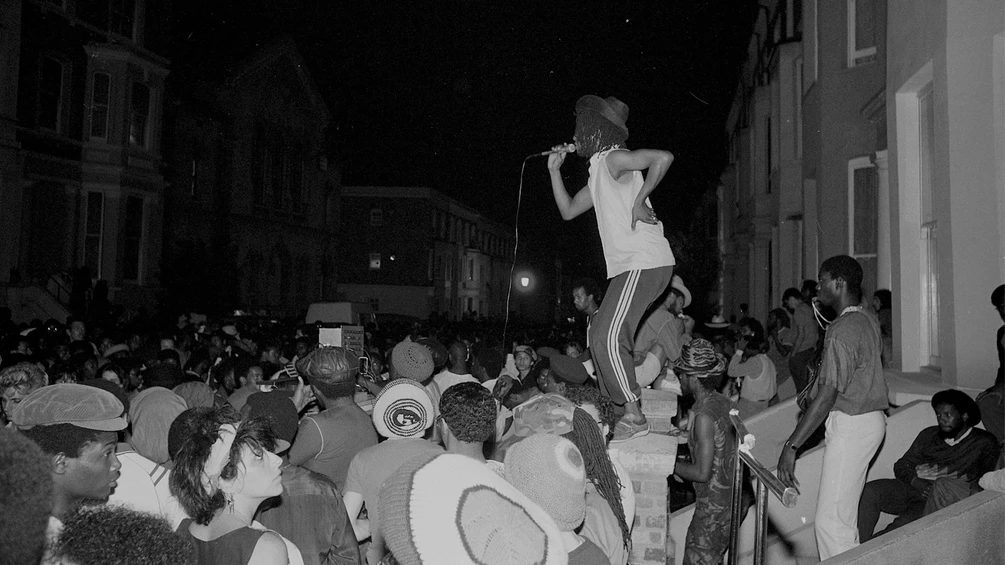
“This photo was taken at my very first Carnival in 1976, when I stumbled across this crowd who were just having a good time. At the time I was learning how to take photographs and this is one of the images I took, which was shot on black and white film. I'm pleased that it’s stood the test of time as a memorial of that era. I think it was taken the day before the trouble erupted. It's got an innocence about it which I love, with people just getting down and enjoying themselves. That was the innocence of Carnival in those days, in the calm before the later storm.”
“In the earlier times at Carnival, people were more free to do their own thing, like dancing in the streets without feeling restricted and watched. The vibe today is very different because you're often surrounded by police, which creates tension, and a lack of spontaneity and fun. Back then, you could just enjoy the music and vibe off each other. This picture captures the impromptu freestyle old spirit of Carnival, with people just enjoying themselves and having a good time.
“I think the photo was taken on Westbourne Park Road, and there would have been people dancing around in the surrounding streets as well, which is why it's such a happy and cool vibe. The DJ was free to suddenly get up and stand on the wall and start toasting. Nowadays we have stages, and health and safety restrictions, but back then there wasn't that commercial vibe. It was a lot freer.”
“In 2024, I had an exhibition at the art'otel in Hoxton, and Linett Kamala came down to see the show. Unbeknownst to her, I had this photo of her as a 15-year-old vinyl DJ. She was the first female DJ to play on a Carnival sound system. She had no idea she would see this image of herself, and she was so emotional and overjoyed to see it. I didn’t realise how significant this photo was at the time I took it, and was equally surprised when she turned up to the show and told me about the photo! I didn’t know who was in the picture until she told me it was her, and we’ve been friends ever since.”
“One of the best things about Notting Hill Carnival is that sometimes it's all about getting on down and having a good time dancing. This photograph shows two people doing just that. I like to show different aspects of Carnival, because for many people this is what they love about it. I’m glad I managed to capture the joy of these two dancers, and this photograph illustrates the exuberance and fun of Notting Hill Carnival. In addition to the laughter, there are serious aspects to Carnival as well, but sometimes, we should be able to go out and just celebrate our Caribbean culture.”
“Carnival is a cacophony of noise and excitement everywhere, but somehow I managed to capture this quiet moment in time where this woman is all at peace despite the chaos around her. It feels like a significant and poignant moment. There's action in the foreground, but she exists in her own calm space in the midst of all the noise. It's almost like she's meditating.”
“The Gladdy Wax sound system is a Carnival institution that’s been going for 60 years, so this photograph coincides perfectly with the anniversary. Jamaican DJ Gladdy Wax, Gladwin Wright, plays a rare selection of vintage R&B, soul and reggae music from the '50s, '60s and '70s through to the present day. He's such a connoisseur that he even wears white gloves to handle his records, which very few people do.
“It just shows the care and attention he pays to his music. He’s also got some old-school gems that nobody else owns, like one of just a few copies of a track from the '50s, or a rare ska import from Jamaica.”
“Carnival is not just about dancing and listening to music, it's also about eating and enjoying food. You can't dance all day without eating well. A lot of people might not eat Caribbean food for the rest of the year, but the one time they do eat this food is at Carnival. This image shows people having a good time eating and savouring the tasty food. They're also covered in paint, so you can see they've been getting down with dutty mas, which is not just about getting down and dirty in the dance, but also when you literally get dirty by throwing colourful paints on each other.”
" Jama is a Carnival legend who was voted one of Britain’s best dressed men. He’s a permanent fixture at Carnival and always dresses immaculately in bright colours. On this occasion, he’s wearing an orange hat, jacket, trousers, tie, shirt, shoes, specs and cane. He’s one of the most stylish people you’ll ever see at Carnival, and a really nice guy too, which made it important to have him in this selection."
“You can't have an exhibition on Carnival without steel pans, and this photo of the Mangrove Steelband is important because it represents a band who have played a significant part in UK Carnival history. The band was formed in 1980 by Clive "Mashup" Phillip and Frank Critchlow. Frank ran the Mangrove restaurant, and was one of the ‘Mangrove Nine’ who won a court case against the UK state after getting accused of ‘inciting a riot’ following protests against constant police raids on his restaurant. The Mangrove Steelband represents that legacy.
“They’ve won the Panorama steelband competition more times than any other band, and there's always a fierce rivalry between them and other steel bands like Ebony. They're based at the Tabernacle, which is in the heart of Carnival, and so it's all in their DNA. If you're a betting person, you'd put your money on them most years.”
“For me, this photo shows off the joy and fun of Carnival. This woman was evidently very happy to be there, captured in this moment. She’s wearing her costume, smiling, not even posing but in her element, proud and happy to have her picture taken. This genuine joy represents the energy and spirit of Carnival whilst showing off the intricate work that goes into making mas costumes. Maybe the smile would have been different if I'd taken this at the end of the day, because by then she'd have had to do a thousand smiles. But this was midday, when she was looking forward to the excitement and fun that the day would bring.”