The Mix 112: Jump Source
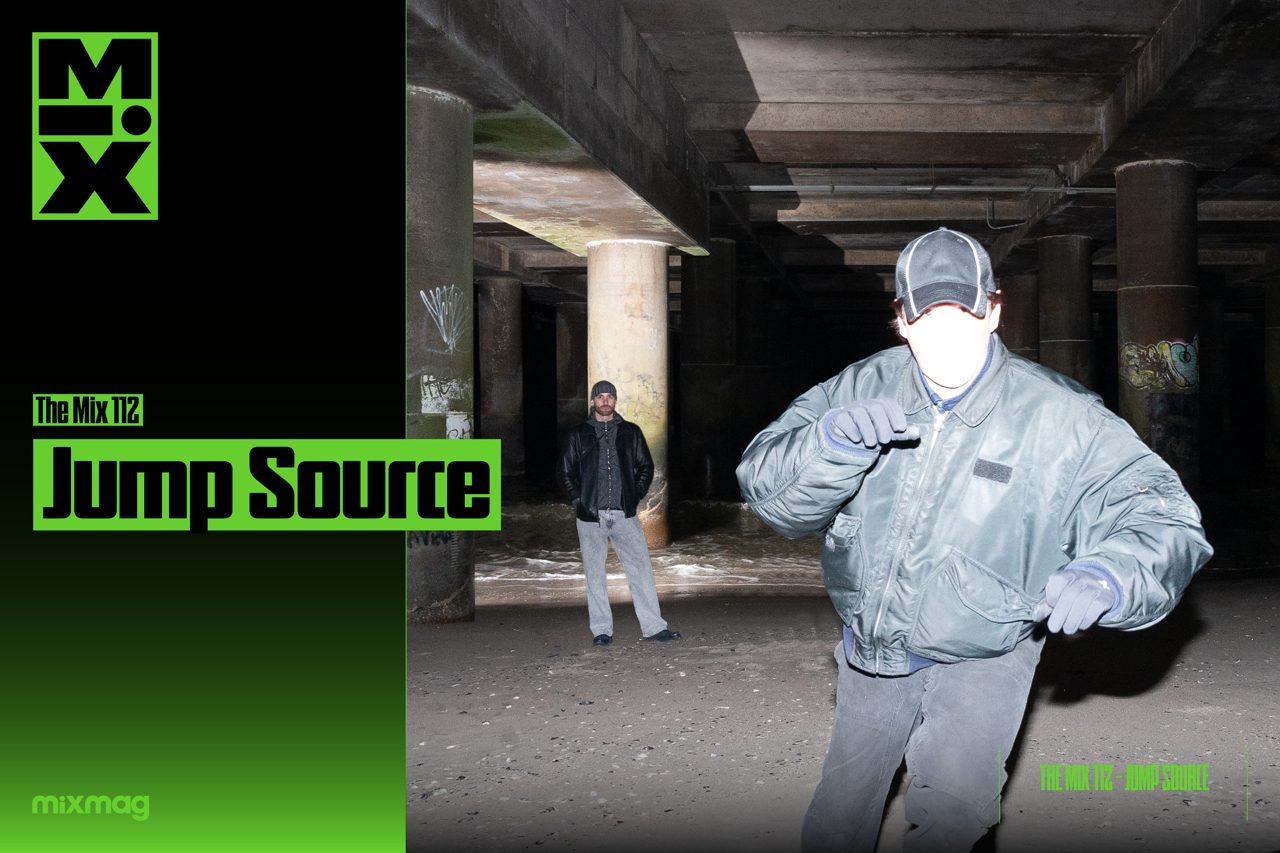
Montreal duo Jump Source, AKA Patrick Holland and Priori, go one-for-one across an unruly three-hour mix and speak to Sophie McNulty about progressing their songwriting, subversive pop and their debut album 'Fold' Continue reading...
“Learning stuff is always the number one thing. I don't really want to do the same thing over again,” says Patrick Holland over Zoom. He’s calling from his studio in Montreal which he shares with friend and long-term collaborator Francis Latreille, also known as the DJ and producer Priori and one half of Naff Recordings , among other projects. Patrick has spent the morning skateboarding before heading to the studio to build out a new modular setup for an upcoming corporate gig. It’s behind closed doors, he explains, but the promoter will provide a Fender Rhodes piano, which he will use as a synth alongside his modular setup. “Woah” says Francis, calling in from Amsterdam, where he played the previous weekend, “You’re getting ambitious with it!” nodding in respect. “Might as well do some educational building on my own while getting paid,” Patrick retorts.
Both Patrick and Francis share some 15 years of making music between them, in which each have steadily become prolific in making quality dancefloor tunes. Together they make music as Jump Source . Their first EP came out back in 2016 via Patrick's now-dormant label, ASL Singles Club , before they started self-releasing music via Bandcamp; a catalogue that focuses on club music, first and foremost, in the 12-inch single format. Outside of their own production work, the pair are also prolific collaborators. In the last year they’ve worked with friends like james K, Physical Therapy and Maara on their album projects, helping with production and mix engineering. They’ve also worked with electro-clash titan, Tiga , on his recent album ‘HOTLIFE’.
We found ourselves on Zoom one Tuesday evening in late May to discuss their debut album, ‘Fold’ , which recently landed via NAFF Recordings . It’s an album that echoes “the electronic LP boom of the early 2000s, while balancing peak-hour club anthems with an everything-goes pop ethos” according to the accompanying text. In other words, it sees them veer slightly left of regular dance music structures to take a more intentional approach and focus on songwriting, including collaborations with Harmony Index, CFCF, billy woods, Loukeman, BEA1991, and more. We talk about that process, why collaboration is almost always a good idea and what makes a good pop song in our conversation below. Their accompanying mix is a three-hour section from a recent set at LA’s Wellness Check party, where they went one-for-one on records all-night-long.
You guys just put out your first album together, ‘Fold’. Throughout making the album, you’ve been touring as solo artists. You’ve also been preparing your live show and collaborating with other artists to produce and engineer their records. That’s a lot of work. How does everything balance?
Priori: You start setting deadlines for yourself or they come from someone else's timeline. Most days, we go into the studio with something specific to do. When we’re home, that's our time to work on this next project before going back on tour. It is more regimented, by nature.
Patrick Holland: For me, I've also put my solo artist project on the back burner these last four or five years to almost entirely focus on either Jump Source or writing, production and mixing for other folks. I realised I enjoy doing that more than working on my own stuff.
Patrick Holland : The variety is a big one. Working alone can be great sometimes, but I did it for a really long time, so I was ready to open that up. It's fun to work on so many different records, even in one week.
I guess you can learn a lot when you’re working in a variety of genres?
Priori: You get put out of your comfort zone a little bit, which forces you to get better at things.
Patrick Holland: I think openness. Always having another idea and never just shutting things down and being stagnant on it. Being able to keep things rolling. Not getting hung up on finer details.
Priori: If someone believes in an idea, we should try it. I think a lot of things are worth trying. Staying open is important. If you work with people who you admire for a reason or you enjoy their music, you should definitely be open to trying things they want to try.
One of your most recent collaborations involved working with Tiga on his album. How did that come about? Did this project take you out of your comfort zone?
Priori: I did a remix for Tiga. He liked what I did and suggested we get coffee. He had been working with so many different producers over the years, but most of those people are in Europe. We did a couple of sessions making a lot of club tunes and he was pulling out a lot of references that were ambitious in the sense of harmonies and songwriting, a lot of stuff from the '80s. I know it’s one of Pat’s strengths, songwriting and writing stuff for guitar, so I asked if he wanted to join a couple sessions. From there all three of us started working together.
It’s been a nice dynamic. Everyone has different strengths and brings something else to the table. Sometimes you lose perspective on the song and it’s nice when there's someone else who can come in and be like “Maybe this section is too long?” or “Maybe this is too quiet? If you bring this element up, it makes the whole track more exciting.” Bringing in more people is almost always a good idea, in that sense, as long as you trust everyone's taste.
You said some of the references Tiga was pulling out in the studio were ambitious. Music from the '80s. What were some of those references? And why did you consider them ambitious?
Priori: He was showing me a lot of stuff from Echo & The Bunnymen and Depeche Mode. Things that were made in big studios, where people play instruments really well and have probably two or three extra engineers in the room. That's what I mean by ambitious. These are records that have been perfected and they’ve been played and captured live.
Writing purely club music can be done entirely in Ableton these days and it can be quite effective on a dancefloor. But once you're trying to capture the humanness of a recording with live instruments and you're trying to write songs with different sections, it’s definitely easier with a few heads in the room.
Priori: I think it’s about doing things intentionally. When I started writing dance music, I had no theoretical skills in writing music at all, I would just do things until they sounded good.
Patrick Holland: I find a lot of dance music is more jam-based. You jam around on different elements until things glue and that's sort of it. And we still do that.
Patrick Holland: It’s not a bad thing at all. It's the most gratifying thing ever. But then it’s about saying “Alright, that's a great jam, but why does this chord sound good with this? Let’s open that up and investigate.” You try to create a bit more narrative, so that it's not super repetitive and you play around more with the different elements you have. On this album, I would say the songs are song-like, but not many of them necessarily run in a classic structure. It's pop-esque, but not full blown pop.
Patrick Holland: A good example of a group that we both admire, big time, that does this thing in-between dance music and song-like structures is Everything But The Girl .
Priori: 100%. Or that Dntel album, ‘Life Is Full of Possibilities’ . He's written a lot of music with pop bands and rock bands and that album has the aesthetics and ideas borrowed from pop, but with a huge IDM influence. Those intersections are very interesting. When you hear things that would be in a pop song, but it's been arranged and processed completely differently. Lali Puna ‘I Thought I Was Over That ’ is an album we listened to a lot. It was an inspiration for this album, in some ways.
Patrick Holland: It’s not so much pop music, it's just straight up songwriting. Rather than it being a three chord part looped, with a melody and bassline underneath. But a song can also be just those elements. It just depends on how it's presented.
I love the track ‘Shattered’ ft. Helena Deland & Ross Meen from your album. The combo of the ear wormy vocal hook and the bassline. And the whispery vocal also reminds me of Opus III.
Patrick Holland: Actually, that whispery vocal was done by our friend who's in a hardcore band. It’s a hardcore vocal but it fits in a really cool way.
Priori: Then the instrumentation we did on top and Helena's vocal really brought it into this catchy zone.
Patrick Holland: Writing that one as a mega challenge. The amount of melodies and lyrical ideas I wrote. It took me almost a month of working on it every day with it on loop to find a good idea.
Patrick Holland: Of course. But once we got the Helena vocal it made sense and we knew what to do with it.
Priori: It's the one song I wasn't involved in making as much. But when I came in, it just felt right to me, which was probably a relief for Pat. It's a lot of experimentation, as much as we talk about being intentional. There’s a lot of thought that goes into it but, ultimately, we're still trying to pair a hardcore vocal with a garage beat. It’s about trying to make those elements fit together in a compelling way.
You mentioned pop songs for the radio need to provide some sort of instant gratification. But there are pop songs which don’t do that. What makes a good pop song?
Patrick Holland: The best pop songs are the ones that are still challenging. They subvert the norm or the formula in a really sneaky way that most people don't even pick up on, yet it works with people's brains immediately; which is a very hard thing to achieve. A band like Talk Talk, for instance, was nuts at that.
Priori: With pop, a lot of people think about this radio friendly sound but, to me, Deftones is pop. Of course, the aesthetic and the instrumentation is maybe not what people would describe as pop immediately, but they wrote songs where, when you reach the end of the song, you just want to play it again.
Grouper is pop in certain ways. If you listen to certain songs, you want to read the lyrics and figure out what it's about. It creates these layers of things to discover. It’s a very loose definition of pop, but in regards to this album we were just like ‘let's try to write songs’.
Patrick Holland: Yeah, songs that are narrative-based and have sections. I guess ‘pop’ is almost more of an adjective here.
With reference to the club music parts of the album, there's a lot of crunchy, minimal moments. I know Ricardo Villalobos was one of the musical inspirations behind the album. What do you love about him?
Priori: There's a long list of things we like about the way that he does things. There's a Villalobos remix of Beck that came out in the 2000s, when a lot of bands were getting remixes done for their records. There was an emphasis on electronica, which was electronic music that wasn't necessarily meant for the dancefloor. People were really experimenting with acoustic instruments as well as tons of electronic stuff on their records and we really like that dynamic.
So many influential and timeless records came out around that time and Villalobos did an insane amount of remixes. He's famous now for playing minimal, but he has an insane range and appetite for music of any kind. Whenever I've seen him DJ, he played something I completely didn't expect. He just seems like someone who really loves music and he’ll play whatever he's excited about in that moment.
Patrick Holland: He's a songwriter. Big time. Tracks like ‘Dexter’ are so melodically rich and emotional. He’s someone who plays whatever he wants, for better or for worse. Whether the crowd likes it or not, he's testing those waters constantly, which maybe isn't even fully intentional on his part, but it's interesting.
Priori: His productions are incredibly rich in general. The drum sounds on songs like ‘Affect’ on our album have this crisp minimalism and very clicky sounds. Tons of people do that now, but I think him and a few others were definitely pioneering that and making it sound really exciting.
Yeah. They have elements that scratch your ears and jump out at you. Listening back through your stuff, I noticed a shift in your output after the pandemic, where things start to feel more textured and have these elements that audibly jump out at you from ‘JS03’ onwards. What happened there on a technical level?